How Is The Church To See The Mentally Ill & Reach Out To Them?


The Stigma Of Mental Illness & The Church

I have come to the realization that the church is often a place for hurting people looking to Jesus for help.  They are no different than anyone else other than they are looking to Jesus for the solution to their pain, sickness, troubles, etc.  I have also come to the realization that in almost every church there is someone (often many) who are facing some form of mental illness and are also looking to Jesus for solutions.

In my last blog page, I invited comments and suggestion on how the Church can reach out to those facing mental illness.  During this blog, I want to look at the issue of stigma.

Oxford English Dictionary (copyright 2012) defined stigma as 1) A mark of disgrace associated with a particular circumstance, quality, or person: “the stigma of mental disorder”; 2) (In Christian tradition) Marks corresponding to those left on Jesus’ body by the Crucifixion, said to have been impressed by divine favor on the bodies of St. Francis of Assisi and others.  Synonyms: brand – stain – taint.

1) A mark of disgrace associated with a particular circumstance, quality or person – In Jesus time “leprosy” carried the stigma of a disease of social disgrace to the point that the person with leprosy had to announce their arrival when in public since the disease was so contagious.  Not only was it looked upon as a medical disease, but also a social one, for having the disease demanded total social isolation and alienation.  One had to move to a leper colony.  The epic movie Ben Hur so vividly portrayed this event.  The Aids Epidemic was America’s leprosy at the end of the twentieth century, but its stigma has been reduced through progress in medical treatment, education, and social awareness and acceptance.  Mental Illness is America’s 21st Century epidemic.  The gospels records that Jesus healed the 10 lepers where only one returned to thank him.  The 21st Century Church needs to address the topic of healing for those fighting mental illness.

2) Marks corresponding to those left on Jesus’ body by the Crucifixion – IPeter 2:25 reads: “for by his wounds you were healed.”  The very stigmatic marks on Jesus’ crucified body should be the very acceptance towards the healing of mental health stigma. 

Often stigma is groomed through ignorance, prejudices, and improper attitudes and judgments.  If a person is diagnosed with a brain tumor, the medical world will ask for brain scans, MRI’s, etc. as part of their treatment, all covered by insurance.  If a person is diagnosed with a mental illness, they are denied brain scans, given only physical medical clearances before being evaluated by a crisis intervention team, a physician, and possibly a judge to determine if they are in a position “of endangering their lives or the lives of others.”  If there is no physical evidence of a possible suicide attempt or a violent action toward a loved one, medical services can and will be denied.  That is stigma. Does a patient have to be in their last stage of cancer before being granted help? No, early detection and treatment is encouraged, but not in the mental health field. That is stigma.

Churches are reeling in trying to learn how to respond to their “high maintenance” parishioners who challenge ethical and moral boundaries when in the depth of depression, the heights of mania, or the whirlwind of a psychotic episode.  The Church can offer hope, but hope in what? Churches have told my wife and I that “we are praying for you”, but what are their specific prays?  Often socially, those fighting with mental illness find themselves isolated or alienated from the very life that could give them hope, healing, and deliverance, but how is the Church to respond?  These are powerful questions being asked of the Church in this century.  Is the Church commissioned to speak on behalf of those fighting mental illness?  If so how?
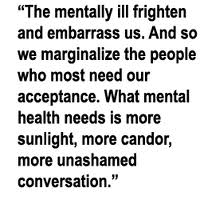
Glen Close Quote:Stigma comes from “not knowing what to do”, and with mental illness everyone involved eventually discovers themselves in that position of “not knowing what to do”, not knowing where to get help, not finding effective support systems to help one through crisis. 

I have attended a church where many physical handicap people have attended and have been accepted. They have become an integral part of the worship experience that has been healthy for this congregation, but I have also experienced an awkwardness by that same congregation on how to handle mental illness even though there are several people who personally are fighting mental illness in their congregation who are a part of their worship experience.  The “not knowing” has been the catalyst to this stigma: the not knowing of what mental illness really is, a physical disease; the not knowing what to do with one in crisis; the not understanding one’s irrational or “insane” actions when the disease is full blown; the awkwardness not knowing how to fellowship with a person struggling with mental illness. It is not that the church is trying to avoid what to do; it is the “not knowing” what to do, and how to “minister” effectively. In upcoming blogs we will try to unlock the “not knowing”, and begin to try to understand, become empathetic, and eventually feel confident in reaching out to those brothers and sisters in the Lord who are struggling with mental illness.

 

Mental Illness & The Church: Discerning Of Voices


When The Sound Of Mental Illness Distorts Voices

People battling schizophrenia often battle the sound of many voices in their head, voices real to them, often voices telling them of harm leading to disaster, self destruction, or even violence.  It is a time when you can’t trust the voices in your head. When healthy, you may listen to the voice of one’s conscience, your moral code of right or wrong. When ill, the voice of wrong tries to convince you that it is right. False illusions produce dissolutions.

The Church has taught me that the “spiritual” is about matters of the heart, yet brain research has revealed area of one’s brain that affects the way a person “spiritually” thinks.  I have witnessed what depression can do to a strong faith-believing wife who questions her salvation when in the depths of depressive darkness.  I live with a wife who learned to “listen” to the voice of God, only to have it distorted by mania that super spiritualized all aspects of her life.  Mental wellness produces spiritual wellness, but spiritual wellness has suffered with the lack of mental or physical wellness. 

Yet with mental illness, it is still spiritual faith that helps one weather the storms: that intangible belief that God can heal when there is no physical evidence.  In the mental health world, “recovery” is defined as living the best quality of life that one can under the conditions they are currently facing. Faith goes beyond recovery.

Imagine how difficult it must be for those fighting mental illness to “believe” when they may face a bleak darkness beyond despair, a manic high beyond spiritual normalcy, hear voices that they believe may be the voice of God telling them to do self destructive behaviors, doing destructive actions like self mutilation, hyper sexual relationships, and the ruination of personal relationships only to feel the condemnation of the church for their “sins” when they are already living under self condemnation, hoping to find someone somewhere who will extend grace to them during this time when everything in their life seems to be spinning out of control.

In the midst of their maelstrom of confusion, despair, and out of control behaviors, what is the role of the Church in their lives?  What does the Church have to offer them?  I have discovered that the institutional church is also in a maelstrom over what to do about this issue.  The Church historically looked at mental illness as a spiritual disease, not a mental or physical one.  The demoniac had “a legion” of demons telling him what to do, only to have Jesus cast them into a herd of pigs that stampeded to their death, bringing fear and skepticism to those living around that area.  The locals had trouble accepting the ex-demoniac sitting fully clothed and sane when amongst them and requested Jesus to just leave them alone.  In fact, Jesus does not grant this newly sane disciple to be a disciple to follow him, but tells him to go back to his own people.  I have seen the damage caused by churches who have looked upon mental illness only as a spiritual disease, and have not witnessed the “good fruit” of healing happening among them.

The church historically has started hospitals, developed prison ministries, taken care of the homeless, etc., but currently, at least here in America, the church has delegated those responsibilities to private or governmental institutions, forfeiting the power of the gospel to people needing it.  The church currently has an excellent opportunity to reach out to the mentally ill whose hospitals governments are shutting down because of financial cost, whose prisons now house thousands who struggle with mental illness, and feeding the homeless who quarters are teeming with the mentally ill.  In the 21st Century, the mentally ill have become America’s “undesirables”, and the stigma has become America’s stench.  It seems no body cares for them; nobody wants to be their advocate or voice; nobody wants to convenience oneself with the inconvenient. 

I will fill you in on a little secret: Jesus cares!  Jesus cares for the homeless, the hungry, the imprisoned, the hurting, and the ill.  He commissions his Church to also care for them “for I was a stranger and …”.  If the Church is an extension of Jesus today, then it MUST reach out to the mentally ill who are homeless, hungry, imprisoned, hurting, and ill.  How long can the church be blind to this dilemma?

The Church needs to reach out to those struggling with a mental illness, but it faces the maelstrom of not knowing how!  I would love to create a dialogue off this blog of comments and suggestions as to how the Church can do this.  You are invited to join me in this conversation.  Please do not give long dissertations of “your story”, but “suggestions” of how the Church can reach out to those who are facing mental illness, physically, mentally, emotionally, as well as being their judicial and political advocates. If you have experienced your church doing this, please share how they did it! I invite you to join in the discussion!


Hearing When There Is No Sound


Dietrich BonhofferApostle PaulMother Teresa


Speaking In The Silent Times

When Moses was in the wilderness for 40 years before he returned to Egypt, what did he hear?  When Jesus was in the wilderness for 40 days, what did he hear?  When Paul was in the wilderness being detoxed of all his religious training, what did he hear?  When Deitrick Bonhoeffer was in Nazi concentration camps, what did he hear?  When Daniel was in the Lion’s Den, other than a roar from a lion once in a while, what did he hear?  When Joseph was in prison for a trumped up charge by Potiphar’s wife, what did he hear?  When Mother Teresa sat with the sick and lowly in Calcutta India, what did she hear?  When the disciples gathered, frightened, who were receiving reports that their Messiah who had just been crucified on a Roman cross, what did they hear? When John was exiled on the Island of Patmos, what did he hear in those early days?  Before the days of Samuel, what did Eli the High Priest hear in order to lead his people?

How comes, some of the most powerful spiritual moments of learning and understanding God come when man can’t hear a thing.  What is it about the stillness, the quietness, the solitude of silence. Simon & Garfunkel questioned the essence of secluded solitude in their hit song “Sounds of Silence”: “Hello darkness, my old friend. I’ve come to talk with you again.  Because a vision softly creeping, left its seeds while I was sleeping, and the vision that was planted in my brain, still remains… within the sound of silence.”

In those dark moments of despair, of hopelessness, of questionable doubts testing one’s faith, when crying out to the Lord only produces serene silence, “a vision that was planted in my brain, still remains.”  It is during those times that the seeing and understanding the vision of faith becomes more important than the hearing.  In those moments of silence, often God tends to “reveal” Himself to us is ways other than oral.

Hebrews 11:1 states: “Now faith is the assurance (or substance) of things hoped for (or expected), the conviction (or evidence) of things not seen. For by it the men of old gained (or obtained) approval.” (New American Standard Bible).  Ironically faith does not come from our physical sense of seeing nor hearing, only through our spiritual sense of believing for those things one cannot physically see or hear!  When the tangible caused by sight and sound are taken away, what do you have left?  “Faith”, the intangible!

I often wondered how Helen Keller functioned without sight or sound in her life during her early childhood of wonder, exploration, and trying to figure out life.  In the Miracle Worker, Ann Sullivan breaks through Helen’s world of darkness and quietness at a water well, pumping water over Ann while spelling w.a.t.e.r through sign language with her hand.  Something clicked in Helen’s head, and the rest is history as Helen Keller went on to earn a college degree while changing the world.  Jesus breaks through the spiritual darkness and quietness of a Samaritan woman’s life also at a watering well when explaining that spiritually he was the drink, the water of life that she needed to have in order for her spiritual life to be opened to the truths of the kingdom of God. Something too clicked in her spirit, and the rest is history as she brings revival not only to herself, but to her town, family, neighbors, and Samaritan race.

It was difficult, in fact excruciating painful, for Moses to wonder as a solitary shepherd for 40 years after being the favored of Pharaoh, for Paul to have his whole theology thrown out the window after being knocked off his horse for zealously opposing this Jesus who accepted him so gracefully, for Jesus to set aside his earthly agenda for his Father’s heavenly purpose to learn obedience to His heavenly Father, for Deitrick Bonhoeffer to question his faith and purpose when in the midst of the Hell Hole of a Nazi Concentration Camp, for Daniel to lay aside his fear of hungry lions when in the midst of faith, for Joseph to suffer in prison when judged unfairly, for Mother Teresa sitting in the midst of poverty and sickness knowing Jesus is their Provider and Healer but physically not seeing it, for the disciples when their visions and dreams seem to be smashed as their leader faces the cruel death of crucifixion, for John who walked with Jesus, led his believers in this new movement of God, now to be isolated from everyone and everything, for Levi to be the spiritual leader of Israel, yet unable to hear the voice of God for himself.

It is excruciating painful when we, as believer’s in Jesus Christ, go through such times of isolation, times of seclusion, times of trials, times of silence, yet it is in those very moments of darkness, despair, hopelessness, and brokenness that something spiritually clicks, and we obtain a new understanding, a new truth, a new hope, a new purpose, a new vision a new drink of living water through faith.  A vision of faith is often solidified during those moments of solitude. As painful as it sounds, we, as believers in Jesus, must learn to embrace those solitary moments of silence when God seems so distant, not present, not listening, not being evident, for in those moments faith, the evidence of things not seen nor heard, become the vision that anchors our faith in Jesus Christ.


Metamorphosis: The Cocoon Stage


A Time Of Rewiring, Reworking, Remaking, Redoing

Several months ago I wrote about the church going through a metamorphosis process, going from being a caterpillar, cumbersome, slow to change, devouring all it can eat in an effort for growth to entering a cocoon stage where a transformation of structure would occur to be released as a butterfly, a sleek structure ready for flight.  I believed the church was about to go through quite a transformation process because it would literally change the “structure” of the church. I wondered what would take place in this cocoon stage that would create such a dramatic change.

Then I remembered that “we” are the church, so it would have to directly affect “me”.  I thought of the church as a whole, as a structure, as an institution, but not that it would affect me personally. How wrong that assumption has been.  I briefly shared my journey then with a group of people last night, and one participant piped out, “sounds like you are in that cocoon now.” I think he is right.

So what is happening inside it? I can wrap it up in two words: drastic change. I feel like I am in a challenging time; it can be a depressing time. I do not have a “critical spirit” that produces negativity, but I find myself questioning everything the church does, believes, and propagates as well as what I do, believe and propagate spiritually.  It’s beginning to drive me nuts, because it creates an illusion of isolation, not being able to “fit” in to current structures, structures that always gave me assurance, support, comfort, encouragement, structures that use to be the pillars of what I did and what I believed.

It feels like I am being rewired, old out dated wiring being ripped out while newer wire that meet more stringent codes of higher quality and standards are replacing them. I am beginning to sense what an old housing structure must feel like when deemed inadequate or even condemned, then completely gutted, only to be rewired, reworked, and remodeled to newer and higher standards and codes. It must be a painful process to that old building when at first experiences being ripped apart, then reworked and even reshaped, before being repainted.  Often we take “before” and “after” shots of our remodeling projects so we can say, “I can’t believe it looked that way once, but look at its beauty today.” 

The hardest part of this process is the constant challenge of new ideas and ways of thinking by the Holy Spirit to challenge my willingness or lack there of to embrace new mindsets. The way that I did church in my childhood seems so antiquated that it parallels with Puritanical times. Societal norms and culture have drastically changed over the century. My grandfather drove a horse drawn cart to deliver milk, experienced the invention and integration of the telephone, radio, television, and internet.  He took a trolley to town, bought a model-T Ford, and saw the creation of superhighways. He lived in a society life centered around the local community church and the local band pavilion, then changed to school and sports activities, to now embracing social networking. His world started local, being interrupted by a World War, followed by its connection through something called a world wide web. He longed for “the good old days” of a simpler, more local life, but gave way to health care, assisted living, and nursing facilities that lengthen his life by several decades. Even my life span of six decades has seen incredible change.

So the cocoon phase brings death to some old structures, pillars, out dated wiring with outdated codes, and replaces it with new life, new pillars, new wiring with more stringent and higher healthier codes.   The new remodeled building or structure looks nothing like its original although basically it is still built on the same foundation. That foundation is Christ Jesus, the Rock.  The Church is facing a world that is changing, one with a greater global vision, more interconnectivity, one actually becoming smaller, a world that can come to one’s Smartphone in one’s pocket, the way I/we structure Church, do Church, will have to be revamped, restructured, reworked, redone, rewired.  

Church, I propose, we are in that cocoon stage.  The only way to come out of it as a butterfly is our willingness to yield and listen to the Holy Spirit and be obedient to His work as he coordinates this restructuring, rebuilding, rewiring, redoing.  If the creature that enters the cocoon as a caterpillar decides to stay in the cocoon, it means only one thing, death. Life, a resurrected life, is one that is willing to oppose the grave and rise in newness, the butterfly, the new structure, a new life.

I am sure as I/we walk through this stage, even more challenges, more new mindsets, more reworking, more repentance, more dying to self and dying for our fellow brethren will have to take place. The cocoon stage has only begun!


Shepherding And Social Networking: Can The Church Capitalize On This New Technology?


How Do You Prepare God’s People For Works of Service? Part VIII

If shepherding is nurturing, caring, and developing, and social networking and new technology is influencing our current society, the church just needs to look reexamine how it shepherds. I read this week that Google is thinking of invading the television business with major capital investments because the 18 to 34 year olds are beginning to watch their entertainment on their smart phones, or IPad devices rather than having to sit in their family rooms in front of their televisions sets.  This “mobile” society is about to see another paradigm shift away from traditional family time, traditions, and cultures and the way we are use to do things.

My age group attends High School and College Class reunions because we have “lost contact” with almost everyone after graduation except for a select few.  That is not true with the younger age group, for they stay in contact through social media formats and tools.  By becoming “friends” they communicate through Facebook and join “circles” to keep in touch with different groups in their social strata. Every time they are on Facebook, they expose what they are saying and doing. You can almost “monitor” what is happening in their life just by following them on Facebook, or Twitter, or other forms of social media. They expose their backgrounds, share current pictures, and post daily comments.  Even the Foursquare software program allows you to “check in” and gain rewards when you notify where you are currently located. All this information and data about people is available, and they are not even in your physical presence.

Mentoring is most effective when done 24/7, but who can be with the one they are mentoring in their Christian growth when you are not in their presence.  Today that can become a reality.  If you are discipling or mentoring a younger believer in the Lord, you can monitor their social patterns, where they hang out, where they shop, who they communicate with, their interests, hobbies, etc. Availability is crucial in a successful mentoring program, and today’s technologies make that possible with smart phones, that not only let you talk to one another, but also see one another. One being mentored can easily and immediately contact their mentor orally, visually, or through written communications like texting or tweeting. If one needs help, prayer, or advice, contact and help can be immediate.  Interactivity is a key to successful social network connectivity.

So shepherding can now be 24/7 and connectivity almost instant.  Part of the Smartphone culture is the need to react to the ding, ping, or sound effect that comes from our phone. It is almost like an immediate response, and instant reaction. Connectivity and availability is crucial.

The danger lies what one does with all this data and information about a person.  In the 1970’s the Shepherding Movement from the Fort Lauderdale Five was birthed out of the need to help younger Christians mature under the direction of older more mature Christians. We have learned through them that unfortunately, it is so easy for the mentor to fall into a “control” mode, guiding every decision of the young Christian rather than teaching them how to make decisions on their own. So far, social networking is not about “control” but “contact” and “communication”, the transfer of information from one to another. That “loose” relationship can actually be a healthy one, for you have to allow everyone to “work out their own salvation”, to “walk their own spiritual walk”, and learn to “hear the Holy Spirit for themselves”, because eventually they will have to walk and stand on their own and hopefully mentor others in future journeys.

The church needs to embrace the power of social networking because it has permeated our American culture. The question is what to do with it, how to effectively use it as a tool for communicating the gospel, and communicating with others in guiding them in their spiritual walk. Many churches are making websites basically to “advertise” their worship service and available services, but they must learn how to make their sites interactive.  If Facebook is only a tool to post information about their church and there is no interactive communication happening on that page, then the church has missed the mark of what social networking is all about.

So pastoral/shepherding skills may manifest themselves in new forms as we enter this social media culture of the twenty-first century. The challenge for the church is how to be open to change, technology, and new mindsets of thought and communication.  


If We Could Only Be Like Little Children

The Faith Of A Child; The Theology Of An Adult

An inquisitive event occurred at the church I was attending on Sunday.  The Pastor gave a sermon on Justification By Faith.  In an attempt to show an unbiased look both sides of the “Once Saved Always Saved” versus “You Can Lose Your Salvation” arguments although he let you knew what side he favored because “it was his responsibility to portray the ‘truth’”, a woman broke into the flow of debate, not to ask a question, nor to give an opinion.  She wanted to share a testimony.

Her testimony was that she had had headaches and back pain during the service.  Someone from the children’s department asked if she would come and let the children pray for her.  She complied. The teacher of the children’s class had been teaching the children how to listen to the voice of the Holy Spirit themselves. As the children honed in on that still small voice, they began to minister to this lady. By the time they were done, she was pain free.  Here she was now telling the adults about this experience as the children released their "child like faith".

That is the beauty of being a child: having child like faith. Adults were discussing “faith”, debating theology, trying to figure out how faith works while justifying their theological positions. The children? They just practiced their faith!  The adults came to no conclusions that united them while the children produced results, a healing!

When is the adult church going to allow the passions of the children of God to arise, that of an evangelist, a shepherd, a teacher, a prophet, and an apostle, and release the children of God to freely exercise them?  The Holy Spirit resides in the temple of God, the bodies of believers in Jesus Christ. Church, let’s allow that spirit to arise, manifest itself, and be released in resurrected life and freedom! 

When is the adult church going to learn it doesn’t have to be theologically correct or kosher all the time; they just need to have faith in Jesus and listen to his Holy Spirit speaking?  Every religious sect thinks the theological “truth” has been revealed to them, and the rest of Christendom is incorrect or missing an element of that truth? Why does the adult church feel it has to “justify the truth” rather than live by the principle of “justification of faith”? Faith in what?

If we have “faith” in Jesus’ power to heal, then let’s just do it: heal!  If we have “faith” in Jesus’ power to forgive, then let’s just do it: forgive!  If we have “faith” in the body of Christ, then let’s just practice IJohn 3:16 and “lay down our lives for our brethren”: let’s just do it! If we have “faith” in “rebirth”, then let’s allow the Holy Spirit to rebirth! If we believer in sanctification, then let’s allow the Holy Spirit to lead us in caring, nurturing, and developing our fellow believers into the image of Jesus Christ!  If we “faith” that God speaks to his children, then let’s listen and be obedient to what we have seen and heard.

When, as adults, are we ready to scrap our prearranged, highly organized, well orchestrated, music and oral ensembles we call worship services, and allow the children of God who attend to just be “children” who want to play, to romp, to sing, to dance, to be free to skip around bear footed, even puddle hop, and maybe even make mud pies while getting dirty instead of always appearing pristine clean? When are we going to allow their passions in Jesus to arise, to help “develop” towards maturing in Christ-likeness, and to release them to be free in the destiny God has for them instead of prohibiting them, holding them back, and controlling them?

I recently observed a parent, who when haggard by their children’s noises of just being kids, playing, sibling rivalries, vying for parental attention, and being fidgety under the strains of having to be in an adult world while still being kids, completely shut down their activity to have “order” for the sake of adult sanity, suppressing any child like life in them for quietness and control. As adults, we do that all the time to our children rather than joining them.

Jesus said, “Let the little children come unto me,” and “unless you are like a little child, you can not enter the kingdom of heaven.”  I want to enter the lifestyle of that kingdom; I want to be a child again; I want to be able to come and jump into the lap of Jesus! Then I got to divert back to my spiritual childhood with child like faith. I got to quit debating, quit trying to be correct, quit trying to always be a portrayer of truth to prove that I am righteous, and just be a kid again!  In an adult world kids are never right; in a kid’s world they just want the adults to join them in experiencing life.

I just want to heal, to forgive, to love, to respect, to honor, to worship, to grow, grow up to be like Jesus! I just want to experieince continual rebirth, to care, nurture, and develop others, to walk our the Word of God in my daily life, live it, to develop my inner ear to hear the still small voice of the Holy Spirit, to be able to envision the Church as a bride without spot or wrinkle prepared for its wedding day.  As a kid, I want to play, imitating my Father. Ironically, as an adult I have learned to “play church”, but as a child I want to be the church; I just want the freedom and release to just do it!


Reinstituting Hospitality Back Into The Church In New Forms


Shepherding Builds Community

How Do You Prepare God’s People For Works of Service? Part VII

In the early 1900’s homes had “parlors”, “sitting rooms”, and “living rooms” for the purpose of informal and formal “visits” from friends and family.  Sunday afternoons were times of traveling to friends for “visits” or be asked over for a meal.  Hospitality was extended to all.  Churches were part of a local community, and since the horse and buggy era was coming to a close, most activities happened locally, usually around church functions.  By the end of the century with the automobile, people were passing each other on the way to church, no longer attending the closest community church, but traveling to the church that now best met their family’s needs in a changing social and religious climate.

Today homes have “entertainment centers” as center pieces in “family/recreation rooms”.  Most families hibernate in them: Pop controls the flat large screen High Definition Television with his complex remote control; the children play video games on their X-box or WIII system; Mom and/or the children text their friends on their smart phones.  No one needs to have “friends over” to visit anymore because they can text, Facebook, Skype, or Face Time them on their Smart Phones. “In person” presence is no longer required, just audio and video and the availability of internet connections. The gift of hospitality is becoming a diminishing and soon to be lost art of developing community.

I believe the shepherding aspect of the five fold may be glue in keeping “church community”.  Although social networking keeps people in contact, there is still nothing like a personal touch, a caring hug, the tone of voice that brings comfort and peace, and a look in one’s eye of assurance and respect. Shepherding is all about relationship and the caring, nurturing, and developing of others to transform them into the likeness of Jesus Christ as well as bringing unity to the body of Christ. 

Hospitality is still the key, because hospitality is all about openness and transparency. When we open our lives and homes and become transparent, people see us for whom we really are.  My question is, “When you open up and become transparent, do others see Jesus in you?”  That development of Jesus in you is what shepherding is all about: not just planting the seed, but nourishing it, maintaining it, cultivating it, and releasing it when ripe for harvest.  Do you feel “at home” in your own skin? Do you feel comfort and at peace? If so, be transparent, and open yourself up to others, so they can “experience” Jesus in you and through you. That is the art of discipleship, of mentoring, of spiritual parenting, of shepherding.

If the Church is to remain the center of hospitality, then the believers in Jesus Christ have to be willing to be exposed, be vulnerable, and take risks if they plan on helping to care for, develop, and mature their brothers and sisters in the Lord. I John 3:16 is crucial in this effort, for we, as brothers and sisters in the faith, have to learn what it means to “lay down your life for your brethren.” Only then will the true art of “shepherding” will occur through the five fold in the body of Christ, the Church.


Why Wouldn’t Your Church Be Open To The Five Fold?


Don’t We All Need Evangelists, Shepherds, Teachers, Prophets & Apostles?

Often the churches that we attend have strength in one gifting of the five fold ministry of Ephesians 4 but also finds themselves weak in other areas.  Wouldn’t it be wonderful if the local church could offer and supply all five areas and giftings instead of just emphasizing one or two?

Every local church needs an evangelists or they will not grow in number, remain stagnant, and eventually die out; every local church needs a shepherd or their members will not spiritually grow in Christ-likeness; every local church needs teachers to keep their local church anchored on the Word of God, the Bible; every local church needs the prophetic so they can be able to hear the voice of the lord individually and corporately; every local church needs the apostolic to encourage the growth of the other four individually, yet network them together for effective service in unity.  So then, I ask the question again, “Why aren’t our local churches open to all five ministries of Ephesians 4?

Isaiah 57 exhorts us to “remove the barriers from my people.”  Often those barriers are called traditions, those pillars that worked in the past on which the local congregation built their ministry.  It is hard to release old traditions that have worked effectively in the past for newness, for in them we find security, history, stability, and control.

Another barrier can be called the clergy/laity barrier, which distinguishes two distinctly different classes in a supposedly non-distinctive church.  Who do we train in most churches, staff for professional development, or the saints for their sanctification in Jesus Christ and the unity of the corporate body? 

A third barrier can be structure, for today’s church structure is liken to a caterpillar, cumbersome, slow to move, but moves steadily while trying to consume as much as it can to continue is journey and produce rapid growth. It order to become a butterfly, a complete different structure is needed so it will be allowed it to fly. There needs to be a metamorphosis, a spiritual cocoon of change which will restructure, remold the way we currently do church. Remember, caterpillars can fly! Butterflies can! But it will take a restructuring to bring flight, so the Church can “soar as if on eagle’s wings.”

So the bottom line is if the church is to be open and receptive to all five giftings to properly function in their midst, then they have to be open to a restructuring where the local church is equipping the saints for the work of service, not just the staff.  When the local church is ready to equip, prepare, maintain, care, nurture, release the priesthood of believes that meets in their midst, that is the people of God, then it will be receptive to the five fold.  Until then, old wine will break through new wineskins as the Bible teaches. Old structures will not hold new ideas and ideals, only new forms and structures will embrace them. Does the church want “break out revivals” as is its history, or do they want “revival from within” because it is willing to restructure? Those are the hard questions the church has to answer in this 21st Century.


The Simplicity of Shepherding; Just Caring For Others

How Do You Prepare God’s People For Works of Service? Part VI

Bottom Line: Pastoring/Shepherd is as simple as caring.  Everyone wants to be cared for, loved, and accepted. Shepherding is all about caring for the sheep, their nurture and development. A good shepherd lives with his sheep and knows each individually. Shepherding is all about relationship, a relationship between a shepherd and his sheep.  Jesus is our chief shepherd, and he has a personal relationship with each of his sheep.  In the five fold sense, we too can be shepherds if we invest individually in the lives of brothers and sisters in Christ who we get to intimately know, nurture, develop, and build up a bond around caring.

You don’t have to be a professional Christian to be a shepherd because it is not about position but about relationship. “Investment in others” is the key ingredient to shepherding.  You continue to pour yourself into others to help them develop into becoming a more Christ-like Christian. It is imperative that Christian elders, those older in the faith, give out, invest, and pour into younger Christians for their spiritual development.

Spiritual development does not necessarily mean formal academic religious education. It just means helping someone along to “mature” and “grow” into the likeness of Jesus Christ. Just practical things are important like: how to get through tough times, how to handle grief, loss, and setbacks, how to develop and independent prayer lifestyle, how to develop a disciplined life of Bible reading allowing the Holy Spirit to be one’s teacher, how to hear the voice of God for oneself and be obedient to that voice, how to receive from the Lord and others as well as how to be a giver, how to build proper, healthy, relationships with others that builds trust, honesty, and integrity, how to love unconditionally, what it means to “live by faith”, how to trust the Holy Spirit, etc.  All these can apply to practical daily applications, and we need older, practical, experienced Christians who have wrestled within themselves and gone through these issues in their personal lives to help other younger Christians walk through their journeys.

As I have discussed in an earlier blog, there is power in walking out one’s faith in pairs like the 70 disciples Jesus sent out or the Road to Emmaus experience. Jesus invested in only twelve intimately for the purpose of their spiritual development that would be the foundation for this new group, the Church. As the Church grew, elders, older Christians, and the Apostles invested in others in developing them toward the maturity of Jesus Christ individually to bring unity to the body corporately.

Finally, what is the cost? We cannot determine the cost in dollars and cents but in time.  Shepherding takes time, commitment, and availability. To shepherd you have to keep your time flexible, for your commitment is to the sheep, and when they need you, you need to be available.  Commitment to your sheep will demand unconditional love at inconvenient times over unconventional circumstances. Godly parenting takes time, commitment, and availability. Children demand their parent’s time, their loyalty or commitment, and their availability at all times. The proper development, nurture, and care of your children all hinges around the time your willing to give, the commitment of unconditional love at inconvenient times in unconventional circumstances that you are willing to give, and the availability of your time to them.  Christian parenting, Christian shepherding is no different.  It is the responsibility of the family structure to reproduce itself from generation to generation through developing, nurturing, and caring for the next generation. 

In most churches today, we believers do not take or offer our time to shepherd others because we are too busy. We won’t commit ourselves to developing caring relationships that build community because we will not commit our priorities in developing the kingdom of God because we are too busy with secular life.  We aren’t available because we feel that we are already over booked!  As parents we have to some times quit taking our kids to soccer practice to keep them active, to the library to keep them reading, to their friends to develop a social life, to youth group to keep them in the church, to grandmas to build family relationships, to school center activities and after school activities, so our children don’t “miss out”, but rather stay home, cuddle up on the couch with them, read a book to them, discuss their day, let them tell their stories of their day from their point of view, hug them, accept them, listen to them, and just unconditionally accept them for where they are at in the developmental stage of their life in their present conditions. That is shepherding: spending time investing in them.

A wise financial planner teaches his clients how to “invest their money” wisely to earn good dividends; a wise Christian teaches younger Christians how to “invest their time” wisely in others developing, nurturing, and caring for others while building lasting, intimate, meaningful relationships bonding together the Body of Christ into a community.  That is shepherding.


Evangelism: Savoring Tips & Guidelines

How Do You Prepare God’s People For Works of Service? Part V

Even though every believer should do evangelism, most of us do not know how to do it or feel very awkward when trying to evangelize.  Here are some tips:

- Natural Story Telling: Evangelism should be a natural response of just telling the story of our own spiritual journey.  Often just telling how you met the Lord, what has comprised your spiritual journey, how your journey has become a lifestyle are all ways of evangelizing.  I remember once when some friends were evangelizing, I just shared about how making Jesus Lord of my life and the power of the Holy Spirit had an impact on my spiritual walk. This left a dramatic impact on those I shared it with, and they not only made Jesus their Savior but also Lord and were willing to receive the Baptism in the Holy Spirit. Evangelism can be as simple as telling your personal story.

- Personal Evangelism: Evangelism is most effective when one on one. Even though we Christians spend millions on television and radio programs, one on one evangelism is still the most efficient and impactful method. There is nothing that beats personal contact, eye contact, and personal discussion and care.

- Building Relationships: Often building relationships of trust, respect, and care open doors for people to want to hear our stories, our message. Relationships are key to communications in the kingdom of God, and establishing them with unbelievers is of essence if we are to win them for Jesus.

- Outside The Walls: Evangelism should occur outside the walls of our church buildings. We need to quit relying on the Pastor and his staff to “give” an evangelism message through their sermons.  Evangelistic sermons have their place and effectiveness, but should not be a substitute for our individual sharing with people in the work place, those we recreate with, our neighbors and friends. 

- Vulnerability: Care is the best thing we can give an unbeliever. Everybody needs to feel cared for. If you build a relationship with a person who thinks you genuinely care for them, they will listen to you and believe that what you said is valid.  Evangelism is all about care: Jesus cared so much for us as sinners that he was willing to lay down his life on the Cross for us.  A key component to evangelism is your willingness to lay down your life for others, just not Christians, but non-Christians too. Only when you are willing to lay down your life and expose your life, will others become vulnerable and open up and expose their lives to you. 

- Stay Simple: Try to refrain from talking “Christian-eze”. Keep your message simple and sincere. Don’t talk down to them as if you are a saint, and they are an ain’t; talk face to face, eye to eye, peer to peer.

-Win With Love: We often think of Bull Horn Evangelists with a Hell-Fire & Brimstone Condemnation message, emphasizing a need for a savior.  What kind of God do we want to portray? What kind of God do we want to offer? True, there will be a judgment day, but we are living in an age of Grace, so we should extend grace, mercy, forgiveness, unconditional love, and a willingness to go the second mile in spit of who they are or how they act towards us. “Loving them into the kingdom” is far more effective, especially for their later spiritual growth, than scaring “the hell out of them”!

- Just Be Who You Are In Jesus; Be Genuine, Not A Hypocritical Phony:  Two men hung on either side of Jesus. The three were peers as “condemned criminals”, but the one criminal recognized that Jesus was innocent; he had done no wrong, yet he was suffering the same fate as the two who had “earned” their death sentence.  Jesus’ righteousness stood on its own, recognized by one of the criminals, rejected by the other. The one who acknowledged it was assured by Jesus to be with him in heaven, the other not. Don’t try to be some spiritual giant, someone who you are not; just be yourself in Jesus. Allow the Holy Spirit to use you and speak through you, and let the unbelievers whom you are a witness to draw their own conclusions. Hopefully it will be the same as the criminal who is with Jesus in heaven today.

Hopefully these are some tips that can be useful in your journey toward evangelism, the telling of what Jesus is and has done in your life.  Evangelism, like faith, is simple. Just be genuine, be yourself, be caring, and keep it simple.


Evangelism: Mid Wife, Coach, Husband, Mentor, Model


How Do You Prepare God’s People For Works of Service? Part IV

How do “equip” or “prepare” someone for evangelism? Good question. In the past the churches that I have attended have had many “evangelistic sermons” by visiting evangelists, or the local pastor preached on the topic of evangelism, or a Bible Study group studied evangelism through some book written on the topic.  No one ever went with me out of the streets or took me along when they evangelized until I broke from the church where I grew up to aide a minister who was starting an inner-city church in our area. He was an evangelist at heart, for that was his passion. Often I went with him on his evangelistic excursions and watch him work.  That was the best training that I ever received on evangelism; when someone actually walked it out with me.

Evangelism is all about birthing. Women understand the process better than men for they have experienced labor pains, birthing pains, the joys associated with the actual birth, the instant motive to mother at birth, etc. When I was born, my father was not allowed to be present. When we had our children, I was allowed to not only go into the birthing room, but was allowed into the Operating Room during a Caesarian procedure.  Today entire families can be in a birthing room as the mother sits in a bathing pool while all witness the birth.  Experiencing a birth is a wonderful memory etched in one’s life forever. It is a joyous moment, a fulfilling moment, an exciting moment, a moment filled with hope and promise filled with dreams for the future.

A father learns that a pregnancy is a nine-month ordeal, not just an instantaneous event. The mother goes through different stages throughout the pregnancy: throwing up, sickness, urges, cravings, cramps, discomforts of a child on her bladder, kickings, movement, and eventually contractions. At birth, all those discomforts and miseries vanish into ecstasy and joy, but pre-birth is a process.  Often when evangelizing one-on-one we forget that there may be trials, discomforts, and even pain in the process of leading one toward the saving grace of Jesus.  It may take days, weeks, months, even years of constantly serving, sharing, extending grace to an unbeliever to prepare his/her heart and spirit to receive the grace he/she so drastically needs.  The most effective evangelistic strategy is “walking with” the unbeliever through this stage of his spiritual journey in unconditional love and grace so that they can see their need. Later we will see how after birth, one needs to also have someone “walking with” them through nurture, care, development, and spiritual growth. The Church is all about “body ministry”, not being alone, but having someone “walking it out with you.” 

I once attended a mass evangelistic rally with Dr. Tony Campolo as the speaker/evangelist. Since it rained, the event was held indoors, and the crowd was predominately people who already had accepted Jesus as their savior. Dr. Campolo asked how many people there had accepted the Lord through television or radio. A sparse few raised their hands.  How many through mass evangelism? A handful of hands were raised. How many through one-on-one, someone speaking to you personally? Hundred raised their hands.

So how do we equip or prepare someone to be an evangelist? We walk it out with them. Go in pairs, mentoring, modeling by doing, being involved with people’s live, releasing people when they are ready to branch out on their own and take someone with them, multiplication.  The greatest investment we can give to someone is “our time”, not our money. Spending time with them, developing an atmosphere of trust, care, grace, and unconditional love are the tools for effective evangelism. There may be trials, temptations, failures and even falls, disappointments, and pains along the way, and they will probably fight you all the way, resisting the invitation you give them, but that is part of the “pregnancy” phase.  In faith, one has to “believe” that the unbeliever will become saved, will receive the saving grace from Jesus that will have eternal consequences, will walk beside them and believe for their “miracle of salvation”, and will bathe them in prayer.

There is no greater exhilarating experience than the moment one becomes “born again” nor when someone else accepts the invitation of a “born again” experience with Jesus Christ. It is like a mother at birth: the miseries and pains are forgotten; the joy of (eternal) life is rejoiced.  Most mother’s experience multiple births in their lives, and an evangelist is the same. A believer pushed by the evangelistic spirit immediately seeks another pregnancy to produce another spiritual birth.  They are driven by the passion for birth and rebirth. Evangelists are truly spiritual midwives. 

So how do we equip believers to be effective evangelists? Walk it out with them! Model by “doing”, then allowing them do “do” it before releasing them to be on their own, hopefully for them to take someone else under their wing to model and multiply the process.  It is not about academic education of understanding the topic of evangelizing, but about actually “doing it with others”. That takes time; that is the price of investment into the kingdom of God.


No, Not More “How To Do Books”!

 How Do You Prepare God’s People For Works of Service? Part III

- Question: How do you  “prepare God’s people for works of service”?

If you check out a Christian book store, you will find whole sections on “How To” books.  “Books for Dummies” have become popular in an effort to teach the “dumbest” how “to do” the simplest task.  Churches love to organize Bible Studies and Small Groups around reading these How-To books. You can probably find books entitled “12 Steps To A Successful Prayer Life”, “7 Ways to More Effective Evangelism”, etc. If the pastor detects a weakness in his congregation’s spiritual and moral life, it will call for more sermons about the topic, more discussions through organized Bible Studies and Small Discussion Groups. 


Nikki shoes has a slogan I think is effective: “Just Do It!”  Their commercials show athletes who are talented. Rather than talking about their sport, they are to “just do it!”  Enjoyment is in the “doing”, the competing, the experiencing the event. As a Church we should understand that it is not what you say that is important, but what you do.  It is in the “doing” that is effective, for the “doing” brings results.

Part of “preparing the saints for service” is “doing” it in front of them as an example, then releasing them to “do it”.  Leading by example was the most effective teaching approach for Jesus  He lead by example, often creating what I call “God Moments” of experience in his disciple’s life by being there with his disciples “doing it”.  Jesus taught his disciples to “walk the walk” rather than just “talk the walk”.  There was no “walk” that Jesus made his disciples do that he himself did not walk.  He wanted them to bear one another’s crosses, only after he bore his own because he led by example.  He tried to teach them about what was ahead for himself and them, the Cross, which proved ineffective because they did not understand until He lead by example dying on the cross and then they too had to experience for themselves in their lives. The had to “just do it”, experience it in order to be effective.  Showing by example “leads the way”, but “releasing them” will force them to “just do it”!  Paul soon learned not to think of the consequences, “just do it”!

I will take experience over theology any day.  It is important to “know” what you believe, but it is eve more import to “do” what you believe. As an experienced public school teacher of 40 years, I will take a field trip over book work in a sterile classroom any day.

So how do we apply this to the five fold?  Evangelism means “being there” (available) for the birth and knowing what to do and “doing it” when birthing a newborn into the kingdom of God.  Pastoral care means “being there for someone in need” and actually “meeting their need”.  Teaching means literally “walking beside someone” in everyday field trips through life while “doing” the kingdom of God principles that you are teaching.  Prophetic means “hearing from God” for yourself and teaching others how to hear from God for themselves and be obedient to what they have heard. Apostolic means seeing over someone’s personal spiritual development because you are physically there for them throughout their journey, then releasing them to “just do it”, to begin to fly as eagles (Isaiah 40).

How do you “prepare the saints for service”? You “just do it”, not just talk about it.


The Power of Pairs


How Do You Prepare God’s People For Works of Service? Part II

- Question: How do you  “prepare God’s people for works of service”?

I never thought this way before, but maybe one reason for Jesus to send disciples out in pairs was that one disciple was “equipping” the other “to serve” others by first “serving” the one with them by example.  What better way to teach “serving” than by leading by example and serving the one with you. There is power in standing beside someone who is older in the Lord, more mature in the Spirit, and “experience” with them the power of their spiritual walk and journey.

As a 24 year old, I had the opportunity to walk with a man through the streets of my city.  Growing up in a conservative, plain dressed, religious community of faith who believed their lifestyle was their witness, I did not know how to verbalize my faith and “birth” others into the kingdom of God, called evangelism. I use to watch in awe as he would lead others into the kingdom. I have used some of his techniques throughout my life to “birth” others into this kingdom. I am eternally grateful that I got to stand beside this man and learn by his example of “doing it”, not just talking about it.

Jesus led by example, with usually another disciple by his side watching everything he did. He didn’t teach “about” healing; he just healed. His disciples “experienced” the power of healing literally right before their eyes. He didn’t teach “about” God’s, his Father’s, provisions; he just fed the 5,000. He later had to discuss the principles of the kingdom with them to enhance their understanding of what they had seen and experienced. Although he often spoke in parables that only were understood by the power and openness to the Holy Spirit, it was the doing, the actually playing out before his disciples that proved the most effective way to teach.

Paul and Barnabas were sent out together. Barnabas, the older of the two, was known as “the encourager”, just the person needed to balance Pau’s intense personality.  Later Paul would take Mark, Timothy, and others with him, now as the elder, teaching the younger how to advance the kingdom of God.

If we, the Church, are to “equip” or “prepare the saints for service”, maybe we should “pair up” with another Christian for a season to learn from them by experiencing daily activities in life’s journey or to pour into someone else’s spiritual life preparing them for the future.  The price: our time, our availability, our dedication, our unselfish giving, and our unconditional love.

When Jesus paired up the 70 to prepared towns before he would come to them, the results were astounding as Jesus literally saw satan falling from heaven. There is power in preparation, and we must begin to prepare those younger in the Christian faith than ourselves by walking beside them, teaching them what we know through example and experience, equipping them for their life long spiritual journey. That is the principle of power pairing in the kingdom of God.


First, We Must Understand Kings & Kingdoms

 How Do You Prepare God’s People For Works of Service? Part I

My wife is an eternal romantic; “Camelot” is her favorite movie. There is something about a good looking King Arthur, a Lady Guinevere, and Sir Lancelot.  “Camelot” was to be a place of peace, tranquility, and equality as the knights sat around a Round Table to share power. Everything appeared perfect, but a love triangle brings down the kingdom.

Americans know very little about kings and kingdoms. The American Revolution was all about breaking from those traditions, the tyranny of a king and rule by the people, yet today American seems not to have faith in its governing system. The President’s most popular day is his Inauguration Day, his first day in office. After that his popularity drops. Currently only 18% of Americans feel Congress, the rule of the people, is doing its job, yet they fail to “vote the bums out” because they selfishly work to get building projects, roads, government grants, and jobs into their districts, so their constituents keep them in office.  Americans do not know what “submission” as a “subject” to the king really means.

First, you must realize that in a kingdom, everything revolves around the King, the people are only his subjects. The king has all authority, rules, reigns, governs, and judges. As long as you are in the kind’s favor, you are safe, so loyalty to the king is of utmost importance to maintain your life and lifestyle. Bottom line: Everything is done for the good of the kingdom through serving the king.

The king gives his nobles “territories” to govern for the price of loyalty, requiring them to come to the King’s aide in season of battles. The King’s subjects are servants, the doers that keep the kingdom running: the blacksmith, the carpenter, the chambermaids, the knights, the farmers, the weavers, etc. They do their occupations to support the kingdom.

Although King Arthur’s Camelot is but myth, the kingdom of God is reality. John the Baptist, the forerunner, came to announce the coming kingdom by proclaiming, “Repent, for the kingdom of God is at hand.” Jesus, the King of this kingdom, while on earth, exerted his energies in teaching kingdom of God principles.

 Christians need to understand that there is an actual kingdom of God lead by King Jesus. He gives territories, in the New Testament they are called cities, to his Church to rule and reign, but expects them to unit around himself during spiritual battle.  His subjects, his believers, are to do their common occupations to support the kingdom while developing community.

Jesus, our King, is also our High Priest and our sacrificial lamb. At the Cross he established his kingdom, vertically (Eph. 4:8-10, John 3:16) and is now seated on his Throne ruling and reigning. At the Cross he established his kingdom horizontally (IJohn 3:16) on the principle of laying down your life for your brethren. I contend you can not learn or know how to lay down your life for your brethren until you have learned to lay down your life for your king. “To obey is better than sacrifice,” Jesus said, and obedience is the requirement of every subject in Jesus’ kingdom.  In America, we have the mindset that we would rather be “free” than “obedient”, so it is hard for American Christians to sometime understand the full impact of kingdom theology.

If we, believers in Jesus Christ, Christians, the Church, wish to rule and reign with Christ, we need to learn how to serve our King, Jesus, first and foremost before we can ever learn how to serve our Brethren. If we are willing to be obedient to the King, Jesus, through His Holy Spirit, he will instruct his subjects, believers in Jesus, on “how to” live out kingdom principles, to actually walk them out, not just learn about them. He has prepared the way (through John the Baptist); he has built the road (Is. 57); and he teaches while walking on the Road to Emmaus (Luke 24).

The first step in knowing how to “prepare the saints to serve” is to first teach them how to be in loyal submission to their king, Jesus, who will do the instructing through His Holy Spirit from there.


How Do You Do It?


A Mother’s Insight

A comment by my 84 year old mother the other day, “I told our minister the other day that he preached his best sermon. Preachers usually tell you what you should be doing, but they very seldom tell you how to do it,” sparked my thinking.  How true; they teach about forgiveness, but very seldom take you through the steps of how to forgive someone, or about discipleship or sanctification, all big words that mean very little to most people as far as understanding them, but seldom walk with youth through your discipleship process called sanctification to show you by example how to life a Christ-like life. I have heard sermons about the unity of the body of Christ, but it seems no one can tell me how that unity is to be accomplished.

The purpose of the five fold according to Ephesians 4:12-13, “to prepare God’s people for works of service, so that the body of Christ may reach unity in the faith and in the knowledge of the Son of God and become mature, attaining to the whole measure of the fullness of Christ.” (NIV) Following the fallacy of most sermon’s, I just told you “about” the purpose of the five fold to bring unity in the body and the fulfillment of Christ-likeness to each believer, but I didn’t instruct you “how” to do it.  How do you “prepare God’s people for works of service” is what I think the Church must focus upon during this century.

In an effort to address this dilemma, I plan to write a series of blogs about the “how to”, not about the “about”. Not through the typical Christian Book Store approach of buying a “12 Steps Toward Five Fold Success” book, or writing a “15 Steps of Christian Service” magazine article, or establishing an 8 week course on the “8 Steps Toward Christian Living”, but by inviting you to join me in my walk together through “experiencing” the five fold, not just talking about the five fold. I am not sure where this walk will take us, but please join me in this walk together, learning from one another.


Is An Interactive Driven Church Service Even A Possibility In Today’s Church Environment?


Have We Become Puppets On A String?

Currently:  Sunday morning Christian church services “enable” those attending: You are given a bulletin of “programs” and “up coming events” when entering; see audio visuals projected of “programs” and “upcoming events” on huge screens in the foyer and/or in the sanctuary; are “cued” when the service begins with music by a professional sounding worship team; told by the worship leader when to stand and when to sit; told what to sing through projected words; because of the “audio mix”, you can choose to sing or not because no one will know if you are singing due to the volume of the professionals singing and playing; are told to sit when the worship leader deems worship has ended; exhorted to financially give to support the staff, the programs, and the system as a continual act of worship; have someone give announcements of “programs” and “upcoming events” because the staff does not believe you read your bulletin nor read the projected announcements; are expected to quietly soak in a professionally developed and delivered sermon which requires no feedback pn your part, so you may actually tune out the speaker if you wish or cat nap as some have been known for doing; asked to respond to selected trained members of a prayer or counseling team in front of the church, join in singing a closing song, or chose to leave the premises.

This is what is required of you to be part of a Christian church service in America today. You do not have to bring your Bible for there is either one under your chair or pew or scriptural references projected as outlined in the sermon to justify the senior pastor’s points.  Even if you brought your Bible, there will be no outlet for you to read it aloud or share from it like the pastor or staff will do for you. You do not have to pray, for the senior pastor or a staff member may do that for you during the service, or a prayer team will take care of that before or after the service.  You do not have to sing, but if you do, all is scripted for you, played loud enough so you might blend in with the background singers if you sing loud enough. You are required to come prepared for one thing: the offering, to give “unto the Lord” to support the professional staff and facilities that is producing for you such a glorious professional production.

What do you learn from this experience? You learned what songs the worship leaders like and the interpretation and theology of the Senior Pastor who delivers the sermon. That nothing is required from you if it does not have financial connections. That the voice of the commoner sitting in the audience or congregation is not important, for you will never hear that voice. You have no idea what their spiritual journey’s story is nor what they theologically believe.  There is no interaction among one another beyond social surface greetings, for you may not see one another again for week. 

We have become reduced to puppets on a string.

What would happen if those who came to the Sunday Morning Christian church service were accountable for daily Bible reading and quiet devotional times during the week, and actually tried to hear the small voice of the Holy Spirit to teach them when reading their Bible and for direction in their lives? If given an outlet to voice what they have read, heard, and understood in place of a professionally delivered sermon, church would begin to be personal and relational.  What if those who are musically or artistically gifted sang, drew, or created during the week? If given an outlet to sing, draw, and create on Sunday, anticipation for creativity by the Holy Spirit may become the norm for a church service.  What if “programs” and “up coming” events were not announced, but instead “relationships” shared by the people attending, sharing their spiritual salvation and sanctification journeys with each other.  You might just now know what spiritual life exists in the members of “body of Christ” who are attending. What would happen if those attending would begin praying for one another on a personal and corporate level, laying hands on one another, releasing one’s faith towards each other? What ministry would that create?  What would happen if community were developed instead of weekly “programs” and “up coming events”, so that the members of the body would intermingle with each other daily or throughout the week, and Sunday morning would only be a corporate sharing time of what was happening amongs them six other days of the week.

“Oh,” comes the cry, “but there must be order. There would be no order,” is the fear! Order through fear of losing control shows lack of FAITH in the leading of the Holy Spirit by those in leadership. Bottom Line: Who is in control here? God has given “gifts” to “see over” what the Holy Spirit is leading and doing when God’s people gather, instead of man’s control through “offices” “overseeing" what is happening to establish order instead of freeing the Holy Spirit and their congregation to worship.

Whose service is it? Really, the Senior Pastor’s, his staff, and the worship leaders, or is it the people of God’s who have assembled together?  “Where two or three are gathered, there I AM.” God, the I AM, is in the midst of His people, so let’s allow Him to manifest Himself there! That is His desire! That is His plan!  If we truly want to worship God, let’s give Him His desire: to be manifested among His people.

So I ask, “Is an interactive driven church service even a possibility in today’s church environment?”


Are All American Churches “Failing Churches”?


A Result Driven Church?

Rick Warren has had quite a lot of success with his “Purpose Driven Life” book which presents the Christian life as a life driven by purpose. What is the purpose for the Church? Thoughtful question!  It is usually answered by Christians very generally like: to glorify God, to establish His kingdom here on earth, to lift up the name of Jesus, to be the Bride preparing itself for its Groom, etc.  But how do you evaluate the “results” of such statements? Can they be measured? Every Christian church truly feels it is glorifying God, establishing His kingdom, lifting up the name of Jesus, being the bride, etc., but how do they measure their results in reaching these conclusions?  Are they too ambivalent?

We demand “results” from our American public education system, so we “test” everything to collect data to evaluate success.  Data now drives the definition of success in education. Data supposedly “proves” if students are making Yearly Average Progress, if the staff is proficient, if school districts are performing well.  The unrealistic goal is that every student will become proficient no matter of their academic capabilities, and there will be data to “prove” if they are or aren’t.

What would happen if we measure our churches by “results”?

How many people received physical healing at your church this week? (Numbers, data, please!) The Bible states that when people were brought to Jesus “all were healed”. Data results: Jesus = 100%; my church (?)

Sunday church service went long; how many people did the church feed before sending them home? (Numbers, data, please!) The Bible records two such events where at least 4,000 to 5,000 men (not including women and children, a slight data miscalculation).  Data results: Jesus fed 4,000 to 5,000 men; my church (?)

How about longevity attendance records?  Jesus called, nurtured, and developed twelve disciples during a three year internship period. He lost only one, Judas, in order to fulfill prophecy. That is only an 8% loss, a 92% proficiency rate. How many people have left or “church hoped” in your church this year? Data Results: Jesus = 92% proficiency rate; my church (?)

Churches judge success by numbers, usually attendance figures to its programs and financial figures meeting its projected budget. Supposedly a successful church is a church growing in numbers that generate higher financial figures so more programs can be offered and hiring of more professional staff.  A successful church carries a huge staff to support its system. Data Results: My church grew by 35 people this year and increased our budget by $65,000. So numbers, data, does count, huh?

But how do you rate, judge, or evaluate a church’s staff? On performance: how well they speak or preach, if they are people oriented, on organizational skills, etc.?  Public school teachers are evaluated on “student performance” and “student achievement”.  How would the church staff fair being evaluated by “parishioner/congregant performance” and “parishioner/congregant discipleship growth or achievement”? Since most church staffs “enable” their parishioners/congregants telling them when to stand, when to sit, when to pray, when to shake hands and greet, when to financially give, when to receive a church bulletin, when to listen to announcements, when to listen to the sermon, when to take notes, when to respond to the sermon, and when to leave the service, I think most church staff’s would receive “FAILING GRADES” on results.  How many parishioners/congregants are “pew sitters”; how many of them are “active”?

How do you judge results of a sermon? Are people really changed by them? Do those listening really apply what they have “heard” in the senior pastor’s excellent oration? Can they even remember what the sermon was about last week, or a month ago?  To be polite a parishioner says, “Nice sermon” as they shake the pastor’s hand while leaving the church, but how do you measure the effectiveness of a sermon since it is the keynote of almost every church service: on presentation or on results?

Look at your church. Who is doing all the work on a Sunday morning: the staff or the saints?  How many parishioners were actually part of the corporate Sunday service (excluding ushers & nursery providers)? Divide that number by your total attendance; now you know how many were actually participating in “worship”, giving back to the Lord what they have received.  I am sure it would less than 10% of your congregation, and most of them would be your staff!

In America we are quick to label public schools as “failing schools” because of data, measurable data, of supposedly recorded results of how those they were teaching performed.  If we did the same with the American church, we would have to admit that we would also have to label the American church as a “failing church”, for we have to admit that in most churches there isn’t much measurably getting done by those who are supposedly being “taught” how to live the Christian life unless they are a professional on staff!


A Surprise, Unattainable, Undeserving, Unmerited Gift


What Did I Do To Earn This?

What did I do to receive this gift? 

Christmas had already passed; my birthday lay months away. 

I lived at my current resident for five years, so it wasn’t a house warming gift.

I never asked for this gift. There was no “list” like at Christmas; how then did the gift giver know that I needed it? 

What did I do to receive such a gift?  Absolutely nothing!  For the most precious gifts we receive we never “earn”; we can only receive because they are given in love.  I often have found it difficult to accept the fact that I can receive something that I never earned, never asked for, but is a gift given because I found “favor” in the eyes of a gift giver.  What did I do to find that favor? What happens if I discover that I did absolutely nothing; the gift was given to me just because the gift giver wanted to give it to me?  What do I do with that?

Just receive it with gratitude, I guess!

I just received such a gift:  I looked healthy, acted healthy, was walking my routine everyday life’s journey when something physically just didn’t seem right which took me down a different path than I had ever traveled before. Before I knew it a cardiologist proclaimed I had 98% blockage in a major artery, labeling me as a heart-attack waiting to happen, resulting in placing three stents in my heart.  The procedure was without pain, without any discomfort, without any complication, perfect in performance and results.  Seventy-two hours later I am keeping scoreclock at a Jr. High Girls Basketball game, living a life that now had energy and zip.  What had I done to deserve this?

Absolutely nothing!

I had just experienced God’s “Grace”, His unmerited favor, not because who I was or anything I did.  For some reason unbeknown to me, God extended His favor towards me, which I warmly received. Hindsight reveals that it had been extended for over six months.  In June that still small voice of the Holy Spirit told me to slow down my lifestyle as I became a retiree after 40 years of being a public educator, quit multitasking, lay down and release the pressures that went with my former profession, learn to be quiet, listening for the small voice and being obedient to it.  I did that, and it was instrumental in saving my life. 

Now I realize I have been given two to three more decades of life! Why? I feel I have to “do” something now in gratitude, but that still small voice says, “No, just receive it, receive life, and live it in Me! You can do NOTHING but receive, accept, and live in it!”

Wow! Grace has nothing to do with work, allowing only gratitude as its reward!  I haven’t earned it, can’t earn it, nor ever will earn it! Grace is a “free” gift of “favor” with NO STRINGS ATTACHED!  I can’t pull God’s string!

God’s “Grace” is always about life, for He offers us eternal life of being in his presence if we accept it, often being healed if we accept it, giving us wisdom and understanding if we accept it, and extending favor if we accept it.  He gives; we can only receive through “acceptance” which produces gratitude, praise, thanksgiving, honor, etc. which He calls worship. It is all about HIS Grace, HIS favor!

I thank God for the grace and favor He has extended to me with another couple of decades of life on earth and the promise of an eternal relationship with Him, and I would like to extend the challenge to your to see what Grace and Favor God has extended to you with the invitation to accept whatever the Holy Spirit reveals!  Please leave comments here on what Grace, what Favor, what Gift God has given you.


A Heart Catheterization Has Opened My Heart & Eyes


A Heart Felt Lesson

Monday I go to the hospital for a heart catheterization to explore if there are blockages in my heart.  According to the prognosis of my cardiologist, a balloon angioplasty or stenting procedure may be in order.  Worst-case scenario would be open heart by pass surgery.  They claim that this blockage may have taken years to get to this point although it has appeared that I have lived a healthy life all along.  They gave me a notebook to read to prepare me for all that is ahead.  What I did not like was the latter part of the manual featuring “Lifestyle Changes” and “Healthy Eating” section.  Not only will this be a procedure that will change the length of my life, but also demand a lifestyle change.

Mostly all these blog pages that I have been written have been about the church, where it is now, and where it might be headed in the future.  The church’s condition is so much like my own: looking healthy, but after centuries of history have formed blockages, not allowing free flow of the blood of Christ and His Holy Spirit.  I believe the church is beyond the stenting and angioplasty stage of improvement, needing a complete open heart surgery called REVIVAL, RENEWAL, and a new REFORMATION!  What it also needs to realize is that with this revival, renewal, and reformation will come a “lifestyle change”, in other words, the way we “do church”.  We may have to “bypass” the way we have always have done church that has caused this condition in order to restore free flow of the Holy Spirit again. If we go back to the old way of doing church, we will end up with the same results we are now facing.  If we embrace a new lifestyle change or way of doing church, we will restore the healthy Christian lifestyle of community in the body of Christ.

I believe the church needs to face a “new lifestyle change” by embracing the power of the five fold as outlined in Ephesian 4, not as church offices or positions, but as personal believer’s in Jesus Christ passions, points of view, and voices that will help them mature individually into Christ-likeness while corporately bringing unity to the body of Christ.

If you are new to this blog, I invite you to go back and read the blogs about “retooling the church”, the current “metamorphosis of the church”, the “21st Century Church”, “the Priesthood of Believers”, “five fold overall”, “new mindsets”, “accountability”, and others in the category section of this home page.  It will expose a new way to look at the church, will require a new lifestyle of community from the church, will demand “grace, mercy, & acceptance as peers” as some of its pillars.  It will demand a drastic “lifestyle” change for the church with a new diet based on “relationships” rather than programs, procedures, rules and regulations, in other words “religion”.  Spiritual life without relationships produce religion, the blockage of the heart of God.

A fragmented body needs not only a restructuring, but also a fresh blood supply.  The Church as a whole needs open heart surgery.  The heart affects all parts of the body giving it oxygen, nutrients, life.  The blood of Christ has always been the central theme of the gospel.  The church does not need a blood transfusion, for the blood is the blood of Christ, but it does need open heart surgery to clear or bypass the blockages that religion has collected inside the Church’s veins. 

I have faith in my cardiologist on Monday that he will perform the procedures that are necessary for normal blood flow throughout my heart and body, and I trust Jesus, the great Healer, through the power of his Holy Spirit to perform the procedures that are necessary for normal blood flow through the heart of the Church to all parts of its entire body to bring revival.  I also trust the Holy Spirit to bring, lead, and orchestrate the “lifestyle” needed to keep the body healthy for centuries to come or until He comes for His Bride.  Who would have ever thought that His Bride would have had to have open heart surgery before her wedding day in order to be healthy, pure, and without spot or wrinkle?  


Five Fold Teaching Is Experience Not Necessarily Knowledge


Doing It Is More Important Than Knowing About It

In the five fold, teaching is a powerful tool, but we must rethink what teaching means in our Westernized culture.  We think of knowledge as something we know about, not necessarily something we believe in, nor something we might experience.  We can study about Communism, even earn a college degree in Political Science and understand the political principles behind Communism, but do not personally believe in it opting for democracy instead, nor ever experienced it personally. In Westernized thought intimately knowing about a topic defines knowledge.

Churches today are based in westernized academic strategy.  For example the sermon is the key to Sunday worship services in Christian churches presented by an academic professional, usually the senior pastor with his academic degrees from Bible colleges and Seminary.  Almost all sermons are in lecture format, well researched, well planned, and professionally presented.  These sermons talk about topics like grace, forgiveness, church unity, discipleship, etc.

Teachers of the five fold come from a different prospective, one built on relationships where they are literally beside the person they are teaching, walking out their spiritual journey along side them, experiencing Christian life and community with them.  They teach forgiveness through forgiving, grace and mercy by extending grace and mercy, hope and faith by instilling hope and faith in each other, etc. They help the individual to personally experience what it means to live a Christ like life by equipping them toward maturity in Jesus Christ.  They help the individually to personally experience what it means to live a Christ like life through Community in the Body of Christ, the Church, to bring unity.  To experience, to live out kingdom of God principles is of essence rather than just knowing about them.

This change in philosophy will redefine how we do Church, for doing church under the five fold will emphasize “experiencing” Jesus Christ in individual lives as well as corporately through community.  Jesus said we are not only to be hearers of the word, but doers.  The “doing”, the “experiencing” the principles is how one is to learn them.  What good is it if we hear them but do nothing?  This is the state of most pew sitters in churches today.  They hear a lot of sermons and teachings, but fail to act on them, experience them. The five fold teacher must walk out the principles he is teaching, model them through use, strengthen them through faith, share them through service. It certainly is more than just academically studying principles and just orally expounding them.  The living out one’s faith is always a more powerful tool.