How To Move Away From Church Politics Pt.2


The Holy Spirit: A Problem Solver

In the last blog, we saw that our mindset toward leadership must change if we are to move away from politics when in church meetings. We need to moved toward being a “servant” instead of trying to be “savior”, having the buck stop with us at the top of the pyramid of hierarchal power. Leadership must be linear, beside one another, laying down one’s life for one another through service and being served. We will only begin to move away from church politics if we instill these principles.

Church business meeting’s agendas often address current “hot potatoes”, topics that have become controversial in the church. It seems like most local church leadership meetings that I have been part of are centered around “putting out the fires” of controversy that seem to lift their heads. You spend more time on “fire prevention” and “fire fighting” than on anything else, and it drains you.

To understand how the five fold can be an effective “problem solver” model you have to understand the role, the passions, the gifting, and the points of view of each of the five fold present so you know their strengths and weaknesses:

The Passion, Drive, & Point Of View toward Evangelism: The evangelistic spirit is all about birth and rebirth. It takes what is lost and gets it found! It draws people to Jesus as the only answer. It demands repentance from the old; the embracing of the new. Once that process happens, it moves on to another lost cause/or person to be found. Evangelists can recognize what is “wrong,” leading people to Jesus to make it “right”. Often the evangelistic spirit can identify the problem, define it in its simplest form (sin), and present it to the group. Now they know what they are facing. The evangelist is usually not good at problem solving, but knows how to lead people to Jesus who is the problem solver. When the group focuses on Jesus, it releases the evangelist to move on. Once a group comes to a consensus, the evangelist is an excellent source then to “proclaim the new”, give “birth” to the solution, begin the process of birthing results to solve the problem. In conclusion: the spirit of evangelism is good at identifying the problem, defining it, moving others toward Jesus for the solution as their “Savior”, then releasing it to the others. Upon their consensus, jumping back into the picture, they love to birth and proclaim.

The Passion, Drive, & Point Of View toward Shepherding: The shepherding spirit is all about caring, nurturing, developing, grooming, and growing others into the image of Jesus Christ.  The shepherd will want to solve the problem from a caring, nurturing point of view. They know the solution may not be instantaneous, though it could be, but probably a process of day-to-day learning experience of adjustments and changes. Walking beside or through the solution is mandatory for the shepherd who walks with his/her sheep and knows their voice, habits, life style, wants, etc. He gives practical applications to the steps needed to solve the problem. Nurturing properly is important to him. A shepherd is a very practical, disciplined person who takes one step at a time. Shepherds are usually not in a hurry, but patient, moving in harmony with their herd. In problem solving, they see that the process leads to the solution desired as a series of steps, a walk, a journey toward a destination. They are instruments of grace, taking their lambs out of thickets, lifting ewes out of ditches, fighting of predators who thrive on problems caused by dumb sheep. They extend mercy even in the harshest of times. Their attitudes extend hope in hopeless situations, and love to the unlovely. They are the practicality of the problem solving process.
The Passion, Drive, & Point Of View toward Teaching: The teaching spirit is all about having everyone “experience” the solution, actually changing mindsets, attitudes, and patterns by “living it out”, not just intellectually knowing it.  “Knowing about” forgiveness is far different that “experiencing” forgiveness or “extending” forgiveness to others. We are to not only be “hearers of the Word, but doers,” so the teacher is there to make sure the linear “walking out” the solution will be Biblically based but practical in life.  Jesus had to allow Peter to sink first before allowing him to walk on water to teach the Biblical principle of “faith”. I’ve learned there are two kinds of students in life: “obedient” ones who do what they are told without questioning and the “stove touchers” who have to “experience” touching the stove to know “why” and are willing to endure the pain to learn that truth. In the end they both learned not to touch hot stoves, but the teacher has to know how to lead both groups toward the lesson to be learned. In problem solving, the teacher often is the person defining the steps and methods how to solve the problem for those who blindly accept the solutions and those who will buck it to find out “why” before resigning to the solution.

The Passion, Drive, & Point Of View toward the Prophetic: The prophetic spirit is all about relationships. Prophets want intimate relationships, usually between man and god. They want others to learn to seek the Father, get into the Presence of Jesus, listen to the Holy Spirit, and intimately enter into worship with all three. In problem solving within the church it is so important to understand “the mind of Christ” by revelation through the Holy Spirit to get a solution. The woman at the well is a good example, where Jesus “understands” her background by revealing it to her before addressing the real problem, her relationship with God. Peter had to understand “the mind of Christ’ by having the revelation of the sheet with unclean animals being acceptable before going to the House of Cornelius. This ability to know “God’s will”, his “revelation” on the problem is crucial in finding “His” solution.

The Passion, Drive, & Point Of View toward the Apostolic: The apostolic spirit is all about discernment and networking. The apostle is not the C.E.O, the Big Cheese, the Head Honcho, only a person who gets “revelation” of seeing the big picture in its entirety. He is known for discernment and knowledge. He “hears” the evangelistic voice, the shepherding call, the teacher’s objectives, the prophet’s discernment, and pulls them all together. He not only sees the problem clearly, but sees the revelation of the answer in its entirety and knows how to network the others into bringing a proper, godly solution that will bear great spiritual fruit. Unlike a C.E.O., he does not take the credit nor leads the drive toward its solution, but humbly gives the credit to the entire group, calling each in his or her own way to use their gifting toward the solution.

Now we have seen what is in our group, we can move forward toward a solution.


How To Move Away From Church Politics: Pt. I

Leadership Model: A New Mindset

 Church politics often devastates church unity. Divisions bring hurt. Hurt produces schism. Schisms rip relationships asunder, destroying unity. Church politics contributes to “church hoping”. Since most local churches pattern their leadership meetings after the C.E.O. hierarchal business model, agendas out line reports to the upper echelon of the hierarchy, old business to be reviewed, and building maintenance, business management, and current “hot potatoes” to be discussed. Finances, or lack thereof, often control what is or is not on the agenda.  By the end of the meeting tempers can flare, disagreements exposed, and disgruntled attitudes can replace hope and direction. Wanting our business meetings to be like worship sessions, “devotions” are read with an opening prayer, but unlike worship which draws all men toward Him, the political battles over heated topics causes withdrawal instead. I have witness church politics at the local, district, and denominational levels, and it never has been a pretty thing nor an unifying process.

Is there an alternative? As long as we opt for a business model with hierarchal power we can expect the same results.  “You can not serve God and money,” yet we patter our church leadership style after the Wall Street business model.

First, we must acknowledge that leadership in the kingdom of God walks beside a brother and sister in the lord, not lording over them. The mother of two disciples was soundly rebuked by Jesus when she wanted her sons positioned for power beside Jesus in his kingdom. In fact, true kingdom leadership bows down while washing feet in service and is willing to lay prostrate by physically and spiritually laying down their life for their brethren (I John 3:16). There is no elevation, only revelation through peer relationships of acceptance and equality. “Chairmen of the Board” and “Senior Pastors” are not scriptural. Contrary to what my Roman Catholic brethren believe, Peter was no “Pope” above everyone. He became known for opening his mouth and inserting his food, humbling himself often. He was even rebuked by Paul at the Council of Jerusalem (Acts 15) in front of all the Church leaders. Being humbled and being willing to follow the Holy Spirit is what propelled him into leadership.

Second, no one is elevated above another! Everyone has a gifting, a talent, a voice, a passion, a calling, a point of view unique to their own personal spiritual walk. When willing to lay all that down at the feet of Jesus and his brethren in total surrender through service does respect come as a peer. Jesus disciples were known as “The Twelve”, not Peter and the eleven, of Peter, James and John and the Nine! They became twelve apostles, all peers, all equals in a linear horizontal relationship. Even James, Jesus’ brother, not one of the twelve, became recognized as a leader.

Who would be in charge of a leadership meeting using the five-fold model? Who is the “Chairman”, the “C.E.O.”, the “Senior Pastor”, the individual where “the buck stops here”? No man is! Christ is the head. He placed His Holy Spirit in charge. Will the participants be willing to listen to him and be obedient to his leading no matter how illogical they may seem? The gospels are filled with illustrations of what seemed to be stupid things His followers were instructed to do, but obedience brought fantastic results! The problems comes when most church leadership teams rely on their agendas, programs, and institutional organizations to work out problems rather than allow the Holy Spirit to “problem solve”.  It is easier to “designate” others to do things to “solve the problem” than it is to be obedient to the Holy Spirit who may tell you to lay down your life, repent of your attitude, redirect your stream of thought, and then actually serve the very person who seemed to have originally opposed you.

So the alternative to the American C.E.O. business model of dominant pyramidal power is embracing a linear leadership style of serving, the taking of the apron and washing the other’s feet as Jesus exemplified. It is never dominating over, but walking beside each brother and sister in the Lord as equal peers, accepting one another’s diversity and differences, and drawing from that diversity instead of using it to cause division. It is a leadership style of “laying down your life for the brethren” constantly. You become known for your humility, your servant’s attitude, your selflessness, your character instead of your power, position, or title. This is the beginning of a new mindset of church leadership.

Celebration: 500th Blog Entry!


Incredible Writing Journey

Who would have thought where my journey would take me when I began writing my first blog “New Beginnings” on Saturday, August 15, 2009? In a little over 4 years I have written 500 blogs dealing either with the topic about the five fold or about mental health and the Church! How can so much be written about basically one topic?

That’s the power and creativity of the Holy Spirit, for the truths about five fold are only beginning to be unfolded. I still believe the five fold is the wave of the future for the Christian Church. I truly believe the Church is in a metamorphosis stage from being a cumbersome religious institutional structure of hierarchy leadership to entering a cocoon of structural transformation that will release a sleek, hard shelled structure for flight. The structure of the Church will be changed from hierarchal to linear. Church leaders will no longer be looked as spiritual giants hovering over their people but walk beside them. Leadership will no longer demand respect but earn it, for they will be willing to lay down their lives for their common brethren.

The Church in China knows the cost of laying down one’s life for their brethren after the persecution they endured over the last seventy years, and amazingly this blog cite gets more “hits” from China than any other country, and I thank my Chinese brethren for faithfully reading this blog and tweeting it to others. It is an honor to be a part of your social networking family. The Church of China has become part of my heart and spirit’s cry, and I pray for you daily.

Since we are only entering the cocoon stage, more change is in store, so I am sure more blog pages will flow. The themes may be the same in many of the blogs, but the content is growing. I would encourage “comments” to the blogs from my readers, for I would love to know how the five fold is being manifested among our Chinese brethren and in other parts of the world. Where churches are open to the Holy Spirit and are obedient to his directions, change will come naturally and powerfully, and we, the Church, need to hear your story. E-mail your story to me or through an attachment at popnozall@gmail.com and I might post it as a blog!

I will also post blog entries on the topic of mental illness and the Church's role. Mentall Illness is the lepordsy of our time, the socially unaccepted disease in many countries due to the stigma of not knowing what to do with it. The Church wrestles with that stigma, but "Grace", "Compassion", and "Mercy" are the keys to reaching out to those fighting that dreadful disease effecting the mind and the stigma surrounding it.

God is a Creator. Jesus is Lord of His Creation. The Holy Spirit of Jesus Christ is creative. This blog cite is dedicated to honor and glorify the Creator, through his creative creation, that which His Spirit is doing in our generation throughout the world.

Thanks again for being a part of my continual journey of exploration into this topic, and I hope you continue to read what the Spirit motivates and inspires me to write, and join in social networking the Church together throughout the world. May the Lord bless you and keep you in His love!

Anthony Bachman, blog’s author


Five Fold Fluidity


The Five-Fold Can Be A Fluid Model

I have written several manuscripts about the five fold, still trying to decide what to do with them. I wrote a Master’s Thesis in 1999 researching the history of each of the five fold in British and American history. I rewrote it in simple language in a manuscript I called Revealing and Releasing Jesus. I followed it with four fictional novels based on the five fold: Five, Five=One, Five Squared, One of the Five. Someone recently commented that I had given them a neat formula, only to crush and destroy it by having varying applications in different situations. They discovered the secret to my five-fold formula or star shaped circle; it is very versatile and very fluid.

The church loves simple models and formulas. If a church perfects a successful model, others immediately duplicate it. Leadership conferences are born around it, but the Holy Spirit isn’t into duplicating. He is into creating and loves to speak into unique situations. The Holy Spirit applies Godly principles to bring the best outcomes for the kingdom of God.

I believe the five fold to be linear based and should not be hierarchal in nature, for no one five-fold passion should be elevated above another. Each with its own place, vision, voice, and point of view, if allowed to dominate or be overpowering, can bring division in the body. If that same vision, voice, and point of view be in a submissive, service spirit as equal peers, it can bring unity to the body. The five fold is powerful when it operates in unity from each, through each, and to each of the five. It creates a circle of love.

They keys to this models success is found in allowing the Holy Spirit, the Spirit of Jesus Christ, to be in charge, for it is a very fluid spirit, working in many ways naturally and supernaturally. The Spirit knows the will of the Father, how to glorify the Son, and how to instruct the saints, the Bride, the Church. Giving up control is difficult for any institution because control defines an institution’s image. Giving up control to something unpredictable and fluid can be scary. The Church’s stringent control over the Holy Spirit led it into the Dark Ages. Why does the church old on to its traditions, just as their Jewish forefathers had, getting the same frustrating results? When the early Jewish founding fathers of the Church yielded to the Holy Spirit rather than traditions, a powerful movement of God emerged, the Church.

So I ask you, the reader, “Can you trust the Holy Spirit?” Are you willing to allow Him to “teach you all things” about the kingdom of God. Is he directing your spiritual journey? Are you holding on to control, or are you willing to release it to him? For the five-fold to work effectively, relinquishing and releasing is mandatory. The model won’t work if the Holy Spirit isn’t in charge! It will only be another lifeless institutional model if implemented without the Holy Spirit’s leading, guidance, and instruction.

In the next several blogs we will look at this model and its potential if we yield to the unpredictable, the Holy Spirit to initiate it, mold it, lead it, direct it, and form it according to the diverse believers’ talents in the body of Christ. Institutions love to reproduce themselves, thinking their way is the only right way which brings division in the body of Christ. The Holy Spirit produces organisms, living forms of a living gospel of a living Word in unique and diverse ways, yet producing unity. If Jesus prayer of John 16 is to come true, unity is mandatory. “Father, make them one as we are one!” The “laying down of your life for your brethren” is the mandatory ingredient for unity, and the Holy Spirit who works with the heart and the spirit of man can do that by bringing repentance, revival, and restoration.

Let’s continue to look at scenarios of how the Holy Spirit can work in this model, uniquely through the people yielding to it and their specific situations.


Five-Fold Prophetic Word Continued

 Part III: The Prophetic Five-Fold Word of 1993:

     On the evening of April 15, 1993, while sitting quietly in my living room, I asked the Lord a question, “What is the five fold ministry all about.  How is it to work? “

     Here is what I wrote down that night: (Continuation of the last two days blogs)

* * * * * * * * * * * * * * * * * * * * * * * * * * * * * * * * * * *

     In Acts 2 apostle Peter sees a glimpse of the whole Body as people begin speaking in the native tongues of many languages of nations of their known world.  Little did Peter know that he had much to learn about vision of apostleship (House of Cornelius, acceptance of Gentiles, etc.), but the apostolic vision came upon Him (vs. 5-13)

     When questioned, Peter kicked into the prophetic (vs. 14-21) as he quoted Joel 2:28-32  and shows its fulfillment.

      (Versus 22-36) Peter flows as a teacher, explaining the prophecies of Joel using Psalms 16:8-11 as a teaching text, and explains the purpose of Jesus and the Holy Spirit. When he proclaims Jesus as the Messiah, it “pierced their hearts”.

     (Versus 37-41)  Peter, the evangelist, manifests himself as he leads 3,000 to the Lord’s gracious salvation.

     (Versus 42-45) illustrates the pastoring that took place in those early days to the 120, then 3,000, then 3,000 plus as they grew.

     The results was the birthing of the five fold ministry and its fruits:

          1)  Unity in faith - continuing with one mind (Acts 2:46);

          2)  Knowledge of the Son of God - Peters sermon of Acts 2:14-42;

          3)  Maturity - fellowshiping with gladness and sincerity of heart (Acts 2:26);

          4)  Measure of Stature - having favor with all the people (Acts 2:46);

     Acts 2 is only a measure compared to what we are about to see:

          Pastoring:  Who would have ever dreamed of Pastor Cho’s church reaching the 3/4 million mark?

          Evangelist:  If Peter could have seen into the future at how Billy Graham has been used with massive meetings and satellite TV international hookups, he would have said, “What is only 3,000”!

          Prophecy:  As we are currently witnessing this movement, the Lord is exhorting, encouraging, edifying, purifying, and challenging His Body as the Church is again “hearing from the Lord”

          Apostolic:  The Holy Spirit is birthing vision of Jesus and His Church in men and women who will “see over” the work of the Holy Spirit who is doing the work, not try to “oversee” the work of the Holy Spirit and interfering with it, and will have their spiritual eyes open to the revelation of Jesus Christ as He prepares to return for His Bride.

     We are truly living in an exciting time:

          The Evangelist will need the prophet to give him/her direction and spiritual insight to break down the darkness of a city and bring revival.  Old evangelistic modes will be replaced with new strategies planned and implemented by the Holy Spirit.  The evangelist needs the pastor to nurture the new converts, and the teacher to teach them while the apostle watched over them to “guard this new body” and develop it toward maturity”.

          The Pastor needs the evangelist to birth his flock; the teacher and/or the prophet to nurture and verify the flock, and the apostle to help it mature into the “fullness of Christ”.

          The Teacher needs to hear the apostle’s vision, and the prophet’s fresh word, then dig into the Word, the Bible, to verify it and teach its principles.  He/She needs the evangelist and pastor to prepare the ground and planting of the seed for his watering through the Word.

          The Prophet needs the pastor to balance his/her assertiveness; the teacher to authenticate the Word; the evangelist to initiate the word, and the apostle to verify the fresh word.

          The Apostle needs the prophet to give a fresh Word to verify his vision or revelation of Jesus; the teacher to check it out through the word; the pastor to see if his “heart” lines up with the Word as a shepherd, and the evangelist to birth the Word.

          Together they function 1) in unity 2) in revealing the knowledge of the Son of God; 3) maturing or preparing the church, the Bride, for her Groom, and 4) measuring the stature or having the church as the Revelation of Jesus Christ shining, bringing respectability.


Five-Fold Prophetic Word Continued

 Part II: The Prophetic Five-Fold Word of 1993:

           On the evening of April 15, 1993, while sitting quietly in my living room, I asked the Lord a question, “What is the five fold ministry all about.  How is it to work? “

           Here is what I wrote down that night: (Continuation of yesterday’s blog entry)

* * * * * * * * * * * * * * * * * * * * * * * * * * * * * * * * * * *

          There will be NO TOP DOG in this church structure.  The apostle is not the top dog, neither is the prophet, evangelist, pastor, or teacher.  The day of the super pastor, super evangelist, super teacher, and super prophet are gone.  Instead we will be in a new day, a day of the supernatural pastor, the supernatural evangelist, the supernatural teacher, the supernatural prophet, and the supernatural apostle.  No office will be greater or lesser than another.  In the past we have been fed teaching emphasizing the greater spiritual gifts by the way that they are listed in the Bible, and blew it, for that is not true.  Beware we do not do the same thing to the five fold offices.

          Only as the members of the five fold ministry allow their star to rotate, will they see “the light of Jesus” radiating from them.  That rotating (Circle on the diagram) is the life flow of the Church!

            I see in the spirit, like on a clear night the sky being full of stars displaying the splendor of the heavens, so the earth will become like the heavens, each Spirit lead, five (fold ministry) pointed star local body, glimmering, making up county, state, and national galaxies of stars.  When the Lord returns all these star galaxies around the world will come together to shine in the Second Coming or the Feast of Lights in its “fullness”, Jesus Christ.

          The Lord showed me how these offices worked in Acts 2 when on Pentecost a “measure of His Spirit” birthed His Church, and those same offices brought “unity”, gave “knowledge of the Son of God”, began to “mature the saints”, and gave “stature or form”.  (Ephesians 4: 13) The Body of Christ will mature into His “fullness” as His Second Coming approaches.

          An apostle had to be an eye witness of Jesus Christ in the First Century, and Paul defended His apostleship by having his road to Damascus experience.  An apostle in the end times church too will have a revelation of Jesus Christ, not in a vision of His earthly or His resurrected body, but as a revelation of His Body, His Church, seeing the big picture, the reason for all five points of the star.

          The apostle will see the book of Revelation, the last book of the Bible, becoming fulfilled.  Instead of the book being viewed as eschatology, as a book of end times tragedies and joys (Biblical scholars were blinded in their charts and theories of Jesus’ First Coming, why would they not be any different in His Second Coming?), the apostle will see it as it’s subtitle reads, The Revelation of Jesus Christ.  The Holy Spirit will open his eyes to reveal Jesus’ Church, His end time’s body to the apostle.

           The Old Testament priesthood is archaic: the New Testament priesthood is going from its birthing in Acts 2 to its fulfillment in the “fullness of Christ”.  The Church is about to experience a newness, another drastic change in its preparation for the communion of the Bride.  It will learn how to “sing a new song” not only individually, but corporately.  It will learn worship that they thought only could happen in the heavenlies as depicted in the book of Revelations, but that worship will be activated in the earth.

          The Church will experience a “communion” of worship with the heavenlies and the Church on the earth.  The heavenlies too sense His soon return, and will join in with the saints on earth, so when the trumpet sounds the groom's coming, His Bride will be ready and waiting because she will be in the act of worshiping, adoring, exalting, lifting up her coming Groom.  The Church, the Bride, is about to experience a “true romance” as it anticipates its coming Groom.  This will take place in her worship and in the relationship of her members to the Father, the Son, the Holy Spirit, and to each other in a depth that she has never yet experienced.

          So the apostle will “see over” the local star, or national, or international galaxy, not “oversee” it as church leaders have done in the past.  The apostle can not do this without the other four points or offices of the five fold ministry, or they can not see the whole picture.  Rejecting one of the other offices by not communicating, serving, receiving, being accountable to, or accepting them will cause spiritual blindness and cause the apostle to see “only dimly” or “in part” when the Holy Spirit wants to show the apostle the “fullness of Christ” for his local body and clarity.

                                    (Continues in next blog…..)


Five-Fold Prophetic Word


Part I: The Prophetic Five-Fold Word of 1993:

     On the evening of April 15, 1993, while sitting quietly in my living room, I asked the Lord a question, “What is the five fold ministry all about.  How is it to work? “

             Here is what I wrote down that night:

* * * * * * * * * * * * * * * * * * * * * * * * * * * * * * * * * * *

  The Lord began to show me how He wants His Church, His Body, to represent Him ruling and reigning in this time.  Jesus is currently reigning in the heavenlies on the right hand of His Father interceding for His Church, His Body, or the remnants of his earthly body, His true (Spirit and Truth worshipers) believers.  His glorified body is sitting by the Father.  The Holy Spirit has been activated to get his Bride, the Church, ready to be in a position, condition, or place to be prepared for His Second Coming, so they too can be glorified with Him.

     As a child I used to put my hands together, interlocking fingers, and begin to recite, “Here’s the church; there’s the steeple” while raising my two pointing fingers up.  Then I opened my thumbs while saying, “Open the door”  as I unfolded my hands showing my interlocking fingers, “and there’s the people”!  God’s Church is still His people. It never was meant to be a building, and never will be.  But the Lord is calling His people to the Five Fold Ministry in these end times.  He gave me a diagram to illustrate this point.  We think of a church building to be in this shape.  We put a cross at the top of it to distinguish it from any other building. The Lord is building a building, not in the natural, but in the supernatural. The building has five points.  Each point is a member of Ephesians 4:11’s Five Fold Ministry. (There is no set position for each office on the diagram.  They can be rotated.)

Each house or building or local (national or international) church of believers needs in it at least one apostle, prophet, evangelist, pastor, and teacher to:

     1)  Equip the saints (vs. 12);  

     2)  Build up the body (vs. 12); until we all attain to: (vs. 13)

          a)  Unity of faith;

          b)  Knowledge of the Son of God;

          c)  Maturity;

          d)  Measure of Stature which belongs to the fullness of Christ.

Currently we only have a “measure”, but the Holy Spirit wants to lead us towards the “fullness” as He prepares the Bride who will be ‘without spot or wrinkle’, the glorified Body of the Church in the ‘fullness of Christ’ for the coming groom at Christ’s Second Coming!”

The Lord has assured me that men will make mistakes as the Holy Spirit leads them through this end times process of preparation, for one way man learns is through error.  Repentance can only come after a fall or mistake, so He will develop a repentant heart, a repentant Church.

The Lord has shown me how in my life time that He has raised up evangelists, pastors, teachers, prophets, and soon apostles not only locally but of international proportions.

In the 1970’s when the charismatic gifts were being poured out, in man’s lack of Godly wisdom and understanding, many were seeking “their gift” not knowing that the Lord’s desire is for us individually and the Church corporately to grow into the “fullness of Christ”, not in meager mustard seed measures.  We are, as a Church, to blossom into His fullness, the Bride ready for the groom.  In the ‘90’s many will scramble to find “their office”, again showing their lack of maturity in Christ.  If people scramble to do this, we will only have the shell (see diagram) of another Church structure with no life in it, and legalism will set in, and self appointed “offices” will fight and bicker with each other, and like other empty structures the Church has built in history, it too will crumble.

The Lord showed me that the star stood over where the Christ child lay during his First Coming, and a star will also mark His Second Coming.  This star will not be in the heavens above the earth, but inside the framework of the Church.  (See diagram)  That star, that light, will be the Holy Spirit manifesting Jesus Christ in His  Church through the five fold ministry.  Each “office” of the five fold ministry can not stand alone, just like a Lone Ranger Christian can not stand alone, but they need to be:

          1) Communicating with each other;

          2) Accountable to each other (Each office is a point of the star and will keep its point sharpened by the other four!)

          3) Serve each other, never Lord over each other.  There is no jockeying for positions, for you can rotate a five pointed star and no one is ever always on top.  They must give to each other!

          4) We will have to learn to receive from each other too!

          5) We will have to accept one another as peers, equals, not a hierarchy positioning.

                                    (Continues in next blog…..)


How Far Can You Fall?


The Pinnacle Of A Pyramid Is Really Up There!

I am tired of a hierarchal pyramid church structure telling me that we are a “family”, the family of God, where we play different roles like mother, father, child, pet dog, etc., but we are equal as family members. I know very few Christians who view their pastor as an equal. His position dictates his spirituality, thus one elevates his stature, often out of noble causes like respect. Church elders, deacons, and board members are treated differently again out of respect to an elevated position. The pastor is looked upon as a super Christian, the leadership as superb Christians while regular none titled members feel inferior, rejected, and sometimes even lost.

I have been impressed, but the last three pastors at our local church have been home grown, birthed, nurtured, and equipped in the faith by our own local body. The last two were saved as youth, went off to seminary only to return to their home church, became Youth Ministers, and eventually given the reigns of leadership as senior pastor. What has been tragic is a pattern I have seen develop over the last two decades: People come, get inspired, become active, given leadership positions, directed up the hierarchal ladder in positioning until they have attained top positions as elders or pastors.  The trouble comes when they resign. The last two resigning pastors left so they would not be in conflict with the new pastor. 80% of resigning elders also left the congregation over disputes or conflicts. Those respected as leaders because of the “character” of their lives, abandoned the character of the family when conflict rose its nasty head, and the fall from high up leadership down the bumpy pyramidal wall became rocky and brutal, forcing resignations, hurt, and despair. Leadership preaches how to solve conflict, but have not modeled it very well in the past.  This is not only true for my local church, but churches everywhere, and it got to stop.

We need to look for “linear” models of leadership, not hierarchal ones. We need leaders beside their people, not above them, so when someone falls, there won’t be permanent damage by falling a great distance. That is why we MUST apply I John 3:16, the laying down of our life for our brethren, as a mandatory Christian practice. If we are laying down our life, one will fall on top of you when they fall, not fall beneath you to be trampled. We can pick each other up together! That is body ministry!

Instead of diversity and our weaknesses hindering us, if we embrace the five fold as a linear ministry of equal peers accepting one another as a priesthood of believers, our strengths will breach each other’s weaknesses, and the body as a whole will be strong.

I have a personal friend who has been so damaged by the revolving door of pastors at his church over the years, that he now is skeptical about building a relationships with any new pastor, which is a lonely position to be in. Just because someone is paid as a professional does not elevate his spiritual status nor eliminate his need for fellowship and relational commitments. We have to think linearly.

Attending a funeral yesterday brought home the feeling of lost no matter how many times you attend funerals. Grieving comes with loss. Every time a pastor leaves a congregation there is lost, but we do not look at it that way, nor give the congregation time to process it that way, but immediately build hype about the expectations of a new leader with new hope, new life, and new direction. Families grieve over loss. The Family of God, the local church, needs to do the same, or embrace those who have fallen from their hierarchal positions to allow them to be regular pew sitting Christians again. They are equal brothers and sisters in Christ Jesus; let’s treat them that way if they allow us.

I am tired of the awkwardness of hierarchal changes in leadership structures, looking at the fall of one as being the potential for rise for another. True linear leadership never “lords” or “hovers over” nor “micromanages” those below them, but walks beside them. Jesus is the true example of that process. He always walked with his disciples.  When ascending to heaven, above his brethren, he sent his Spirit, the Holy Spirit, the Spirit of Jesus Christ, to not only walk with believers but personally indwell them. “Do you not know your body is the Temple of the Holy Spirit?” Even his Spirit is not in a hierarchal position over you, but with you, in you, being a part of you! Relationally, as believers in Jesus Christ, that is where we should be with each other, then no man can fall far, only into the arms of the one beside them! That is commitment; that is unity; that is the truth of Body of Christ if we follow linear leadership. We must be our brother’s keepers, even when they have fallen! 


History of Experience?


A Historic Jesus Or An Every Present Jesus!

We are a data driven society. We want to know facts in order to rationally figure everything out. What happens if the rational or natural becomes irrational because of the supernatural? What do you do when the explainable now becomes supernaturally unexplainable?  How do you handle it when the facts of data are face-to-face with actual experience that goes counter to those facts and data?  How do you handle faith?

It is amazing what we know “about” subjects but really don’t “know” the subject. For example, we know a lot about “marriage”, what it should and should not be, how it should or should not work, yet once we said “I do” and experienced marriage do we discover we know very little about it!  We learn more and more about it as we experience it! I love to talk to couples who have been married 35 years or more, for they can share wisdom that is not data driven, but experience driven.  Marriage works, but only if it is applied, if you experience it, work through it, embrace it, live it.

I’ve met people who know a lot “about” Jesus, so they think, yet they do not really “know” Jesus because they have not experienced him! They can spout off about the historical Jesus, their conception and “scholars’” conceptions of what Jesus was like when he was a human here on earth, but they know very little about the Jesus of today, personally or corporately.  If Jesus today is the corporate church, they know him as an institution, a religious organization, not as a living organism of relationships between his people. You have to “experience” Jesus as an “”organism”, a living form through his people in order to truly understand him. How?

The five-fold is all about relationships, the laying down your life for your brethren in a peer-to-peer relationship of equality and acceptance. It is all about bringing life to the individual believer, developing him in the image of Jesus Christ, and to the corporate body of believers called the church, bringing unity in spirit and truth. If you pattern Christian life after church history, you follow traditionalism, the very thing that opposed Jesus when he was on earth. Jesus came to earth to bring life for man to experience life in Him not to establish traditions never to be broken. If you follow only a historical Jesus, you establish your understanding of Jesus through tradition, laws, decrees, etc., not out of personal relationships and experiences.

It amazes me how someone as dedicated as a seminary student can know some much about Jesus, yet not have personally experienced him, but it happens. I know ministers who deliver excellent sermons and exegeses “about” Jesus historically, quoting Greek, Hebrew, and Latin, and every known scholar, yet never having personally experienced him as a living, unexplainable, supernatural organism.

In order to understand the five-fold, you have to experience the five fold. Just knowing “about” it is not good enough. It is one thing knowing everything about evangelism but never evangelizing, know about care, nurturing, and discipleship but never shepherding anyone, knowing about the Word and being able to quote it verbatim but never experiencing or living it, knowing about God personally but never prophetically listening to his still small voice, knowing about administration from a business model, but never seeing over what the Holy Spirit is already doing while networking his people from an apostolic framework. My goal is not for the Church to know about the five-fold but experience it, live it, making it an organism of personal, sacrificial relationships.

We face a challenge in these days to either bring life through experiencing Jesus, or follow the “traditions of men” as the Bible calls them, and continue our Westernize view of the gospel of “knowing about” our faith through facts and data while quoting scriptures. We need to live our faith, live out of our faith, and experience our faith if we wish to see it as an organism. What a challenge! Let’s do it!


The Five Fold Option?


Part IV: Possible Linear Pattern To Evaluate!

If we are demolishing old structures and looking for new, what possibilities are there? One may be the five fold model under the following pretenses:

  • The five fold is not offices or positions but passions, desires, and points of view that drive a believer in a certain direction.      
  • The five fold is not part of a hierarchal system of professionals with titles over nonprofessional believers.
  • The five fold is evidenced by what one does, what motivates that person, what drives them, not who they are or what position they hold.      
  • The five fold is a linear process of believers walking beside other believers in their Emmaus walk of faith together, not hovering “over” someone.
  • Since each of the five fold separately has divided the Church so far in history, each must learn to serve each other and submit to one another, being willing to “lay down their lives for their brethren” in order for it to work.

Each of the five fold:

  • Is a peer to the others, an equal in the faith, that is driven by a passion, desire and point of view.     
  • Needs the other four, for one’s gifting, or strength, augments the other’s weaknesses.
  • Needs the other four to become balanced in ministry and approach.     
  • Walks beside one another serving, not ruling. (Jesus modeled this when on earth as a man.)     
  • Is relational to the others either birthing, nurturing, teaching, developing, or networking through service     

Every local church, body of believers:

  • Needs an evangelist to birth new converts, birth new projects, be the midwife to what the Holy Spirit is doing    
  • Needs an shepherd to nurture, care and develop the sheep in practical day to day faith.      
  • Needs an prophet to bring spiritual life to a church, draw others into worship, and listen to the voice of the Holy Spirit through obedience.       
  • Needs a teacher to keep everyone grounded in the Word, the Bible through apostolic teaching rather than religious dogma      
  • Needs an apostle to network people serving people from their strengths and callings      
  • Needs the five fold to bring birth, develop maturity, and cultivate unity.     

The five fold is a linear model worth evaluating to see if the Holy Spirit can be released among God’s people in the spirit of service.


Demolition Or Historical Preservation?


Part III: Demolition… Ka-Boom! There She Falls!

Isaiah 57:14-27:  It shall be said, “Build up, build up, prepare the way, remove every obstacle out of the way of My people.” For thus says the high and exalted One who lives forever, whose name is Holy, “I dwell on a high and holy place, and also with the contrite and lowly of spirit in order to revive the spirit of the lowly and to revive the heart of the contrite. “For I will not contend forever, neither will I always be angry; for the spirit would grow faint before Me, and the breath of those whom I have made because of the iniquity of his unjust gain I was angry and struck him; I hid My face and was angry, and he went on turning away, in the way of his heart. I have seen his ways, but I will heal him; I will lead him and restore comfort to him and to his mourners, creating the praise of his lips. “Peace, peace to him who is far and to him who is near,” says the Lord, “and I will heal him. “But the wicked are like the tossing sea for it cannot be quiet, and its waters toss up refuse and mud.  There is no peace,” says God, “for the wicked.”

I love historic sections of cities, the “old section” of town that is rich in heritage and history. What happens though when it turns into the “slum” of the city. Slumlords become tenant renters never fixing up their place, trash is strewn throughout the streets, crime, prostitution, and drug selling is found around every corner. At this time the section of the city gasps for life, shakes in fear, and loses hope. Soon “death” hovers over the streets instead of “life”. Something needs to be done when so much “life is lost”!  This is the time for renewal; cities call it urban renewal; churches call it revival.

Revival demands change: individual changed lives as well as structural institutional changes. If we keep the same institutions, we get the same results, and the slum mentality will remain in a new environment until it eats away at any progress that was made. Often total demolition is a necessity before renewal can be birthed or maintained.

Isaiah pointed out that to “build up, build up,” first “ remove every obstacle out of the way of My people,” needed to happen. Demolition to religious structures had to be done before renewal was to begin. The Tabernacle had to give way to a Temple when the nation Israel was established. The Temple eventually had to be destroyed, never to be rebuilt, when Christianity was birthed because Christianity professed that the believers’ bodies were the temples of the Holy Spirit, not physical structures. Old structures had to give way to new ones. The previous “Books of God” were now called “the Old Testament” giving way to the new “Books of God” called “the New Testament”. Old influenced the new, but a time came for the old to be old, gone, done away with, “Ka-boom”! It was replaced by something new, something better! That is how God has worked historically as recorded in the Bible, and will continue to do so!

I have written blogs in the past on excerpts of a manuscript I have written called “Metamorphosis” where I believe the Church is going from their current caterpillar stage into a cocoon stage that will “restructure” what a caterpillar looks like. In fact what comes out of that caterpillar will not look like a caterpillar at all; it will be a butterfly, a completely new structure. The old will be gone; behold the new!

What will this new structure look like? Well that is what almost 500 of these blogs have been written about.  I believe we will have a new structure build around the five fold as passions, beliefs, and points of views of average, normal believers in Jesus Christ who have linear relationships with each other of “laying down their lives for their brethren.” This sacrificial love will transform the way we do Church in function, worship, and personal relationships. It will be revolutionary in our thinking, because it will be a new structure. Old hierarchal clergy/laity structures will fall as well as institutional, organizational mindsets based on those structures.

If everything we do becomes relational, either vertically with the way we worship the Father, the Son, and the Holy Spirit, or horizontally, the way we accept one another, it will force us to rethink how we do Church, what is the Church, and demolish old mindset while openly receiving new ones, new revelations as the Holy Spirit reveals.

“Ka-boom”! Another structure falls, another organization, but in its place a butterfly, an organism suitable for flight into the heavenlies, replaces it, a better structure, a better form, a re-form, a newness: revival!


Organizational Structures

Part II: Understanding Organizational Structures: Pyramidal Versus Linear

We have asked the question, “How can we keep from becoming an organization, an administrative and functional structure, and remain an organism, “a living thing, a living being, an individual?” In order to answer this question we have to look at understanding organizational structures.  In America, the hot bed of world capitalism, we worship the “Business Model” of Corporate America with C.E.O.’s, Boards, Stock Holders, and Workers. This mentality has also infiltrated the American Church.

Christian church leadership America primarily follows the C.E.O. model of a Senior Pastor heading a staff of associate pastors, staff, and personnel being monitored by a Church Board. All positions, paid or voluntary, have titles, job descriptions, and professional expectations. The Stock Holders are their parishioners whose “tithe” finances the institution. They are told they are investing in the “kingdom of God”, when most of their investment goes to building and grounds maintenance, professional staff salaries and benefit packages, and paying for programs to bring nonchurch people into their building or enrich or entertain their constituents. Benevolence and missions, the origin of this organization, is now lost in the miniscule regions of the over all budget, as most finances goes to maintenance of the system.

We who have been part of this system all our lives feel it is normal, acceptable, never questioning it, and believing that supporting it is “God’s will”, but what about new believers or even nonbelievers? How do they see it? A fact is that the church has been losing membership over the last couple of decades, and are losing the “young” that are to be the anchors of the church of this century. What will it take to attract the “young” adults back into the “life” of the Church? By returning to the “organism”! The question is how?

We, the Church, need to look through their eyes. When I was young, I wanted to believe I was “anti-establishment”, opting for relationships over religion and systematic organizations. Now older, I catch myself defending my “religion” and the organizations that support my lifestyle while hearing the “young” still crying out for “relationships”. Today’s 20-30’s have been labled “flat-worlders”, believing in linear relationships as being “friends” on Facebook, supplemental “likes” as accepting comments and websites, and networking with others, all relationship on a linear, horizontal plane. They look at hierarchal structures as “speed bumps” (See earlier blog). Social Networking has given them a voice of peer acceptance and equality, but hierarchal structures and leadership have stifled that voice, minimizing their importance and losing the feeling that they are neither “accepted” nor “equal” to anyone, thus they don’t come to church, primarily because of the structure.

So the structure must change from a hierarchal one to a linear, horizontal, accepting one of peer equality as believers of Jesus Christ, a priesthood of equal peers, without titles or positions of stature.  It is what we do, not who we are, nor what title we wear that gives us validity.  It is the “laying down of our lives” to one another that says everything, so titles and offices become irrelevant to our actions and attitudes.

Changing our “religious” mindsets to “relational” mindsets will not be easy, for it will demand structural changes to our established organizational thinkings laid down for centuries. The over emphasis of organization brought the “Dark Ages” for hundreds of years; the emphasis of returning to becoming an organism will bring “Reformation”, or revival. Reformation will not just include “re-forming” our structures, but disposing many of them so the Church can remain fluid in following the Holy Spirit as it had to do during its birthing process. Relying on the Holy Spirit and being obedient to him will trump established church tradition or the Church will forever be fragmented, which is not the will of the Father. Jesus prayed, “Father, make us one,” and to do that drastic change will have to evolved.

How do we have this change evolve? By tearing down the old, and believing in ICorinthians 15 that in “Christ Jesus all things are new!” It is hard for even me to accept, but urban renewal begins with the demolition of old structures, in spite of the local historical federation wanting to keep everything as it was when first established, before new can be build.

Organization or Organism


Part I: Can We Keep An Organism From Eventually Becoming An Organization?

Organism

Definition: noun, plural: organisms  (Science: Biology) - An individual living thing that can react to stimuli, reproduce, grow, and maintain homeostasis. It can be a virus, bacterium, protist, fungus, plant or an animal.  Supplement - Word origin: Greek organon = instrument. 
Related forms: organismic (adjective), organismal (adjective), organismically (adverb). 
Synonym: living thing, living being, individual. (http://www.biology-online.org/dictionary/Organism)

or·ga·ni·za·tion noun \ˌor-gə-nə-ˈzā-shən, ˌorg-nə-\

1) a company, business, club, etc., that is formed for a particular purpose 2) the act or process of putting the different parts of something in a certain order so that they can be found or used easily 3) the act or process of planning and arranging the different parts of an event or activity

Full Definition of ORGANIZATION - 1  a :  the act or process of organizing or of being organized;  b :  the condition or manner of being organized 2  a :  association, society <charitable organizations>  b :  an administrative and functional structure (as a business or a political party); also :  the personnel of such a structure. http://www.merriam-webster.com/dictionary/organization)

It is so easy to go from being an organism, “a living thing, a living being, an individual, to becoming an organization, an administrative and functional structure. We discover how to bring life or a solution to a problem, then immediately want to organize it to make it more “efficient”.

For example, many hospitals were birthed as a “living” effort to reach out to the sick, especially those who are poor, but once established it becomes an organization to improve its “efficiency” which has brought us to America today where we have developed entire “conglomerates” whose bottom line is the business model of dollars and cents rather than for care for the poor. What started as a good cause, became an efficient system, that eventually becomes all consuming and overwhelming where the organization becomes more important than the original cause. An example is the YMCA, originally a British Christian outreach program for physical health and cheap housing, who now has lost the “C” and is known strictly as the “Y”, and is memorialized by the Village People propagating the gay population in San Francisco in their hit song, “YMCA”.!

This phenomenon also happens with the Church. A person shares one-on-one the gospel producing fruit with several others now believing. As they share their faith, the group grows in size. As it does, they soon believe they can meet more needs if they organize resources to make it more efficient, thus structure and order is formed. Soon structure and order leads to tradition, and we begin to lock in our organization standards which eventually become set in stone, and the movable, fluid, organism is stifled, if not crushed. It is also the dream of some churches to organizationally grow into “religious conglomerates” known as mega-churches where maintaining the huge system becomes an albatross to the effectiveness of the ministry.

We, the church, spend so much time and effort into organizing structures, services, and activities to be more efficient, believing that is the definition of “good stewardship”, rather than spending it on relationships and personal one-to-one contact with our neighbors and other believers. Soon we are willing to “invest” our finances to hire a professional staff to fill organizational positions to perform religious activities rather than staying personally involved in one-to-one relationships, and we wake up discovering we have also become “the institutional church”, though we tend to deny that truth. 


Small Groups And The Five-Fold


The Need For The Five-Fold In Small Groups, Cell Groups, Home Groups

Pastor Cho discovered the necessity of small groups in his church in Korea that became the backbone of establishing the largest in the world. The reason is that in small settings, interactive relationships are established forcing one to make the Logos, the written Word, a Rhema, or living Word.  One has to live out their faith when rubbing elbows with others in very practical day-to-day experiences.

Many small home cell groups have been tools for evangelistic expansion as they divide and multiply producing growth while cementing old relationships and establishing new ones, calling on talents of older experienced members, but living on the freshness and motivation of new ones. Many small home cell groups have stagnated, keeping the same participants and becoming cliquish. How can a group prevent this from happening? The answer lies in embracing the five fold in the midst of the group.

Every small group needs a member driven evangelistically, always winning the lost, bringing new members to the group.  This newness brings vibrancy to the group, and propels it forward evangelistically. If the group is missing this link, stagnation can quickly set in.

Every group needs someone as a five fold teacher to walk out one’s faith scripturally but practically, not as a theologian, but through relationships in practical applications in one’s daily life, like Jesus did when walking and living with the twelve disciples. This way it does not become a religious exercise or class or course with only academic training, but practicality becomes its main principle.

The group needs someone prophetic to bring the practical reality of worship to the group, the challenge of allowing the supernatural to work amongst them, and to challenge each member individually and the group corporately to be drawn into the likeness of Jesus Christ. Someone apostolic, who sees the big picture of the corporate group, and naturally networks the talents of the group within itself to minister to one another in sacrificial love is also needed.

These are not formal offices, nor even positions, but passions within believers in the group that just motivate them to serve one another from their passions as well as receive from differing passions differ that augment them. These passions just surface when needed or all called upon to help mature the saints within the group, or call the corporate group to action as a body. If they all are “released” to flow in freedom and to also receive from the other diverse passions, a synergy is created strengthening the group to be more Christ-like individually and as a group. The Word becomes “life”.

If your small group is struggling, ask yourself, is there someone in the group that likes to “ignite” the group, the catalyst, one who “births” things, then release their “evangelistic” spirit and let they go, let them flow. If some nurtures, mother-hens the group, becomes spiritual parents to everyone, release them to “shepherd” their pastoral gifting. If some live to study the Word, the Bible, allow them to share their spiritual truths in practical ways to produce an “Emmaus Road” experience of walking out their faith with everyone. If some are prophetic in nature, release them to minister spiritual life, releasing supernatural faith in very natural situations. Finally if one is like the eagle of the group, soaring above situations, keenly observing with wisdom, always seeking to allow others in the group to minister, release them to release others through networking to bring the group together in purpose, direction, and unity.

If you release the five fold in your group in this way, you will have newness in life through the evangelistic, nurturing through shepherding, spiritual growth grounded on the Word, living faith, and proper over sight and coordination; the five fold. There will be balance in ministry, constant flowing of the Holy Spirit, and a freedom to “release” one another, yet draw from one another.

As the group expands, mentoring new members in your passions, prepare them for their callings, as the group “equips the saints for the work of service” for the next spiritual generation of the group. There will be a time when the group realizes that it is time to “release” the once new, now “equipped” members to begin their new group, and the Church expands, grows.

The five fold is a very practical way to bring and keep life to your group and growth to your church.


Five-Fold Recipe


Ingredients for Five-Fold Revival

If the Holy Spirit is “cooking” up the next revival, what would be the ingredients needed for such an adventure? Here may be a few suggestions that I would have.  None of these are new. They have been addressed in previously written blogs, but together they could become a powerful pastry!

- A Recognition That The Holy Spirit Is In Control – Without the Holy Spirit, there is no revival, yet so often we, the established church, try to dictate the dosage allowed. Often we want enough of the Holy Spirit to bring revival but keep it clean, neat, and orderly, but not enough to lose control, but without allowing the Holy Spirit total freedom, there will be no true revival.

- A Dose of the Doctrine of the Priesthood of Believers – Revival begins at the grass roots level with the masses, the believers in Jesus, the Church. I Peter 2:9-10 states, “You are a chosen race, a royal priesthood, a holy nation, a people for his own possession, that you may proclaim the excellencies of him who called you out of darkness into his marvelous light. Once you were not a people, but now you are God’s people; once you had not received mercy, but now you have received mercy.” When God’s people and their voices get marginalized, revival validates their voice, their position in Christ, and takes them out of their darkened state into enlightenment.  Peer acceptance and equality are standard ingredients for revival.

- Diversity in the Body, the Church, is a Mandatory Ingredient - Galatians 3 verse 26 states, “For you are all sons of God through faith in Jesus Christ", and verse 28 concludes, “There is neither Jew nor Greek, neither slave nor free man, neither male nor female; for you are all one in Christ Jesus.” Although there is great diversity in the Body of Christ, the Church, there is equality and acceptance as peers, as priests in a united priesthood. The Body of Christ transcends nationalities, races, denominations, and political points of view. The Great Commission calls the Church to be comprehensive on a world wide scale, and with today’s world-wide-web of internet activity, the church needs to look at a new set of ingredients that will “raise” the bar of evangelism, nurture, teaching, prophetic insight, and apostolic over sight to a world wide level of influence.

- Leveling The Playing Field – Today’s younger generation looks at the world from a “flat world” mentality, of peer relationships and acceptance rather than hierarchal structures of leadership. They look for leadership to be walking beside them, rather than being over them in dictatorial fashion. The Church needs to examine its hierarchal structures of leadership, modify, adjust, and sometimes even scrap the old for a more linear relationship built model based on service and sacrifice.

- A Large Dosage Of New Mindsets – If we are to embrace this next generation, their broadening world view, their peer acceptance, and their yearning for linear, meaningful relationships built on trust, respect, and acceptance, then we, the Church, must embrace new mindsets on how we do church, what it means to be the Church, and how the Church is to function among its diverse members to develop individual Christian maturity in the image of Jesus producing group unity. This is why the five fold would be the best ingredient possible to attain those goals according to Ephesians 4.

- Cook Slowly, Simmer, Heat Thoroughly – When “the heat is on” revival flourishes. Persecution and martyrdom were the ingredients that brought expansion to the 1st Century Church. What “heat” will need to be produced to bring a “world wide” revival that transcends countries, nations, and continents. What will the Church have to experience globally to bring it to its knees, in humble recognition and obedience to a sovereign, merciful God who created this world, and whose kingdom is to reign over it? The Church in the past has looked at “revival” as a time of blessing, but this time it will come at a price: the “laying down your life for your brethren” (I John 3:16) which will bring unity, not division, preparing the Bride of Christ, the Church, for the Groom’s, Jesus’ return to a Church without spot or wrinkle. Setting the oven the right temperature always is a prerequisite for properly baked goods. You don’t want to under-bake it nor burn it, and the same is true for revival.

There you have it: some of the ingredients needed for the next revival. Come Holy Spirit, supply the ingredients, mix the diversity into one united batter, then heat precisely to have it raise it into a beautiful baked work of art. Holy Spirit, bring revival!


Standards For Revival


The Priesthood of Believers Includes All Who Believe In Jesus

- Revivals always start in the soil that has been prepared by God, at the grass roots level.

- Revival never flourishes in institutional structures, but eventually affects those structures.

- Revival is usually a threat to institutional structures, thus they oppose true revivals.

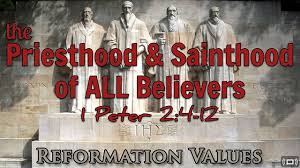
- Revival is birthed out of the belief that all believers in Jesus Christ are part of the ”Royal Priesthood” defined in I Peter. It is a priesthood of peer relationships of “acceptance” and “equality” through brotherhood and bonding through the Holy Spirit. It is a fluid organism, not a rigid organization.

- Revival transcends religious institutional positions and offices and touches individual believers’ lives individually and in masses.

- Revival is in the control of the Holy Spirit, but the institutional church will fight for that control.

- Revival can touch you, a believer in Christ, if you are open and accepting of the Holy Spirit of Jesus Christ.

Since the Great Reformation, lead by Martin Luther, the doctrine of the Priesthood of Believers surfaces during a season of revival, because revival touches individual believers and the masses. Revival works in the hearts and spirits of individuals that touches the corporate good. Individual believers in Jesus Christ begin to recognize who they are in Jesus Christ through the teachings of the Holy Spirit. This exposure of recognizing one’s position in Christ, forever changes how an individual believer in Jesus Christ thinks, acts, and what motivates him.

The need for a priesthood in the Jewish faith is archaic because there is no Temple, temple worship, or animal sacrificing any more.  God created a priesthood to have humans He could draw near and who would draw near to him.  There is still that need, and the Priesthood modeled by Abraham through Melchizidek before the Mosaic priesthood ever existed is an example of one. This priesthood became a New Testament “Royal Priesthood” under the High Priest, Jesus Christ.

This priesthood operated effectively in the first century because believers were “equal peers” in the faith. There was no hierarchy of church government, but Christianity was built on the bonding of relationships with their God and with each other. At first Christianity was known as the only religion that did not have a building, a temple, a spiritual institution where they formally met. Believers claimed their bodies to be “the temple of the Holy Spirit”, thus no need for a physically built building. When the Temple in Jerusalem fell to foreign invaders, Christianity remained, even grew. Although historically rooted in Judahism and Temple worship, they could survive, grow, and flourish without a physical building. Revival spread.

Today, in America, aging Temples, alias Christian religious structures, are in almost every city block, dotting the rural countryside, and are even called “churches”, and we as “the Church” have lost focus on the people being the Church, not the building nor institution nor the hierarchy. The Church was birthed without buildings and a hierarchy, and can survive, revive, and grow without them, but it can’t grow without a priesthood of believers.

I firmly believe if the five fold is to be the next wave of revival for the Church, it must be grounded in the doctrine of the Priesthood of Believers, where every believer in Jesus Christ is an equal peer that serves one another sacrificially and is willing to lay down their life for their brethren. It is a daunting challenge, but an attainable one in Jesus.


Diversity Is Mandatory


Diversity Is The Strength Of The Five Fold

Churches are known for producing “look-alikes”, replicas. People who come in our church doors are as diverse as the weather conditions around the world. They come in all shapes and sizes, races, nationalities, talents, and interests. They leave packaged! Usually packaged by denominational standards, by moral codes, often by the way they dress, their appearance. In the American political world we label one as a Republican, Democrat, or Independent. In the Church world we too have labels: Roman Catholic, Protestant, Orthodox, Baptist, Pentecostal, Mainline, Organic, Missional, Independent, etc. Each group has their own organizations, their own seminaries and educational institutions, their own hierarchy of leadership. Though they may have different doctrines in theology, the people they produce under their banners are looking pretty generic. That is a good thing, for it is ripe for revival!

In the past diversity in the church usually meant future church splits, division. Paul wrote several times, “I heard there are divisions among you.” Often they were caused by the polarization of the diversity present. In this next major revival, the five fold will restore unity as part of its wave or movement. The purpose of the five fold as outlined in Ephesians 4 is “for the equipping of the saints for the work of service, to the building up of the body of Christ; until we all attain to the unity of the faith, and the knowledge of the Son of God, to a mature man, to the measure of the stature which belongs to the fullness of Christ.”

The Lord doesn’t want to stifle diversity; He wants to actually use it for the good of the Body of Christ. Every local church needs the evangelistic spirit, the nurturing caregiver, the grounded Bible teacher, the prophetic insight, and the apostolic over sight, the five fold, five different passions, drives, points of view that are in individual believers in Jesus Christ. If each of those five operate out of the I John 3:16 principle of “laying down your life for your brethren,” by unconditionally serving the others and allowing the others to serve them, a unity will be bonded like the Church hasn’t seen in centuries.

Unfortunately, when sitting through most church services, you do not see the diversity among the saints, the common believers, arise because of the preplanned, orchestrated service which renders God’s people to be inactive, passive. In I Corinthians 12 Paul explains how the body has many parts, relying on each other, and the significance of each diverse part. At the end of the chapter he lists some of the diversity amongst the Corinthians: apostles, prophets, teachers, doers of miracles, healers, administrators, etc. There is diversity among them. Now allow the Holy Spirit to mold them into one body, one voice, one purpose, that is not generic, nor sterile, but vibrant, alive, and unique to each individual local church body.

We, the Church, need to get back to recognizing the diversity among us, and begin “accepting” that diversity as a gift from God, not looking at it with fear and trembling. “Acceptance” of one another is a key component in the success of the next revival.

We, the Church, need to recognize each other as “peers” in Jesus Christ, equals in Christ, all capable of following the leading of the Holy Spirit while being grounded in the Word and living the Word. No group is better than the other. No individual believer is above another in stature or in spirit. “The Priesthood of Believers” is also another key component in this revival.

We, the Church, need to allow the Holy Spirit to orchestrate this next revival. A good orchestra has much diversity in its instrumentation. The greater the diversity; the richer the sound. Let’s allow the Holy Spirit to be the conductor, bringing out unique, diverse solos when needed, but bringing all the members of this orchestra to play in harmony, together, at once, in the richness of a new sound to glorify Jesus and bring unity. If we don’t, there will be no revival! God’s symphony will remain silent. The Holy Spirit is tapping his baton, signaling that He’s ready to lead God’s orchestra in the symphony of the ages.


Five Fold In A Practical Situation

 Successful Summer Sr. High Camp

Last week, as a speaker for the Sr. High Camp at Camp Timberedge, in Beach Lake, PA, I enjoyed beautiful weak of perfect weather, heart warming fellowship, and an experience that changed lives. Pondering its success, I realized that all five passions, points of view, and drives were evident in very practical ways.

I combined the evangelist with the teaching component as the evening speaker, sharing Biblical principles that sparked small group and individual discussions. The camp counselors provided the pastoral, shepherding, nurturing care to those in their cabins/tents. They took what I had taught and applied it to their everyday life, helping the campers to walk out the principles.  They also reinforced the teaching component in a more intimate setting. Their nurturing care developed a “family” atmosphere rather than a camper/counselor pyramidal structure. Their built relationship with the campers was genuine, real, and caring, not authoritative.

The worship leader had a prophetic passion, drawing everyone into a more intimate desire to grow in Jesus all weekend, sensing tit-bits of directions, information, and encouragement, leaning everyone even closer to Jesus in their personal relationship with him. “Worship” was monumental to him and his band. He brought Rhema, or life, to the Logos or written word that I taught.

The couple who were camp directors had apostolic talents, networking everyone in their staff as well as campers in serving one another, taking personal interest in each camper’s spiritual growth as well as the corporate growth of the entire group. They let counselors be counselors, never micromanaging, allowed me to be myself, and basically “saw over” what the holy spirit was leading and doing rather than “overseeing” from an authoritarian position as many administrators do.

I taught about service and grace, and the counselors, staff, and leaders practice it. Campers willingly volunteered to do dishes after every meal, clean up the camp, throw out trash, watch or play with the staff’s young children. The owners of the camp complimented the staff at how immaculately clean the camp was at the end of the week. Everyone served willingly, not out of obligation. They submitted to each other through service, and it worked!


By mid week, campers were praying for one another, supporting one another, serving one another, yet still being themselves competitively playing quirky games, challenges, and competitions. Friday night’s “Country Fair”, featuring booths for dart throwing at balloons, knocking over milk jars, floating duck pulls, ping pong balls in fish bowls, etc. to earn tickets for cotton candy, funnel cake, and drinks in ball jars with straws, could have been taken as “old fashion boring” by most teenagers, but these kids engaged in them all as a family, cheering for one another, supporting one another, making sure everyone was a winner. Even at the talent show, when talent was thin, everyone cheered, clapped, and supported one another. There were no rude remarks or catcalls as teenagers are normally prone to do. Truly everyone felt like part of the family that night.

The lessons that I taught became practical applications by the staff the next day, real life experiences for the campers. These campers opened up in worship, extended grace instead of blame, never criticizing only complimenting, served one another, and bonded in friendship and unity. They even began to minister to the staff.

The power of evangelism, nurturing, caring, teaching by doing, prophetically bringing life, and apostolic oversight by networking were just some of the ingredients to the week’s success. The staff sacrificially laid down their lives for the campers and each other, and their serving attitude was reflected by the campers by the end of the week.

I saw typical teenagers coming to camp, but experienced dramatically changed lives by the time they left. They came, not sure how to define God in “godly” or Christ in “Christ-like” but became living examples of them before their departure. I worked with the staff where no internal conflict was evident to me, but attitude of service, understanding, and open communications pervaded.

The five fold doesn’t have to be “spiritual”; it is just practical! 


What If You Tithed Your Time?


A Different Mind Bending Concept About Tithing

Being a church member, unfortunately, usually breeds passivity. Sadly, we need only “attend” church services to be looked upon as a Christian in most cultures. Attending Sunday morning worship and one activity listed in the bulletin per week satisfies our stature.  We are so dependent on the professional staff to do everything, that they “enable” us by doing their job effectively. No wonder we do not feel part of the life of the local church.  Usually churches that are professionally programmed driven usually ask only one major form of activity from their casual members; their financial giving.  The offering is a central piece of every Christian program. Sometimes pre-offering speeches can be longer than the sermon, and “tithing” is a quarterly sermon theme.

What would happen if we Americans would tithe from what is most precious to them; their time?

What would the church staff do if each and every member in your church was willing to volunteer 4 hours, 1/10th of their 40 hour work week to the church? The staff would probably generate more programs for them to attend! Really, if you have 100 members in your church each giving four hours, what would they do with 400 hours of volunteered time each week? A 500 member church with 1,000 free hours? Sounds like a cell phone plan!

If I would ask that question during a staff meeting I may get suggestions like: janitorial work, building maintenance, shrubbery trimming and clean up, painting, secretarial work, running off bulletins, up dating data base of members for email, newsletters, and mailings, etc., all institutional chores, but what happened to feeding and clothing the poor, caring for the widows in the congregation, hospital and jail visits, etc.  Most staff hired by churches are program related where they are highly visible, but who does the invisible tangibles that empower a church?  What they would list on a whiteboard as suggestions would show the priorities of that church.  With 400 hours a week of volunteering would force a change in priorities.

What would happen if the members spent their volunteer time forming nonprofit businesses in a service sector like a lunch time deli where they would feed and serve their community in a nonchurch financially profitable atmosphere?  How about a “Foot Wash”, fancy name for a car wash reflecting the foot washing passion of Jesus to the community, not as a fundraiser for more church activities, but for community benevolence. How about a moving company to help low income families and church families in moving to a new residence? These business would not only produce financial profits, but “help equip the saints for the works of service,” the Ephesians 4 principle as well as produce entry level jobs for young people, the homeless, and those wanting to start a life of financial independence while serving. Actually these acts of service are great evangelistic efforts, touching the secular community, and grafting them and the local church into stronger community bonds.

What impact would volunteered tithing hours have on the elderly if church members did not just visit them for ten minutes on a Sunday afternoon during visiting hours, but instead took them to their doctor and dentist appointments, or helped maintain residential housing that is beyond the physical capabilities of an aging widow, so she can still have the freedom of living in her home instead of being forced into an assisted living situation?

What freedom would it give a parent of a physical or mental handicap child if volunteers would spend time with that child, freeing them to go shopping alone, going to the athletic club for their own health, or just have a badly needed date without the pressures of caregiving 24/7?

These possibilities only scratch the surface; allow your imagination to soar at the possibilities of how “active” how “alive” a local church would be if we tithed from our most sacred resource, our time. I cannot find in the scriptures where Jesus asks for our money, but he does request our time when he says, “Follow me.”  “Following Jesus” will always change the way we think of doing church, the way the community sees church, the way the “staff” would have to operate, and the way we would chose church leadership.

What do you think? What impact would “tithing of our time” change the way your church would do “church”? What would “church” then look like? How would the church manage all those volunteers and hours without hiring a “case manager”, another full time professional position? Let’s hear from you! 

What The Church's Response To The Mentally Ill Should Be?


Resurrecting “Lean On Me”; A Personal Response

 A 2011 Baylor University study revealed that help from the church with depression and mental illness was the second priority of families with mental illness, while it ranked 42nd on the list of requests from families that did not have a member with mental illness.

If we offer “care” for someone, what does that mean?  Clinically we say, “We offer services,” as a friend, “I’m there for you,” and as a church attender, “We will pray for you.”  One offers programs, one personalization, and the last a detached response. Institutional churches can offer programs they label as ministries like a drug and alcohol ministry or mental health ministry. “We’ll pray for you,” offers concern but no personal involvement or social interaction with the person, and often turns into gossip circles. The personal, “I am there for you,” option is the most effective, the most Christ-like option, but requires sacrifice and commitment of actually being “available” 24/7 on our parts!

The personal option does not need building or program structures; it just needs you! Your involvement, your time, your commitment, your concern, you “just being there.”  Often most forms of effective ministry never need a designated building or specifically designed program, it just need the human element of love, care, commitment, and involvement, just “being there” for someone.

Mental illness strives for isolation and detachment. Just “being there” prevents both of these from occurring by reinforcing the recovery process. One fighting depression often feels “overwhelmed,” unable to tackle situations alone, but “being there” eases that pain. Schizophrenia distorts one’s rationale, but having one by your side whom you trust counters that. Currently clinical help only comes during the crisis stage, but having someone sensitive to your mood, stability, and needs by you can detect when something isn’t right early. That is called prevention.

Since the “Church” is not an individual, but a collective group, the “being there” can be shared, distributed among others, not to be a burden. Intimate small group ministry that meets regularly can offer more than a clinical Group Therapy that discourages close interpersonal relationships by its members. Church small groups shouldn’t turn into programs like Bible studies, or just talk sessions, but become a process for building relationships that produce life beyond group meetings. That’s family!

Religious cults and inner city gangs draw people into their midst because they act as an accepting family. Family offers a support system to someone stripped of many of their abilities, talents, and social graces due to mental illness. Without a family homelessness and a skirmish with the lay can be a real possibility.

Bill Wither’s Lean On Me song, now decades old, advocates what one must do to be effective. “Sometime in our lives we all have pain, we all have sorrow, but if we are wise, we know that there’s always tomorrow.  Lean on me, when you’re not strong, and I’ll be your friend. I’ll help you carry one, for it won’t be long till I’m gonna need somebody to lean on. Please swallow your pride if I have things you need to borrow, for no one can fill those of your needs that you won’t let show. You just call on me brother, when you need a hand. We all need somebody to lean on. I just might have a problem that you’d understand. We all need somebody to lean on. If there is a load you have to bear that I can’t carry. I’m right up the road; I’ll share your load if you just call me.