Shepherding In A Five Fold Peer2Peer Relationship

The Five Fold = Peer2Peer Relationships – Part III

Ephesians 4:15 - As a result, we are no longer to be children tossed here and there by waves and carried about by every wind of doctrine, by the trickery of men, by craftiness in deceitful scheming, but speaking the truth in love, we are to grow up in all aspects into Him who is the head.

After ten hours of intense labor contractions, a decision was made to have a Cesarean Section. Since completing Child Birth Classes together, I was allowed in the O.R. to witness the birth of my first son. With his birth, the job of the Obstetrician was finished; he was now placed in the hands of a Pediatrician who would monitor his growth as a baby, a toddler, and a child with the goal of keeping him healthy.

There are parallels to the five fold. With a spiritual birth, the evangelist’s job is done, for he majors in birthing. A spiritual pediatrician is needed to nurture this newborn’s growth in ”the knowledge of the Son of God to a mature man, to the measure of the stature which belongs to the fullness of Christ,” and to grow up in all aspects into Him who is the head.” Obstetricians and pediatricians perform two entirely different functions. The same is with the evangelist and shepherd. It isn’t that the evangelist doesn’t care about a new convert; it is that he is just driven to win the lost. His passion thrusts him immediately toward finding another lost soul to save.

What do we, the church, do to these “newborns”? We baptize them “into the church”, make them “church members”, and indoctrinate them to our theology in a “New Believers Class”. Seldom are they taught what it means to be “baptized into Jesus’ death and resurrection”, or being a member of “the family of God”, or how the Holy Spirit “will teach you all things and remind you of everything I (Jesus) have said to you.” - John 14:26 because He resides in your body, the temple of the Holy Spirit.

Just as the building of personal relationships as peers was important in the evangelistic stage, the building of personal relationships as equal peers in Jesus is monumental in the shepherding stage.  “So in Christ Jesus you are all children of God through faith, for all of you who were baptized into Christ have clothed yourselves with Christ. There is neither Jew nor Gentile, neither slave nor free, nor is there male and female, for you are all one in Christ Jesus. If you belong to Christ, then you are Abraham’s seed, and heirs according to the promise.” – Galatians 3:26-29

In the natural, my son grew in size, weight, and strength over the years. Developmentally, he did certain things as an infant, a toddler, an elementary school age child, adolescent, etc. with each year of growth. Spiritually, it is different, because you only grow if you, personally, choose to grow. Some people choose to stay as spiritual infants.  Paul recognized this with the Corinthians, “I gave you milk, not solid food, for you were not yet ready for it. Indeed, you are still not ready.” - 1 Corinthians 3:2

As a young adult, my son desired to have a man of God other than his father or his pastor from our local church to stand beside him and shepherd him, someone he could relate to as a peer and respect. All our church could offer was a “men’s mentoring” program which basically was a book/Bible Study on the topic of “5 Steps In Becoming A Godly Man”. He was not looking for a good Christian book read, but for another male peer to walk in faith with him, modeling the spiritual walk in Jesus. He was seeking a I Timothy 5:1 man, “Do not rebuke an older man harshly, but exhort him as if he were your father. Treat younger men as brothers.” There were no takers to my son’s challenge.  He has suffered greatly because of it.

Every evangelistic church must have a spiritual nursery composed of common believers whose passion it is to nurture newborns in the faith and be willing to walk with them in their spiritual walk as Jesus did with his disciples. The church needs true elders by spiritual age who are willing to walk with new babes in Christ, who are willing to put up with their failures by extending grace, who are willing to “carry their cross” when their burdens are to heavy to bear, and who are willing to invest in other’s lives by “equipping them for service” then releasing them to walk on their own. Like teaching your own child how to ride a bike, you must be able to run along side them until they get their spiritual balance, then release them for their own free flight!

I believer that there are common believers, like you and me, whose passion is to serve Jesus through nurturing and caring for others as “spiritual parents”. I have written a book, I Was A Stranger And…, about Joyce and Morgan Ilgenfritz who have taken in over 350 people into their home to live for a month or longer over a 35 year period. Their passion allowed them to become spiritual parents to over 350 people of all ages from all around the world. The Ilgenfritz’s aren’t pastors or on a church staff. Morgan, an electrician, and Joyce, a nurse, are everyday parents who raised four children, all who attended college. Living by faith was their testimony. They required everyone who came through their door to be a member of their family. That acceptance proved to be the open door.

Pastoral shepherding in the five fold process is about Peer2Peer, the building of relationships with people, equals, peers in Jesus walking together in faith, building up one another in the Spirit, encouraging one another in times of difficulty, believing together for a supernatural God to move, and praying together and watching God answer those prayers in practical ways.

Shepherding is the process of teaching an individual, a newborn believer in Jesus Christ that this walk isn’t just about them, but about others too!  It is about becoming a family, a family of God. “For where two or three gather in my name, there am I with them.” There is the power of “two” in the Peer”2”Peer process of the five fold!


Evangelism In A Five Fold Peer2Peer Relationship


The Five Fold = Peer2Peer Relationships – Part II

1 Peter 2:10 - Once you were not a people, but now you are the people of God; once you had not received mercy, but now you have received mercy.

                  I have a simple definition for “worship”: Worship is “the act of giving back to the Lord what one has already received from Him.”

                  An evangelist’s most coveted prize is his salvation. God’s grace cannot be earned; it’s a gift paid for by Jesus’ death on the Cross. What better way to worship God than to “give away” one’s salvation to another? That is the passion of an evangelist! There is no greater satisfaction to an evangelist than giving salvation to another!

                  The church has spent millions of dollars on evangelistic events on television, radio, and mass crusades in stadiums and outdoor rallies with what results? Dr. Anthony Compolo addressed a rally in my hometown asking the audience how they accepted Jesus. A large majority acknowledged that it was through one-one-one relationships with other believers. The most effective method of evangelism still remains the one-on-one encounter with people of faith who had built relationships with people seeking faith.

                  Peer relationships and peer equality are vital in sharing the gospel. A “better-than-thou” attitude or a “cleanup-your-act-to-be-accepted” speech is never received well. A sinner is more apt to accept grace from a sinner saved by grace because he/she can identify with both being sinners as common ground of equality.

                  The Facebook generation understands the importance of “acceptance”. Being “accepted” as a “friend” is the key to social interaction. Being a “friend” gives one an equal voice. Hitting the “like” button means “acceptance” and often “approval”. What starts out on Facebook as shallow communications builds with each entry, each post, each picture, and each “like”. Only after a considerable time of sharing does one finally listen to another’s belief system. Only then can the “friend” now accept or reject the offer. That is also how the gospel works.

Today’s churches have it backwards by inviting someone into their building rather than reaching out to them, telling them they must clean up their lives, follow the church’s doctrines, beliefs, and social codes before being accepted into church membership. This gives the message of rejection before acceptance. Both social networking and presenting the gospel first accept one as an equip peer where they currently are and builds relationships before opening up in sharing one’s belief system.  When they embrace this new belief system, it is the Holy Spirit who will convict, producing change.

The church can continue to promote its bull horn, hell, fire, and brimstone street evangelist or dooms day prophets handing out gospel tracts, or it can embrace, equip, and release ordinary believers in Jesus to listen to the voice of the Holy Spirit, built relationships with their neighbors and work colleagues accepting them as peers, and watch the Holy Spirit convict with power and compassion. Peer2Peer evangelism is about people accepting people, people recognizing people as peers, people sharing and receiving faith from one another. It’s all relational. It is not about church programs or offices.  It is about “sharing” Jesus and “giving” them Jesus when they are ready to “receive” Jesus.  Rejoicing begins upon the “”acceptance” of both parties in Jesus, for now both are equal peers as brothers and sisters in the Lord in the family of God.

    “Once you were not a people, but now you are the people of God; once you had not received mercy, but now you have received mercy.” - 1 Peter 2:10

 “And it shall come to pass in the place where it was said to them, ‘You are not My people,’ There they shall be called sons of the living God.” - Romans 9:26


Introduction to Peer2Peer Relationships


The Five Fold = Peer2Peer Relationships – Part I

Matthew 18:20 - “For where two or three gather in my name, there am I with them.”

                  The five fold is not just for the professional clergy and staff but is for every believer in Jesus Christ. It is just believers serving believers because “Where two or three gather in my name, there am I with them.” Wherever you have peer-to-peer relationships in Jesus, you have Church! You do not need a pastor, a hierarchal church structure, or well-organized program; you just need another believer by your side as a peer in Jesus.

                  If the purpose of the five fold is for the equipping of the saints for the work of service, to the building up of the body of Christ, until we all attain to the unity of faith, and the knowledge of the Son of God to a mature man, to the measure of the stature which belongs to the fullness of Christ, then the five fold is all about peer relations of service to one another to build up the Priesthood of Believers and bring unity of faith as well as help each individual believer to “grow up” into a mature man in the fullness of Jesus Christ. It is not about programs or an institution. It’s about people “serving” people!

                  It is about giving and receiving from one another.  Paul said,  “I wish that all of you were as I am. But each of you has your own gift from God; one has this gift, another has that.” - 1 Corinthians 7:7 The five fold is all about giving out of your passion to Jesus and His body, the Church, and receiving from other’s diverse giftings and passions in the body.

                  In the next series of blogs we will look at each passion of the five fold and how it effectively serves the body of Christ, the Church, when its believers are in a peer-to-peer relationship.


A Biblical Narrative: Consensus Can Be A Difficult Journey

Consensus And The Five Fold – Part V


Coming to a consensus has not been easy; ask the children of Israel while they were in Egypt and even after their Passover.

Biblical consensus occurs when one hears from God. Moses heard from a burning bush telling him to “Let my people go”. He became obedient and left with a message for Pharaoh, but after 500 years of bondage, the mindset of the Israelites was not quite ready to receive such a message. They first agreed with Moses, but after Pharaoh’s demand for more productivity at the local brickyard, they now have to get their own straw, and they began to question Moses’ directions.

After all the plagues, Pharaoh grants them their freedom, and it appears that they are finally having a consensus, going the right direction, the same direction: out of Egypt.  Consensus waivers when they get to the Red Sea with the Egyptian army heading in their direction! Consensus is strong when the only option becomes the Red Sea dividing into dry land for an escape route before them. They again moved in the same direction.

Moses gets another word, the 10 commandments plus is told that they should go to the Promise Land!  All are with him until the wilderness becomes known as the “Wilderness of Sin” and the Israelites become known as “Children of Disobedience”, and they are forced to walk in circles because of doubt and unbelief. Because they were not “obedient” to the Word of the Lord and pulled together to go the same direction, all but three would die in that wilderness and never enter the Promise Land. Only until Israel was finally spiritually united believing they had a consensus to “take the Land”, that the “battle was the Lord’s” did God allow them to again move forward in unity as they crossed the Jordan, fight the giants, and defeat their enemies.

As I said in an earlier blog, to have a consensus you: 1) first, have to allow God, the Father, Jesus, the Son, and the Holy Spirit to be in total control. God calls the shots; we are just obedient to His directions; 2) each believer, though diversely different from one another must “lay down our lives for the brethren”, individually and corporately; by 3) submitting in service to and from one another, giving away our giftings to serve others, and willingly receiving the giftings from those so diversely different than from ourselves as equal peers in Christ. If we do these three things, there will be a “consensus”.

God had to lead the Israelites through the dessert: 1) to teach them to hear from Him, trust Him, and be obedient to Him and His Word; and 2) to make these people become “God’s people” by learning to serve one another and prepare them to move forward, in one direction, for upcoming battles. Today, God is still leading his believers, His people, through wilderness experiences to teach them: 1) to hear His voice; trust His Holy Spirit, and be obedient to Him and His Word; and 2) make them “God’s people, a Priesthood of Believers, peers and equals in Jesus Christ so they can serve one another and receive one another to mature individually into becoming Christ-like and to unite corporately as a Body, a family, a Church.

Yet, like the children of Israel, we to would rather rely on institutions, on empires, on what is traditional and routine for us rather than listening to the voice of God and have a consensus to move the same direction towards the promise land. As a Church we are fragmented, divided, sectarianism rules, division persists. We are known for shooting our own even when wounded. Like the children of Israel in the dessert we resist forming a Holy consensus of becoming obedient, laying down our lives for one another, and moving in the same direction.

Consensus has not been easy for the Israelites nor for the Christian faith because it demands obedience, allowing the Holy Spirit to be in control, and trusting the Holy Spirit. It demands laying down our life for the brethren, unconditionally serving them, washing their feet no matter how dirty they may be. Consensus looks like an art the first century Church practiced but has been lost. With all this division consensus does not look like a reality, “but with God all things are possible.” (Matthew 19:26) I am convinced more than ever, that “consensus” is the way God governs his Church. That is why he has established his kingdom, his government on His Son Jesus, for “the government shall be on his shoulders.” His divine will is to govern that kingdom, His Church, through consensus. The Church will hear the voice of the Lord, be obedient to it, and move forward in the same direction. Come on Church; let’s reinstitute consensus as our form of government.


Can A Five Fold Congregation Govern Itself?


Consensus And The Five Fold – Part IV

What results would the church get if it recognized and released the five fold passions of its believers in its congregation and allowed then to govern a church body towards a consensus? This would not be a democracy where majority rule reigns, nor a dictatorship where a top down leadership directs all calls, but it would be where the passions and giftings of every believer would be needed to birth, nurture, ground, revive, and oversee the will of the Father through the leading of the Holy Spirit of Jesus Christ toward a consensus of the common good. Sounds more like the first century church!
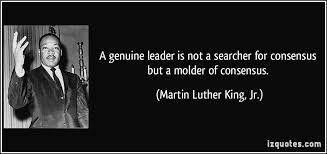
When the will of the Father is expressed through his Son, Jesus Christ, by the voice of the Holy Spirit, a consensus of direction can be established. Somebody driven by an evangelistic spirit would champ at the bit to “birth” the consensus reached by this group. Another would want to “nurture” it toward maturity, while yet another would make sure it is grounded in the Logos Word, the Bible. Another peer believer would want to activate that Word into a living Rhema Word, all under the supervision of a believer who sees the big picture, yet releases everyone else’s giftings as peer equal to complete the consensus that was reached by the group. This process of building consensus is the “building up of the body of Christ” producing “unity” corporately and “maturity” individually.

 “As a result, we are no longer to be children tossed here and there by waves and carried about by every wind of doctrine, by the trickery of men, by craftiness in deceitful scheming.” There would be no division caused by doctrine, no trickery through church politics, and no scheming. Instead there would be unity, purity, and obedience to the Holy Spirit.

 “We are to grow up in all aspects into Him who is the head, even Christ.” WE NEED TO GROW UP, and that is the purpose of the five fold, to help believers in Jesus Christ GROW UP, become Christ-like, God-ly, a MATURE MAN by “equipping the saints for the work of service” and then by RELEASING them!   You cannot lose your job in the five fold because it is not a job; it is a believer’s passion. You are not “replacing” yourself. You are “replicating” yourself; you are multiplying. You are investing (laying down our lives for the brethren) to equip them, your peers, your brothers and sisters in the Lord, in their walk of faith in Jesus.

Then there will be consensus in the Body of Christ, the Church as “the whole body being fitted and held together by what every joint supplies (as peer believers in Jesus), according to the proper working of each individual part (through the five fold passions and giftings), causes the growth of the body for the building up of itself in love.

That’s the power of “consensus” through the five fold.


The Effectiveness Of Consensus In The Five Fold


Consensus And The Five Fold – Part III

Question: How do you get a consensus from five totally different passions, drives, functions, and points of view?  How can five become one?

Answer: 1) Allowing the Holy Spirit to be in total control; 2) each believer “laying down his life for the brethren”, individually and corporately; by 3) submitting in service to and from one another, giving away ones giftings to serve others, and receiving willingly the gifts of those so diversely different than from ourselves as equal peers in Christ.

How: Through consensus!

Consensus comes through the process of “giving” and “taking”.  Not only are we to “give” to one another, but we must also learn how to “receive” from one another.  This unconditional giving and taking can build a rich relationship of becoming equal peers, equal brothers and sisters in the Lord, from once shallow friendships. A person driven by the passion for evangelism needs brothers and sisters who are pastoral to nurture him/her, who are teachers to ground one in the Word, who are prophets to bring life to the Word, and who are apostolic to “see over” one’s welfare individually and as a group. This five fold process brings an unique form of accountability unknown to the modern church because it is built on a give and take relationship between believers built on trust: the willingness to receive and yield to another’s point of view diversely different from your own while giving support from your own gifting.  This gives all the confidence to move toward in the same direction together.

Consensus comes through relationships rather than positions. When a believer learns to die to self and is willing to lay down his/her life for their brothers/sisters, recognizing them as equal peers, they can begin to respect and trust one another rather than appose one another and always be defending their position. Diverse points of view can actually be productive, by creating a diverse support system around one’s own particular gifting.  In a peer believer five fold leadership model, no one is the “head” or “ultimate leader” as in a hierarchal structure, for Jesus is the head. No one gifting or passion dominates over another, not even the apostle’s. Any of the five fold giftings may rise and take leadership in any given situation and the other four will follow, not oppose, by standing in support along side them, not above or below them in stature, giving them a more diverse, unique gift that can produce a far different outcome than what we are use to today. This supportive attitude brings consensus. The pastoral/shepherd driven believer may rise with a “nurturing” solution, while the evangelist may have what is needed to “birth” the process while the teacher “grounds it in the Word” releasing the prophet to “activate” that Word into a Rhema, living Word, while the apostolic driven believer just sits back and “sees over” what the Holy Spirit is doing and how He wants it done through obedience. The group arrives at a consensus. The process may be totally different the next time if the process began with a prophetic word which sparks an evangelist to birth that word, the shepherd to nurture it, the teacher to ground it, and the apostle to release the leading of the Holy Spirit to bring yet another consensus, another resolution, another move of unity in the same direction in agreement with each supporting one another.

Consensus comes through accountability of the willingness to serve and be served. When someone serves you unconditionally for a long time, you naturally trust them, not because they have a title or position, but because of the relationship that has been built between the two of you. If you have faithfully served them, they trust you; it is reciprocal.  It is easier to arrive at a consensus when the parties involved have faithfully served and trusted each other through Christ-like relationships.

Consensus arrives when all these diverse passions and points of view point in the same direction, toward Jesus, the Head, and being obedient to the Holy Spirit to set that direction. Does the outcome of this group bring glory and edify Jesus is the standard. The bottom line remains “Who do you trust?” Is your full trust in the Holy Spirit of Jesus Christ? No matter how irrational the steps may look that you must take to be obedient to the Holy Spirit, can you trust the Holy Spirit to lead you through those steps? Is your wisdom, rationale, or intellect greater than His?

Consensus’ goal through the five fold is “the building up of the body of Christ, until we all attain the unity of faith, and the knowledge of the Son of God to a mature man, to the measure of the stature which belongs to the fullness of Christ.”  If we truly follow the leading of the Holy Spirit and are willing to “lay down our lives for the brethren” by unconditionally serving and receiving support from one another, will that not be “building up the body of Christ,” reaching an “unity of faith,” and personally growing toward become “a mature man in Christ, becoming Christ-like and God-ly? This “fruit” produced by the five fold is exactly what is needed to arrive to a consensus.


The Need For Consensus Among The Five Fold


Consensus And The Five Fold – Part II

Ephesians 4 introduces us to the five fold: ie. apostle, prophet, evangelist, shepherd, and teacher.  All five are gifts he gave to men, believers in Jesus, that are very evident in the first century Church. I define the five fold as “passions and functions” in every believer in Jesus that “drives” or “motivates” them toward service to build up the body of Christ, to bring unity in faith, and to develop Christian maturity. Unfortunately, the institutional church has categorized them organizationally into “titles” and “office” of leadership held by church officials, which was not their original intent. They are “gifts” given to “believers in Jesus Christ” that become their passion driving them toward service.

Historically, when each is predominately emphasized individually, division has become its fruit, for they have been given as a “body” ministry to produce unity when used together and to bring maturity in being Christ-like. Although they are five different passions with five different functions, they have been created to support, serve, and receive from one another. They are “Body” gifts to equip the saints for service and to mature them into the image of Jesus Christ.

All five are necessary in the development of a believer’s spiritual growth.  All five are necessary in the creation of a healthy, growing, spiritually active church. All five perspectives, passions, and points of view bring diversity to the Body of Christ. Every individual believer and every local church needs an evangelist for birthing, a shepherd for nurturing, a teacher for making the Logos Word become the Rhema Word, a prophet to hear, discern, and be obedient to the voice of God, and an apostle to “see over” what the Holy Spirit is already doing and directing, not “overseeing”  by micromanaging. The Holy Spirit, who indwells every believer, must always be in control, for He gives the comfort needed to nurture growing Christians towards being Christ-like, the teaching to reveal Truth, the clarity to hear the voice of God and be obedient, and the discernment, wisdom, and direction to bring it together. The five fold is all about listening, yielding, and be obedient to the Holy Spirit.

If the five fold can be so divisive, how can it ever bring unity and maturity? Jesus told his disciples, “With men that is impossible, but with God all things are possible.” (Matthew 19:26) Unity and maturity can come about by: 1) first, allowing the Holy Spirit to be in total control. He calls the shots; we are just obedient to his directions; 2) each believer, though diversely different from one another must “lay down our lives for the brethren”, individually and corporately; by 3) submitting in service to and from one another, giving away our giftings to serve others, and willingly receiving the giftings from those so diversely different than from ourselves as equal peers in Christ. If we do these three things, there will be a “consensus” among all the diverse parties present and a direction of unity drawing the group towards it.

Let’s examine more closely how consensus is the key to the effectiveness of the five fold in our next blog entry. 


What Others Say About The Five Fold And Supporting Scriptures


Consensus and the Five Fold – Part I

21/03/2006

Do you believe that God still uses the five fold ministry? If so please explain your answer.

Of course He does. The Bible says in Ephesians 4:11-12 that God has given His gift to the body of Christ, apostles, prophets, evangelists, pastors and teachers, for the equipping of the saints for the work of the ministry until we all attain for the unity of faith. The five-fold ministry is sent by God, people that are true bonafide apostles, prophets, evangelists, pastors and teachers are to equip the saints so that the body of Christ, at large, is doing the work of ministry, evangelizing the world, caring for the hurting, healing the hurting and reaching this world for Jesus Christ. We’re going to do that, five-fold ministry people are going to equip the saints until we all attain to the unity of faith. Until we finish the work God has for us. Then, God won’t need the five-fold ministry on this earth any more.― Gregory Dickow Ministries

@ http://changinglives.org/tabid/2623/Default.aspx?cat=Five%20Fold%20Ministry

***************   

BY GREG STIER, CHRISTIAN POST GUEST COLUMNIST

October 6, 2012|6:18 pm

One day a lady criticized D. L. Moody for his methods of evangelism in attempting to win people to the Lord. Moody's reply was "I agree with you. I don't like the way I do it either. Tell me, how do you do it?" The lady replied, "I don't do it." Moody retorted, "Then I like my way of doing it better than your way of not doing it." .― Greg Stier, The Christian Post @http://www.christianpost.com/news/the-best-method-for-sharing-the-gospel-82820/

***************

                  If you are a new believer, you have recently accepted that you were born with a sinful nature which separates you from having a full relationship with God and from having eternal life after this earthly life. You believe that Jesus died for your sins and have verbally confessed that He is Lord ( Romans 10:9-10).

As new believers, you need to know some basic foundational principles as you grow in your new life as a Christian.  .― One Flock One Shepherd Ministries, @http://ofosm.com/ministries/new-believers/

***************

Teaching Scriptures:

Titus 2:7-8 - Show yourself in all respects to be a model of good works, and in your teaching show integrity, dignity, and sound speech that cannot be condemned, so that an opponent may be put to shame, having nothing evil to say about us.

Proverbs 22:6  - Train up a child in the way he should go; even when he is old he will not depart from it.

Luke 6:40 - A disciple is not above his teacher, but everyone when he is fully trained will be like his teacher.

1 Peter 4:10 - As each has received a gift, use it to serve one another, as good stewards of God's varied grace:

Psalm 32:8  - I will instruct you and teach you in the way you should go; I will counsel you with my eye upon you.


In 1Corinthians 14:31, Paul wrote, “For you can all prophesy one by one, so that all may learn and all may be exhorted.”

***************

“While it is safer to start a church in the West, it may actually be simpler to plant one in Iran. Go to a church planters’ conference in North America, and you will hear about budgets, programs, marketing campaigns, and the need for a good worship set. Attend a conference for Iranians, and you get a very different picture. They’ll talk about starting by sharing Christ with friends and family, gathering new believers for a weekly Bible teaching and fellowship, and then encouraging and praying with them to go and share with their friends and family.”.― http://www.sermonindex.net/modules/articles/index.php?view=article&aid=33252 

* * * * * * * * * * * * * *

Therefore I, the prisoner of the Lord, implore you to walk in a manner worthy of the calling with which you have been called, with all humility and gentleness, with patience, showing tolerance for one another in love, being diligent to preserve the unity of the Spirit in the bond of peace. There is one body and one Spirit, just as also you were called to one hope of your calling; one Lord, one faith, one baptism, one God and Father of all who is over all and through all and in all.

But to each one of us grace was given according to the measure of Christ’s gift. Therefore it says, “WHEN HE ASCENDED ON HIGH, HE LED CAPTIVE A HOST OF CAPTIVES,

And HE GAVE GIFTS TO MEN.”(Now this expression, “He ascended,” what does it mean except that He also had descended into the lower parts of the earth?  He who descended is Himself also He who ascended far above all heavens, so that He might fill all things.) And He gave some as apostles, and some as prophets, and some as evangelists, and some as pastors and teachers, for the equipping of the saints for the work of service, to the building up of the body of Christ, until we all attain to the unity of faith, and the knowledge of the Son of God to a mature man, to the measure of the stature which belongs to the fullness of Christ.

As a result, we are no longer to be children tossed here and there by waves and carried about by every wind of doctrine, by the trickery of men, by craftiness in deceitful scheming, but speaking the truth in love, we are to grow up in all aspects into Him who is the head, even Christ, from whom the whole body being fitted and held together by what every joint supplies, according to the proper working of each individual part, causes the growth of the body for the building up of itself in love. – Ephesians 4:1-16 NAS


Question: Can The Principle of “Consensus” Be Taught?


 “Consensus” Through Family Interaction

My dad told us that as a child he had been taught, “Children should be seen but not heard.” When visiting his grandparents, he and his brothers and sister were instructed to sit around the table quietly and only talk when spoken to or questioned by an adult. Seldom were they ever a part of adult conversation, and never were they part of decision making. The “Poppa” ruled the house because he was the “head of the home”, and “Mamma” ran the house because she was “the neck that could turn the head” any direction that she chose! There was no consensus in those households, only parental dictatorship. As a child, you were expected to only do what you were told or face discipline.

As a dad, my house was different. During the evening meal we sat around a round table conversing. My wife told us of the challenges and triumphs of her work day as a painter and wallpaper hanger. My children talked about “school”: bonding of friends, the breaking up with others, and the comical events of the day. My daughter told of new gymnastic moves she conquered, my son what rudiments he could drum, and my younger son telling what guitar pieces he mastered. All shared the excitement of upcoming concerts, gymnastic meets, church youth group events, and painting and wallpapering experiences. These were noisy times, for it was part of moving forward as a family. Silence usually signaled a problem or a hurt feeling, certainly not the respect and dignity their grandfather had often shared. These times around our table taught us to support one another, show interest in other’s activities, and a time to pull together to map out strategies so that all could participate in individual efforts as well as family events.

These efforts were tested in 1993 when my wife and I were invited to go to South Africa during the demise of apartheid as part of an United Methodist Lay Witness Team for a sixteen day trip from Johannesburg to Capetown. Since this invitation effected every family member, I called for a “family meeting.” After my wife and I shared the facts with the children, we wanted to hear what they thought. Unanimously they thought we should go on the trip even though it would mean they would have to alter their schedules for twenty-one days. Everyone shared how the trip would effect them personally, yet there was a consensus that we move forward and go.

As a family we prayed, and we began to see those prayers answered: checks came from friends to financially support our trip; the school district allowed me to take a twenty-one day “Sabbatical” from teaching for educational travel; and our friends who had six children of their own agreed to add our three to their family for three weeks. While we were on the trip, our children prayed for us daily, and the trip became “life changing” for all of us individually as well as a family.

Now, as adults, our children are vastly diverse, more independent, each unique, following different paths on life’s journey, yet as a family we are still close. They learned that family is important! Even during challenging times, we still seek consensus on how to support, aide, and give direction to each other on life’s journey. While other families fuss, feud, and debate bringing division, our family has “learned” that consensus may not come easily, may surface pain and conflict, yet we as a family can still move forward with positive support for one another. “Consensus” is a process that can be taught and learned by families.

The same is with the family of God, the body of Christ, the Church. Today’s church could operate through consensus if it were willing to give everyone a voice, validate everyone as a peer in the group, a member of the Priesthood of Believers, and work toward a common direction that will produce positive results for the good of the group. Maybe, just maybe, instead of being an organization, the church needs to return as an organism, a family, governed by consensus, just as it was when it was birthed at Pentecost.


Who Can We Trust To Get A Consensus?


The Act of “Consensus” – Part VI

 In Conclusion:

Building a consensus, to be “in one accord”, takes work, and it takes trust. Bottom line: In the vertical relationship between us and our God (John 3:16), can we trust the Holy Spirit to direct us into a consensus? If that same Holy Spirit indwells each of us believers because our bodies are the temple of the Holy Spirit, cannot that Spirit arise among us to bring unity, purpose, and direction toward Jesus Christ, the Head of the Church?  In the horizontal, peer, relationship with other believers in Jesus Christ (I John 3:16), can we trust each other to bring consensus, agreement, and unity of faith in the Body of Christ? As a Christian, I ask, “Who can you trust?”

With all the splits, all the sects, all the denominations, all the church offices, all the different giftings, etc., with all this diversity in the body of Christ, how can consensus be found in the 21st Century Church structure? How can consensus be the norm of church governing? 


Question: Does Consensus Mean “Being In One Accord”?


The Act of “Consensus” – Part V

            Frank Viola, in his book Reimaging Church, states, “What was the New Testament pattern for decision-making in the early church?  It was simply by consensus.  "Then it seemed good to the apostles and the elders, with the whole church," and, "it seemed good to us, having become of one mind," was the divine model for making corporate decisions (Acts 15:22, 25 NASB).  In other words, the decision-making of the early church was not in the hands of the elders. It was in the hands of all the brothers and sisters.  

Because the church is a body, all the members should agree before it moves forward in obeying the Head (Romans 12:4-5; 1 Corinthians 12:12-27; Ephesians 4:11-16). In fact, a lack of unity and cooperation among the members reveals a failure to embrace the Head (Christ).  

Majority rule, dictatorial rule, and a Robert's Rules of Order mentality do violence to the body image of the church.  And they dilute the unvarnished testimony that Jesus Christ is the Head of one unified body.  For this reason, Paul's epistles to the churches are saturated with exhortations to be of one mind (Romans 15:5-6; 1 Corinthians 1:10, 2 Corinthians 13:11; Ephesians 4:3; Philippians 2:2; 4:2).  Recall the Lord's teaching on the following text:  

Again, I tell you that if two of you on earth agree about anything you ask for, it will be done for you by my Father in heaven. (Matthew 18:19)

Significantly, the word agree in this passage is translated from the Greek word sumphoneo.  Sumphoneo means to sound together-- to be in one accord.  Our word symphony is derived from this term.  So the meaning is clear.  When the church is in sympathetic harmony, God will act.  

In this connection, consensus mirrors the decision-making activity within the triune God, whose nature we were created to reflect.  God acts when the Father, Son, and Spirit agree.  Decision-making in the Godhead is communal and marked by mutual submission.  In other words, it's consensual.”

Viola continues, “Again, the elders of the early church bore the bulk of spiritual oversight and pastoral care for the assembly (Hebrews 13:7, 17, 24).  But they didn't make decisions on behalf of the church.  Nor were they solely responsible for the church's direction.  

Therefore, an elder has no biblical or spiritual right to bark out commands to a passive congregation.  Instead, the elders (once they emerged) worked together with the whole church toward reaching a unanimous decision and a single mind (Acts 15:22, 28).  But it was the church, as a whole, that made the decision as "one new man."   

But what about Hebrews 13:17?  In that text, some translations have "Obey them that are over you."  The Greek word for "obey" in this passage is not hupakouo, the garden-variety word for obedience used elsewhere in Scripture.  It's peitho (middle-passive form), which means to yield to persuasion.  The author of Hebrews was simply saying, "Allow yourselves to be persuaded by those who are more mature in Christ than you are."

So within the decision-making process of the early church, the role of the elders was to help the church reach a consensus on a matter.  By virtue of their relative spiritual maturity, they were sometimes able to persuade the church into a unified understanding of the Lord's mind.  But they had no right to force the church to adopt their view.  The elders were people who simply demonstrated qualities that build family solidarity (1 Timothy 3:4-5; Titus 1:6).”

Viola concludes “There's no doubt that consensus is costly.  It imposes responsibility upon all the member of a church to seek The Lord for themselves.  It demands that each believer patiently wrestle and struggle with one another to secure the Lord's mind.  It often means trading quick decisions for gaining confidence through delay.  But what building together it affords!  What working out of patience.  What expression of mutual love and respect.  What exercise of Christian community.  What restraint imposed upon the flesh.  What bearing of the cross.  What dying to our own agendas.

Is such a cost not worth the value of securing the Lord's mind for his body?  Is it not worth giving Him the opportunity to work in us more deeply as a people?  Does not confidence in getting the mind of The Lord on a matter relating to His church outweigh the convenience of making premature decisions-- decisions that can damage the lives of our brethren and miss the Lord's will?  We so often forget that, in God's eyes, the means is just as important as the end.  Once again, Christian Smith puts it beautifully:  

Consensus is built on the experience of Christian community.  It requires strong relationships able to tolerate struggling through issues together.  It requires mutual love and respect to hear each other when there is disagreement.  Consensus also requires a commitment to know and understand other people more than a desire to convince or railroad them. Consensus, as a way to make decisions in the church, is not easier, just better.  To paraphrase Winston Churchill, consensus is the worst form of decision-making in the church, except for all the others.  Consensus is not strong on efficiency, if by that we mean ease and speed.  It can take a long time to work through issues, which can become quite frustrating.  Consensus is strong on unity, communication, openness to the Spirit's leading, and responsible participation in the body.  In achieving those values, consensus is efficient.  Deciding by consensus, then, simply requires belief that unity, love, communication, and participation are more important in the Christian scheme that quick, easy decisions.  It requires the understanding that, ultimately, the process is as important as the outcome.  How we treat each other as we make decisions together is as important as what we actually decide.


Question: What Are The Elements Of Consensus?


The Act of “Consensus” – Part IV 

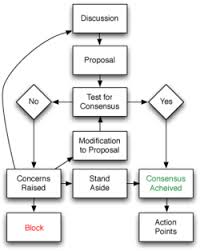
The decision making process or consensus became common among first century believers in the governing of this newly born Church. Dr. Tim Hartnett outlined in his article “The Basics of Consensus Decision-Making”  (www.GroupFacilitation.net) the common elements that are definitive of consensus decision making. These include:

Inclusive: As many stakeholders as possible are involved in group discussions.

Participatory: All participants are allowed a chance to contribute to the discussion.

Collaborative: The group constructs proposals with input from all interested group members. Any individual authorship of a proposal is subsumed as the group modifies it to include the concerns of all group members.

Agreement Seeking: The goal is to generate as much agreement as possible. Regardless of how much agreement is required to finalize a decision, a group using a consensus process makes a concerted attempt to reach full agreement.

Cooperative: Participants are encouraged to keep the good of the whole group in mind. Each individual’s preferences should be voiced so that the group can incorporate all concerns into an emerging proposal. Individual preferences should not, however, obstructively impede the progress of the group.

Acts 15 records such a proceeding in the early Church over the question of following the Jewish tradition of circumcision in this new group of believers, particularly among the newly converted gentiles.  A couple of hundred years later the Church would send its top brass, regional Bishops, to preside over a council to draft position papers on a controversial subject, debate with persuasion over the matter, and expel the opposition after an edict was passed. The hierarchal leaders in the power struggle would maintain direction and order. Any opposition would appear as heresy, but that was not the case at this first Church council held in Jerusalem. Let’s examine how the common elements that are definitive to consensus decision making were used.

Background: (Acts 15:1-3)

Some men came down from Judea and began teaching the brethren, “Unless you are circumcised according to the custom of Moses, you cannot be saved.” When Paul and Barnabas had great dissension and debate with them, the brethren determined that Paul and Barnabas and some others of them should go up to Jerusalem to the apostles and elders concerning this issue. Therefore, being sent on their way by the church, they were passing through both Phoenicia and Samaria describing in detail the conversion of the Gentiles, and were bringing great joy to all the brethren.

Inclusive: As many stakeholders as possible are involved in group discussions.

(Acts 15:2) ….. the brethren determined that Paul and Barnabas and some others of them should go up to Jerusalem…..

(Acts 15:4) When they arrived at Jerusalem, they were received by the church and the apostles and the elders.

This new “Believers in Jesus” movement had originated as predominately a Jewish movement, most believers living in the Jerusalem area after Pentecost. Like today, the “traditionalist”, those of Pharisee background, (the ‘Word’ faction of the 1st Century Church) wanted to be doctrinally heard. Those who had seen the transforming power of this gospel, (the ‘Spirit’ faction who had ‘experienced’ the power of the Holy Spirit even among the gentiles) wanted to present their defense. Both factions, who were hotly sincere about their convictions, wanted the whole church of their time to come on a consensus to settle the dispute. Recognized leadership through the apostles and respectful wisdom from older, mature Christians, the elders, also participated.

Participatory: All participants are allowed a chance to contribute to the discussion. We hear from the concerned, critical “Word/Holiness” faction led by Pharisaical brethren which produced debate; the “Traditional/Historical” perspective from Peter, the Apostle, produced silence; the experiential testimonies of the “Spirit/Pentecostal” faction were led by Paul and Barnabas; and the “Scriptural” perspective from James, the brother of Jesus, an elder were shared\ before the group could come to a consensus on the issue.

Collaborative: The group constructs proposals with input from all interested group members. Any individual authorship of a proposal is subsumed as the group modifies it to include the concerns of all group members.

-  Word/Holiness Faction (led by Pharisees): (Acts 15:5) But some of the sect of the Pharisees who had believed stood up, saying, “It is necessary to circumcise them and to direct them to observe the Law of Moses.”

-  Traditional/Historical Faction (led by Peter): (Acts 15:7-12) After there had been much debate, Peter stood up and said to them, “Brethren, you know that in the early days God made a choice among you, that by my mouth the Gentiles would hear the word of the gospel and believe. God, who knows the heart, testified to them giving them the Holy Spirit, just as He also did to us, and He made no distinction between us and them, cleansing their hears by faith. Now therefore why do you put God to the test by placing upon the neck of the disciples a yoke which neither our fathers nor we have been able to bear? But we believe that we are saved through the grace of the Lord Jesus, in the same way as they also are.”

-  Spirit/Pentecostal Faction (led by Barnabas and Paul): (Acts 15:12) All the people kept silent, and they were listening to Barnabas and Paul as they were relating what signs and wonders God had done through them among the Gentiles.

-  Scriptural Faction (led by James): (Acts 15:13-18) After they had stopped speaking, James answered saying, “Brethren, listen to me. Simeon has related how God first concerned Himself about taking from among the Gentiles a people for His name. With this the words of the Prophets agree, just as it is written ‘After these things, I will return, and I will rebuild the tabernacle of David which has fallen, and I will rebuild its ruins, and I will restore it, so that the rest of mankind may seek the Lord, and all the Gentiles who are called by My name,’ says the Lord, who makes these things known from long ago.”

Agreement Seeking: The goal is to generate as much agreement as possible. Regardless of how much agreement is required to finalize a decision, a group using a consensus process makes a concerted attempt to reach full agreement.

James throws out a proposal that shows that everyone’s voice has been heard. No view is totally rejected, nor totally accepted, nor is a compromise established to gain political influence. James suggests,  (Acts 15:19-21) Therefore it is my judgment that we do not trouble those who are turning to God from among the Gentiles, but that we write to them that they abstain from things contaminated by idols, and from fornication and from what is strangled and from blood. For Moses from ancient generations has in every city those who preach him, since he is read in the synagogues every Sabbath.”

Cooperative: Participants are encouraged to keep the good of the whole group in mind. Each individual’s preferences should be voiced so that the group can incorporate all concerns into an emerging proposal. Individual preferences should not, however, obstructively impede the progress of the group.

 (Acts 15:22-31) Then it seemed good to the apostles and the elders, with the whole church, to choose men from among them to send to Antioch with Paul and Barnabas – Judas called Barsabbas, and Silas, leading men among the brethren, and they sent this letter by them,

The apostles and the brethren who are elders, to the brethren in Antioch and Syria and Cilicia who are from the Gentiles, greetings. Since we have heard that some of our number to whom we gave no instruction have disturbed you with their words, unsettling your souls, it seems good for us, having become of one mind, to select men to send to you with our beloved Barnabas and Paul, men who have risked their lives for the name of the Lord Jesus Christ. Therefore we have sent Judas and Silas, who themselves are also report the same things by word of mouth. For it seemed good to the Holy Spirit and to us to lay upon you no greater burden than these essentials:

 That you abstain from things sacrificed to idols and from blood and from things strangled and from fornication; if you keep yourself free from these such things, you will do well. Farewell.

So when they were sent away, they went down to Antioch; and having gathered the congregation together, they delivered the letter. When they had read it, they rejoiced because of its encouragement.

Agreement was reached through consensus. It was not decided by vote, or majority rule, nor dictatorial decree from leadership, but through a consensus of agreement among all present. All voices had been heard; all voices were given credence, and the Holy Spirit brought the group to a consensus, and understanding, a direction which all could proceed forward. Everyone left proclaiming the same message which brought encouragement, not division. There were no church splits, no continual feuds, not criticisms about what happened, but everyone left “in one mind”, “in one accord”.  The Church has not been able to reproduce this astounding accomplishment over the centuries as it established a hierarchal pyramid of leadership structure that began to dictated doctrine, decree, and dogma. With the clergy/laity divide the voices of the common believer, the laity would be silenced or ignored. Opposition would be looked upon as heresy, and its advocates shunned or ex-communicated from the church, and the church would be baptized into what would be known as the Dark Ages of history. 


Question: What Does Ekklésia Have To Do With Consensus?


The Act of “Consensus” – Part III

Nowhere in the New Testament are strict guidelines given on how to form and run Church government. All agree that Jesus is the head of the Church and that “the government shall be upon his shoulders”, but how that works practicality is debatable? 

 In the United States of America, the Church as a whole finds it hard to understand how to govern collectively. Under the old European system, traditional orthodoxy was led by strong hierarchal structures that created Bishops, Cardinals, and a Pope. Secular kings and dictators aligned themselves with church movements: Henry VIII of England created the Anglican Church in protest against the Roman Catholic Church. Germany aligned themselves with Luther and the “Protestant” movement. Even Hitler made sure he appeared to be aligned to the Lutheran Church of his day. When the United States formed its new government, they made sure there would to be a separation between church and State.

Democracy became a vertebra in the backbone of American politics and government. In a country with a two party political system, government gridlock is the norm; having an “unanimous” decision on anything seems impossible and only happens rarely. 51%, a majority, brings “agreement”, although 49% can be in opposition. Biblically, there is no support for democracy as a form of church government; the Bible clearly does not support majority rule.

Ordained Old Testament government was a theocracy, headed by God. Although it started with strong leadership from Moses, it yielded to judges, then kings, and even established a high priest and a Levitical priesthood to set the religious bounds for Israel.

 All that changed when Jesus became the “messiah” and “king” establishing his “kingdom of God.” “If anyone is in Christ, he is a new creation; old things have passed away; behold, all things have become new.” (II Corinthians 5:17)  The Old Temple system of worship would be abolished. God’s Spirit would indwell in any and every man or woman who believed in Jesus Christ. “Do you not know that your body is the temple of the Holy Spirit who is in you, whom you have from God, and you are not your own?” (I Corinthians 6:19)  Animal sacrifices were now archaic since Jesus had become the sacrificial lamb. Even the Levitical priesthood demolished. A new priesthood, a royal priesthood was birthed. “But you are a chosen generation, a royal priesthood, a holy nation, His own special people, that you ay proclaim the praises of Him who called you out of darkness into his marvelous light; who once were not a people but are now the people of God, who had not obtained mercy but now have obtained mercy.” This priesthood of believers would form what would become known as the Church.

Those operating under this new kingdom differed from those under the Old Testament style of government. They governed by “consensus”.  The Bible uses the term “with one accord”. Told to tarry in Jerusalem until the Holy Spirit would come, they obediently “continued with one accord in prayer and supplication, with the women and Mary the mother of Jesus, and with his brothers.” (Acts 1:14) “When the Day of Pentecost had fully come, they were all with one accord in one place.” (Acts 2:1)  The promise of the Holy Spirit came, and this spirit of consensus continued. “So continuing daily with one accord in the temple, and breaking bread from house to house, they ate their food with gladness and simplicity of heart.” (Acts 2:46)

Steve Atkerson’s article “Building Congregational Consensus” shares an insight into the word ekklésia. “The Greek word ekklésia never refers to a building or place of worship, and it can refer to much more than just a meeting, assembly, or gathering.  Our understanding of Christ’s church will be much impoverished if we fail to factor in the dynamics of the original Greek word. With so much emphasis today on the separation of church and state, the last thing people associate church with is government. Yet, this was exactly the original meaning of ekklésia.

During the time of Jesus, ekklésia was used outside the New Testament to refer to a political assembly that was regularly convened for the purpose of making decisions. In the secular ekklésia, every citizen had “the right to speak and to propose matters for discussion.” [1]

Why did Jesus choose such a politically loaded word (ekklésia) to describe His people and their meetings?[Matthew 16:13-20 & 18:15-20.] Had Jesus merely wanted to describe a gathering with political connotations, he could have used sunagogé, thiasos or eranos. Perhaps Jesus intended His people, the Church, to function together with a purpose somehow parallel to that of the political government. If so, believers have the responsibility to propose matters for discussion, decide things together, make joint decisions and experience the consensus process.

God’s people have a decision-making mandate. A church is fundamentally a body of Kingdom citizens who are authorized (and expected) to weigh major issues, make decisions, and pass judgments on major issues. Though decision making will not occur at most church meetings (there aren’t usually issues to resolve), an understanding that the church corporately has the authority and obligation to settle things is important. Churches where the congregation never grapples corporately with problems or resolves issues may be failing to fulfill their full purpose as an ekklésia.”

Atkerson continues, “An important caveat is that the church, in its decision making role, should be judicial rather than legislative. Christians are subject to the Law of Christ. The church’s job is not to create law – only God can rightly do that. This is one point where the ekklésia of God’s people would differ in function from the ekklésia of the Greek city-states. Our responsibility as believers within Christ’s ekklésia is to correctly apply and enforce the law of Christ as contained in the New Covenant (Mt 18:15-20). Church members are to be like citizen-judiciaries who meet together when necessary to deliberate and decide issues or to render judgments. This form of government works tolerably well in a smaller church where people love each other enough to work through their disagreements. It is virtually impossible to operate this way in a large church setting.”

Atkerson concludes, “Not all occurrences of the word ekklésia in the New Testament involve a decision making body.  The word ekklésia is actually used several different ways in the New Testament. Yet its most fundamental usage remains that of a group of people gathered for the purpose of making decisions. In this sense, the ekklésia is not merely the coming together of God’s people.  It is also what occurs when God’s people come together. The church is authorized by the Lord to make decisions about the correct application of Scripture. It is expected to enforce the law of Christ (within the family of God) and to deal with issues as they arise. There will not always be issues to resolve, but God’s people must ever bear in mind their obligation to function as an ekklésia when necessary.”

[1] Lothan Coenen, “Church,” The New International Dictionary of New Testament Theology, Vol. 1, Colin Brown, General Editor (Grand Rapids, MI: Zondervan, 1971), 291.


Question: What Do Others Have To Say About Consensus?


The Act of “Consensus” – Part II 

“Consensus isn’t just about agreement. It’s about changing things around: You get a proposal, you work something out, people foresee problems, you do creative synthesis. At the end of it, you come up with something that everyone thinks is okay. Most people like it, and nobody hates it.”David Graeber 

“Effective strategic leaders know how to get everyone involved in policy making and build consensus in the process. Within large complex organizations, whether public or private, consensus is the engine that sustains policy decisions. No strategic leader can succeed unless he or she can build such consensus. Thus, the search for consensus among peers, allies, and even competitors becomes a requirement for shared commitment to a national policy, and to corporate, business policy.” ― From National Defense University’s Website (http://www.au.af.mil/au/awc/awcgate/ndu/strat-ldr-dm/pt3ch11.html) – paper: “Strategic Leadership and Decision Making 11”

“Someone has postulated that most human beings only use ten percent of their brain. If that is true, then ten people have to be in a meeting to get whole-brain thinking. This explains the value of working in teams.

Everyone who has been in one of my management training sessions knows that I define a "team" as a group of individuals who "step forward together" to achieve a common goal. Teamwork requires individuals to pool information and consider different viewpoints to find solutions and make decisions. Seldom do all team members have the same view about an idea or issue. Polarized views, opposing opinions, and stubborn holdouts can often block the progress of a team. The success of a team relies heavily on how quickly the members can come to consensus on both what their goal is and how it will be achieved.

A significant portion of a team's effectiveness and "health" is tied to how well the team members interact and make decisions…..

Coming to true consensus among a group of individuals is hard to do. It takes great facilitative skills and effective process tools among the group to bring everyone to agreement. True consensus requires everyone to remain firmly grounded and completely committed to their consensus decision once the team discussion has ended.

Unfortunately, I've found that consensus in many companies is only consensus until everyone leaves the room. Once people get back into their work area or start to ponder the team's decision outside the team room, some members tend to question the team's decision and their commitment to it. The key, therefore, to achieving consensus is not just getting it, but also making sure it sticks once it is reached.” ― Mac McIntire, President, Innovative Management Group  (On website: http://www.imglv.com/articles/gaintrueconsensus.htm)

“So what was the New Testament pattern for decision-making in the early church?  It was simply by consensus.  "Then it seemed good to the apostles and the elders, with the whole church," and, "it seemed good to us, having become of one mind." was the divine model for making corporate decisions (Acts 15:22, 25 NASB).  In other words, the decision-making of the early church was not in the hands of the elders. It was in the hands of all the brothers and sisters. “― Frank Viola; “Reimaging Church” 

“It is important to remember that the process a church goes through in achieving consensus may be just as important as the consensus that is finally achieved. Consensus governing takes time, commitment, mutual-edification, and lots of brotherly love. It truly can work in smaller churches, such as were found in the New Testament era.  We must love each other enough to put up with each other. The concept behind consensus might be called government by unity, oneness, harmony, or mutual agreement. Do we really trust in the Holy Spirit to work in our lives and churches?” “― Steve Atkerson; “Building Congregational Consensus”

Question: How Did The Early Church Come To An Agreement?

The Act of “Consensus” – Part I


The early church followed what form of government?

Certainly not a democracy, for there were no viable democracies in the first century. The church did not vote on matters with the majority ruling the day.

Certainly not a monarchy, even though Jesus is referred to as King of King. Jesus taught that his kingdom leadership was built on service, not “lording over” others like the gentiles do. His kingdom would be composed of a royal priesthood; a kingdom that would recognize Him as both King and High Priest, but his believers would be a linear, relational priesthood of peer equals in Jesus Christ. There would be no hierarchy or distinctions among them as in secular institutions.

Certainly not a dictatorship, for the Roman Caesars vividly displayed the ruthlessness of such a structure. The “laying down of one’s life” rather than the taking of another’s life seemed to be rule of thumb in Jesus’s kingdom.  “This is how we know what love is: Jesus Christ laid down his life for us, and we ought to lay down our lives for our brothers and sisters.” (I John 3:16) In fact the gospel takes it farther, “But God demonstrates his own love for us in this: While we were still sinners, Christ died for us.” (Romans 5:8) Laying down your life not for just your own, but also outsiders is a pillar of the Christian faith.

If the Church was birthed in a Middle East, Westernized world of kings, Caesars, ruthless dictators, why did they not just make Peter the Pope and the Apostles the Ruling Council of Lead Elders to micromanage this new organization. The answer is simple. The church is not an organization. It is a living organism. Man directed it towards becoming an organization and later an institution. It does not have to follow Robert’s Rules of Order, just Jesus’ unconditional love by worshiping the Father and laying down your life for your brothers and sisters in Jesus.

If not an organization, then how did they govern themselves as an organism?  Another simple answer: through consensus in the Holy Spirit. They learned to listen and be obedient to the Holy Spirit. When he speaks, he speaks in one voice, the voice of God, that brings unity. He reveals only what Jesus wants, and Jesus reveals the heart of His Father. The three speak as one in unity.

When the Holy Spirit spoke, the Church did not debate about what He said, they just obediently followed it. They did not write position papers, or create dogma, or write doctrinal statements, etc., they just were obedient and followed it. God could speak through any believer, and often through several, yet his Word, his message, was always the same, bringing unity and clarity. All were in agreement, “in one accord”, in consensus. No debate, no dialogue, no critiquing, no criticizing, no theologizing, only faithful obedience! All moved ahead in the same direction because they had consensus on every matter when the Lord spoke to them.

Let’s look over the next few blogs on how this consensus worked, how effective it really was, and how the church has wondered away from that model into the hierarchal models it practices today. Finally let’s examine how we can “revive” the spirit of consensus back into the Church.


A Question: Who Can You Trust

The Lack of Trusting in Today’s Christianity


Why is it so hard for Christians to trust?  Particularly one another? At least here in the United States?

It is hard for many Christians to trust the Holy Spirit because they feel the Holy Spirit may do something rash, radical, different, obnoxious, and maybe even embarrass them! They want to keep the Holy Spirit “under control” at an arm’s distance rather than trust the Holy Spirit to be “in control”.   Because of this lack of trust, most church services have become “safe” places, with predictable, well orchestrated, micromanaged, planned programs.

It seems to be very difficult for professional Christian leaders to also trust those in their congregation, the laity. They equate themselves as “shepherds to be trusted”, but the laity as “dumb sheep,” untrustworthy.

The demise of Mars Hill Church in Northwestern United States under the leadership of Mark Discoll was caused by a “toxic atmosphere” of leadership mistrust. Leading elders would lose trust in their younger, lower positioned elders who might question them, then literally “throw them under the bus”, dismissing them for lack of submission to their leadership. The laity, on the other hand, had absolutely no voice; the only thing they were asked to do is financially give to support their “trusted lead elders” who made fabulous salaries and to volunteer to help keep church programs running smoothly.  The elders of these satellite churches, now newly formed independent churches, have chosen to continued to follow their exclusive “elder led; congregational informed” model of leadership.  The laity still has no voice, unless it is through their wallet.

Christians are known for not trusting other Christians outside their own religious “camps”. Everyone outside their tunneled scope of theology is wrong; only they are right. Every sect warns about “false teachers” and “wolves in sheep’s clothes” that are among believers in the body of Christ who believe differently than they do. They claim exclusive “Biblical truth”, as if no other Christians follow the Bible correctly. Judgment and “correct doctrine” triumphs over grace and mercy, and Pharisees again arise as they did in Jesus’ day. Jesus still cries, “Woe you scribes and Pharisees” to the religious order of our day!

Ephesians 4 says we are to “equip the saints (not the staff) for works of service.” If we truly follow this scripture, we are to not only “equip” the saints for service, but then must “trust” them by “releasing” them to be led by the Holy Spirit.

The United Methodist Church offered a Lay Speakers class to teach laity how to prepare and deliver sermons, so they could fill pulpits when clergy was on vacation or ill. Only a handful ever got to “preach” because most clergy would not “trust” the “none seminary trained” laity in their pulpit for fear of false teaching or dogma contrary to sound United Methodist teaching.

Ironically, this lack of trust has now “enabled” Christians to remain passive, for nothing is required of them but financial giving. Some churches still give mini-sermons before every offering because they fail to trust their tithers to follow through each week.

The lyrics to an old hymn was “Trust and obey for there is no other way to be happy in Jesus, but to trust and obey.” Today’s Christian leadership demands “obedience” from its laity, but still questions if they can “trust” them.


The Principle Of “Reigning With”, Not “Ruling Over”


Prepositions Define Leadership Style & Relationships

God established a Priesthood so that He would have men “draw near TO him.” God’s design was never to have a “distant” relationship WITH mankind, but an intimate, close relationship. God had walked IN the garden WITH Adam and Eve; they all communicated as close friends. Sin separated man FROM his God; distant relationships came THROUGH sin.

Relationships were mutual BEFORE the fall; Adam and Eve did everything IN one accord, together, IN unity WITH God. Sin brought distance IN Adam’s relationship WITH Eve, and as part OF the curse the male would dominate or “rule OVER” the woman who would cling TO him. This intimate mutual relationship OF equal peers could only be restored THROUGH the shed blood OF Jesus Christ ON the Cross, as an atonement for the sins OF mankind. Now, IN Jesus, a mutual relationship as equal peers to be united as one was restored not only TO the institution OF marriage but also TO the Church as a whole. God’s design was never to have a “distant” relationship WITH mankind, but an intimate, close relationship.

Jesus told his disciples that the gentiles “rule OVER” one another, but that is not the way IN the kingdom OF God. God’s people “reign WITH” one another by being “BESIDE” one another IN a linear relationship OF equality. Even though Jesus had to return TO the Father IN heaven to intercede FOR His believers, He promised that he would not abandon them as orphans. He does not believe IN distant relationships. Instead they He made them “children OF God”, and their physical bodies would become the “temples OF the Holy Spirit.” God’s personal Holy Spirit would not be “ABOVE” them in the far distance, nor descending as a dove had upon Jesus when he was baptized, but would be “IN” them. How intimate is that?  All mankind has to do is allow the Holy Spirit “IN” their lives, and He chooses to dwell or live there forever! How awesome is that?

Unfortunately when we diminish relationship, we establish religion. As “God’s people” became known as “The Children OF Disobedience” IN the dessert, a religious institution replaced those relationships WITH an Old Testament Priesthood headed by a High Priest, a man, who oversaw animal sacrifices and a Levitical priesthood. By the time Jesus appeared the Ark OF the Covenant, God’s Presence, was missing IN a Temple that had replaced the Tabernacle. God wanted to reestablish relationships, to again “draw men near” him, thus he faced the Cross, death, that led TO his resurrection. God had already established a “Priesthood of Believers” according TO the order of Melchizadek who was without genealogy, tradition, and IN the likeness of Jesus Christ. Fallen relationships had been restored THROUGH Jesus.

Religious “institutions” have built pyramidal organizational structures WITH a man AT the top. I don’t care if it is the High Priest, the Roman Catholic Pope, or the Protestant local Pastor who lord “OVER” their flock or group. The foundation OF the clergy/laity schism is built ON this pyramid of church power and politics of who will rule “OVER” the church. OVER the centuries the clergy have made sure power has become entrenched WITH them while the laity are to be only followers.

This is not how the kingdom of God works. Leadership “WITHIN” the Church is defined by who is “BESIDE” you, “NEXT TO” you, “WITH” you, not who is “OVER” you. When Jesus was ON earth, He never lorded “OVER” anyone. He did not establish a pyramid structure where he was “ABOVE” his disciples but always walked “WITH” them, “BESIDE” them while teaching them AS a peer, a man, a teacher teaching only what the “Father” was telling him. In fact, the last thing he taught his disciples before going TO the Garden OF Gethsemane and the Cross was how not to be “ABOVE” them, but stooped down “BELOW” them and washed their feet. He was preparing them to learn the principle OF how to “lay DOWN your life FOR your brethren” by literally “laying DOWN his life FOR them.” When you lay something DOWN, it is “BENEATH” you, not “above” you.

The Church needs to learn to lay “DOWN” their lives FOR one another; Christian husbands need to learn how to lay “DOWN” their lives for their wives, not lording “OVER” them. They are your equal peers, your Eve’s, restored TO oneness “WITH” you so that you can be IN agreement IN all things! They are not to be controlled but served! You are to present them TO yourself “without spot or wrinkle”, pure, holy, blameless, as a restored equal IN Jesus!  Leadership needs to not be “ABOVE” those they are to serve, but be AT their level: “AHEAD” of them to lead, “BEHIND” them to cover their backs, and “BESIDE” them IN their personal journeys, and they need to begin to “equip the saints”, not the staff, for the “works OF service”, teaching them to serve one another THROUGH personal examples!

As believers IN Jesus, God is “WITH” us, not distantly “ABOVE” us, out OF our reach, but actually “IN” us; His Holy Spirit choosing to “IN”dwell us! The church needs to rethink and restructure its leadership models. Institutional hierarchy models are not scriptural, not the plan of the kingdom of God, and not relational as equal peers IN Jesus Christ. If the Church wants true revival, radical changes will have to occur IN its mindsets, IN its methods, and how it handles relationships, especially between leadership and the rest OF the body of Christ.  Leadership MUST begin to get off its pedestal “above” its congregation, and not only mingle, but be equal peers WITH them THROUGH service.


The Cross: A Dying Principle


What Does “Laying Down Your Life For Your Brethren Mean?

“This is how we know what love is: Jesus Christ laid down his life for us, and we ought to lay down our lives for our brothers. If anyone has material possessions and sees his brother in need but has no pity on him, how can the love of God be in him? (IJohn 3:16-17)


  • Even nature teaches us that you cannot have life without death.
  • The season of “spring” comes only after the dying of the “winter” season.
  • The Christian Church was birthed through death & resurrection, thus the Easter story.


During the Lenten season, I often ask the Lord to reveal a new aspect of the Cross to me. There is so much to learn from the Cross, for it is central to the Christian faith.  One year I learned the principle that “God can make beauty out of the worst possible scenario; he can make the ugliest situation the most beautiful.” The most painful, cruel, inhumane judgment the Romans executed was the crucifixion. Jesus hung beaten beyond recognition, exposed before women, and totally disgraced in front of his own mother, YET in less than three days he would be resurrected in a new body with scars but without pain for his mother and his disciples to see!  The beauty of the resurrection replaced the horror of the crucifixion.  When I find myself in dark spots, places of disgrace, in areas of pain and suffering, those ugly places, in hope, I look for the coming resurrection that can only be found in Jesus.

This Lenten season I am focusing on IJohn 3:16-17 as I continue to ponder over the meaning of “laying down your life for your brethren.“This is how we know what love is: Jesus Christ laid down his life for us.” That principle I understand in my head, in my intellect, but practically in every day life the “we ought to lay down our lives for our brothers” still baffles me.

Being a retired 8th Grade English teacher for 40 years who had to teach English grammar, I am fascinated by John’s choice of pronoun here: “We ought to lay down our lives for our brothers.” The pronoun “we” is inclusive and plural. It doesn’t say “I” but “we”. We, I believe, refers to the Body of Christ, the Priesthood of Believers, the corporate Church! Today’s church is known for shooting their wounded, criticizing their brethren, debating profusely over theology and doctrine, yet hypocritically proclaims that “we” are one Church, united in Jesus! If we truly are united in Jesus, then our actions should speak louder than our words, and they don’t. When we see brothers and sisters in different Christian denominations, sects, or local churches not under the same Christian sect’s banner as our own, we do not meet their “need” nor show “pity” towards them, but judge them by “pitying” them for having a “need” as if it were judgment for their lack of faith or incorrect theology! As John and I both ask, “How can the love of God be in (us)?

Laying down one’s life is the central message of the gospel. “Jesus Christ laid down his life for us.” That single act opened the door for redemption, reconciliation, healing, hope, faith, love, etc. “And we ought to lay down our lives for our brothers,” that single act, will open the door for redemption, reconciliation, healing, hope, faith, love, etc. between brothers and sisters in Jesus Christ. The Cross ended the curse of sin that divided mankind from his God; the Cross also ended the curse that caused Cain to kill his brother Abel that has divided mankind throughout history.

Death brings resurrection. Jesus’ body that laid in the tomb three days dead was resurrected. History was now changed forever. Only if “we”, the Church, the believers in Jesus Christ, the Priesthood of Believers, are willing to lay down our lives, dead to our past traditions and mindsets, can “we” expect to see a resurrection of life and unity in the Spirit and in the Church!

But the question still needs to be asked, “How do we lay down our lives ‘practically” in our day to day life towards each other?” What does that mean? What does it look like? What practical steps must “we” take, individually as believers in Jesus and corporately as a Church, a Body?

As this series of blogs professes, I truly that believe by embracing the five fold as passions, drives, points of view, and diverse voices in the body of Christ to build up the saints into the image of Jesus Christ while bringing unity to the Body of Christ, every believer in Jesus Christ, every member of the Priesthood of Jesus Christ, is responsible for the “we” who are to “lay down his life for his brethren.” If I truly profess that the Church is going through a metamorphosis stage of redevelopment and structural reconstruction, then I need to focus on the “we”, the Church, part and figure out how I can lay down my life for my brethren, not for the institution nor its organization, but for my fellow brethren, real live people! This Easter “I” need to die to self; “we” need to die to ourselves, and begin to “lay down our lives” for one another! That is the price for true revival!


Have I Missed The Mark? I “Think Not”; I Just “Experienced It!”


Having Second Thoughts About The Next Movement Of God?

I had forgotten an important principle in my life: In order to learn a spiritual kingdom of God principle, I usually have to experience it! Head knowledge for me is never enough!

Although revivals usually work outside the boundaries of the institutional church, I believe the next major movement of God will directly affect present day Church structure.  I sense God will work within his own body, the Body of Christ, to reinstitute the Priesthood of Believers as peers, equals, brothers and sisters in the faith where linear relationships built on trust, service, honesty, and integrity will be solidified. The clergy/laity schism will finally be diminished. Like every other revival or movement of God, this must be orchestrated by the Holy Spirit, and obedience to what the Holy Spirit reveals is mandatory.         

I believe that this move of God will be a “metamorphic” transformation of present day church structure that is professional, clergy driven, and pyramidal in structure (caterpillar stage) to a laity driven, linear structure of peer relationships among believers in Jesus built on acceptance, equality, and accountability to “one another” (butterfly stage). How does the Church get from Point “A”, the caterpillar stage, to Point “B”, the butterfly stage?

On this path lies the dynamics of this next movement of God, the cocoon stage. As God covers, masks, and builds this cocoon around his Church, unobservable by the outside world, the Holy Spirit will supernaturally reconstruct what was once natural into a butterfly. The butterfly’s structure will not resemble anything the traditional church has ever seen; the old structure will be totally reconstructed. “The old has passed, behold the new!”  Infamous for not embracing change, the Church will embrace structural change and how it functions. Since butterflies function differently from caterpillars, this new Church structure will demand new ways, new forms, and new mindsets.

My dilemma: I have believed that my local church, which has embraced drastic changes in the past, would be open to embracing this new movement of God. I became shocked when leadership opposed it, not wanting to hear about it, so conflict arose which has forced me to break ties with that body. It became a power play. Why would a strong, pyramidal leadership structure relinquish their control over the Priesthood of Believers? I have looked “unsubmissive” to their leadership by questioning them. Some have even accused me of “slandering” their office and “defiling” their sheep. One elder advised me to accept their strong, pyramidal leadership style that he thought biblical or leave the fold, the family, that which I have been grafted in for almost twenty years. I told him I am seeking leadership who will be in front of me to lead, behind me to cover my back, and beside me to walk relationally through my faith journey with me, not a leader who dictates what I should and should not do and can and cannot do over me. I am looking for an equal brother in the Lord, not a leader who renders me voiceless, threatening severe church discipline if I make one more mistake.

While what was my local church keeps choosing the path of institutionalizing, empowering clergy and staff, while enabling the Priesthood of Believers into passivity, families are leaving, numbers dwindling, with many of the faithful no longer faithfully attend. I still believe God is working in their midst, for they are entering their cocoon of introspection, and it is painful because inside the cocoon at the center of all this activity is the CROSS!

The Cross is a painful place that brings death. Without death there is no resurrection. Great opposition led Jesus to the Cross. The Pharisees of Jesus’ day could not hear nor see what God was saying or doing. Today is no different, for Pharisees are always spiritually blind and tone deaf. I know; I am a recovering Pharisee. Like Saul, now Paul, I have been there! At the Cross God reconciled himself to man (John 3:16) and reconciled man to mankind (IJohn 3:16). The Cross is the only place God can teach his faithful, his Priesthood of Believers, how to “lay down your life for your brethren,” bringing transformation from dominant leadership to peer acceptance through reciprocal service to and from “one another” as equals. There are no classes of distinction, no offices nor titles in the kingdom of God, only equals, a Priesthood of Believers.

In spite of the opposition, the darkness of the hour, facing the emotional feelings of rejection and abandonment, I still believe God is faithful and moving, and revival IS happening IN the CHURCH right now as it approaches this metamorphic stage. God, give us, the Priesthood of Believers and church leadership everywhere, strength as we go through this dynamic transformation! 


How To Move Away From Church Politics Pt.3

The Spinning Wheel Of Diverse Ideas

In the last blog, we recognized the role, passions, and point of view that drive the evangelistic, shepherding, teaching, prophetic, and apostolic spirits that can be in a church leadership meeting. No one passion or role dominates the others if they are going to work in unity. As the model of a five fold diagram suggests, each distinct passion of the five fold reaches out to the other four and receives or submits to them, thus creating a star shape in a pentagon of accountability. A key to the success of this model lies in the circle around it, for the pentagon can rotate, and the passion or the point of view needed at that moment can arise to the occasion with the other four being supportive. As the circle rotates, different passions and points of view are shared and a solution is found. It is in the relationships of giving and receiving/submitting of the five to one another, yet releasing each individually to “do their thing” or release their passion that is monumental in keeping unity, yet achieving success.

Let’s look at a hypothetical situation.  Hot potato problem: The Tuesday Evening small group that meets at Matt & Mildred Miller’s has the same 8 people in it as when they created the group three years ago. They recognized their group has become “very close” but have become accused of being “cliquish”. The group has become stagnant, lacks motivation, and they are asking leadership for help.

After the leadership team have prayed and sat in silence, listening to the Holy Spirit, the evangelist in the group rises and identifies the problem. He discerns that Matt Miller, their leader, is a true shepherd, nurturer, who cares for those in their group, thus they have followed his lead, allowed him to shepherd them, producing their small group as a safe nest and have become introverted as a group.

The prophet now rises as the five-fold circle rests on him. He gets the world “expand” and exhorts the group “to reach out to others producing new streams that will water their group.” He continues to exhort them to “expand beyond just the care of a shepherd, and begin to instruct and guide these new ones. A teacher in the group will arise. He will walk beside them as a shepherd leading his herd as he instructs.” He continues to prophesy, “and one of you will network these new ones into various aspects of the five fold bringing life.”

The teacher in the leadership group now arises in the circle of the five fold to share scriptures pertaining to the kingdom of god and its expansion, scriptures about the shepherd and his sheep like the parable of the shepherd who left the 99 to find the lost one. The shepherd of the leadership team confirms that they could take the nurturing Mat Miller instilled in them and now walk “beside” these new ones in their group in instruction in practical day-to-day experiences.

The remaining leader with an apostolic bent confirms the possibility of all these suggestions if the group first identifies the giftings in their group who has the passion for evangelism, shepherding, teaching, prophesying, and networking. The person with the networking passion can then coordinate the others in their united attempt to nurture the influence of these new ones, releasing each in the group to go with their passion. The five look at each other in agreement, are unified on their recommendation, no longer looking at the Miller group as a potential problem but as a promising prospect, and released them to be obedient in following the Holy Spirit’s guidance!

The Miller group begins by releasing the evangelistic spirit: inviting others to join their group, some from within their existing church structure, some nonbelievers who they personally know. They begin “loving” on them, caring for them, nurturing them, fellowshipping with them, sharing the power of the gospel with them, inviting them to enter God’s kingdom and love. Several respond. Now the group responds by allowing the shepherds and teachers in their midst to begin to walk out their new faith through daily living. The prophetic members of the group teaches the new ones how to listen to the Holy Spirit for themselves and share what they hear with the group. The Holy Spirit begins to speak to the group and instructs them to “expand even further” and they begin to reach out to the homeless now that they have a base of nurture, care, and resources in their group to do so. The group grows, expands, is full of life, and moves forward changing lives. In just six months they have grown so huge they decide to split into two, so they can keep the feeling of an intimate small group, and further “expansion” begins as they continue to grow in strength, spirituality, and numbers.

What was once looked upon as a problem has now become a success story because of the “voices” of many, the diversity of different points of view in helping the group, and being willing to release the passions of each member in the group with the support of the others. That is the potential of the five-fold in problem solving.