Power Shortage or Outage?


Where Has The Power Gone?


Yesterday, the day after Christmas, on PBS they aired a program on Buddhism where they explained miracles in the context of that faith as just being “the unexpected” in a mundane rational world.  Having a cup of coffee instead of tea could be classified as a miracle.  There is no supernatural in Buddhism when everything derives from within oneself and the mind. There is no life after death when all emphasis is on the present, this minute moment of self awareness and fulfillment, the avoidance of suffering.

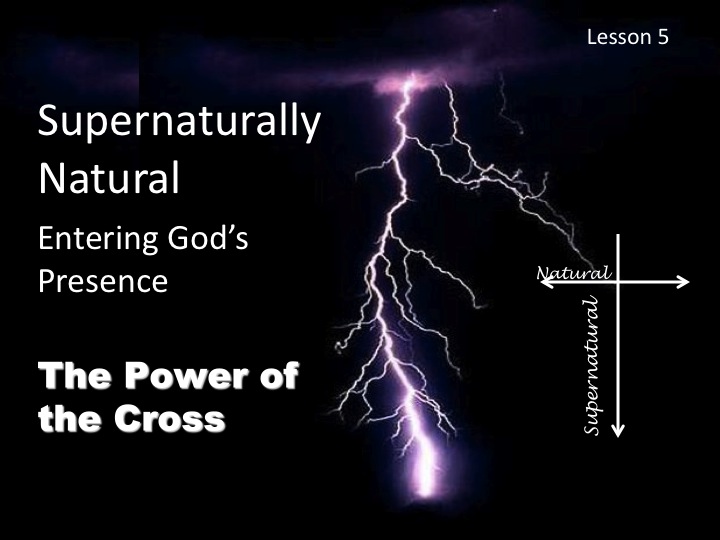
I have just finished teaching a series on “the Cross” where I defined it as the supernatural (vertical relationship with the divine) dissecting or intersecting the natural (horizontal relationship of our own life). I have personally chosen to call those times “God Moments”.

The program made me stop to think that most Christians, like their Buddhist counterparts, have chosen to live in the present moment, not expecting the divine to “actually interfere” with their lives, looking for an unexpected event to be their miracle rather than experiencing the divine nature of God in them to rise and manifest itself, producing the unexpected.

I missed the influential days of the 1970’s and Charismatic movement when I witnessed actual miracles.  I miss actually seeing physical healings, demonic deliverances, manifestation of spiritual gifts, tongues, interpretations, prophetic utterances, singing in the spirit, out door Jesus rallies, nondenominational gathering of actual Body ministry with unique corporate worship, fellowship among the saints without any religious label or denomination placed on a person, a hunger for Jesus, a hunger for worship, a hunger to get into the Word of God, a hunger to fellowship with other believers, a time when one “expected” the “unexpected”, one “expected” the Holy Spirit to move producing the “unexpected”, alias a miracle.

Jesus warned those in his day about seeking only miracles while missing the Miracle Maker, the supernatural, in their midst.  I am not talking about focusing on “miracles”, but focusing on Jesus.  Jesus’ whole life was the “unexpected” visit of the Godhead, in the form of man, to earth through a virgin birth! Everything he did was “unexpected” for his time, thus miraculous. Even the “expected” cruel death on a cross was usurped by the “unexpected” resurrection, leaving all the officials of his time without a rational explanation.

I propose, that as Christians we need to “expect” the “unexpected”!  We need to “anticipate” the moving of the Holy Spirit in our lives as “supernaturally natural”.  That is why Christianity in its purest form has so much more to offer than Buddhism.


Knowing the Heart of the Father


How To Understand Agape Love


Lesson 4 - "Learning to be Christ-like - Revealing The Heart Of The Father" will be taught at CityView Community Church in York, PA.Note:  Bonus Lesson 

Eldon Post, a guest speaker at our church in 2004, showed how ancient Hebrew was also a pictorial language.  His lesson showed how writing symbols were not only alphabetic but pictorial.  Through those pictures he taught what the word Agape Love meant and eventually translated it into Revealing the Heart of the Father. 

Till the end of the lesson, when placing  revealing the heart of the father in place of the word love, an unique revelation occurs:

Example:

“For God so loved the world that he gave his only begotten son…..” John 3:16

“For God so revealed the heart of the Father to the world that he gave his only begotten son…..”

“A new commandment I give unto you, to love one another as I have loved you, so you must love one another.”  John 13:34-35.

    “A new commandment I give unto you, to reveal the heart of the Father to one another as I have revealed the heart of the Father to you, so you must revealed the heart of the Father to one another.”  John 13:34-35.

It was always the will of Jesus when on earth to reveal the heart of His Father, and it is still his will through the Holy Spirit.  We as believers in Jesus Christ have the ability to know the heart of the Father as Jesus did when he was a man on earth.


Freedom of Worship


The Climax To An Unique Course


Note:  On Sunday,  December 26th, 2010, I will be participating in the final session , Response To Worship in my “Journey with Pappa B” Series at CityView Community Church, just north of Rt.30 on Roosevelt Ave (on top of the hill) at 9:30 a.m. until 10:15

In the past 7 weeks we have learned:

     - The trinity, the Father, the Son, and the Holy Spirit is in each believer in Jesus Christ

     - Every person has to face his own personal Passover, Pentecost, and Feast of Booths individually with a requirement for each.

     - God’s name is “I AM”, and the rest of the Bible records his character and nature, so that we as believers can give back to Him what He has given us.

     - We have the ability as believers in Jesus Christ to seek the Heart of the Father, thus sharing His love.

     - We can be in proper relationship with mankind if we take 100% responsibility with 0% blame.

     - When the supernatural dissects the natural, we can expect “God Moments”.

     - We are Priests according to the Order of Melchizedek, thus we need to act like priests.

So the last session will be an open session of worship where we can celebrate the trinity in us, acknowledging our salvation, empowerment, and fulfillment in Jesus Christ, worshiping his character and nature through the power of His name, seeking the Heart of the Father while in right relationship with mankind, while acting as priests unto the Holy Spirit.

During this session you can read a scripture, a Logos Word, that has become activated, alive, a Rhema Word in your life, or a new song, or a poem, or a testimony of the power of His Name in your life.  Feel free to minister to one in a Christ-like relationship, encouraging one another, empowering one another as priests of the Holy Spirit.  Feel free to worship musically, verbally, or silently!  It is a time where as Priests of the Holy Spirit, a Priesthood of Believers, you can give back to the Lord what He has given you.

Being the day after Christmas, this should be a special session of honoring Jesus on the celebration of His birth.


Evangelism in the 21st Century


What’s Happening?


I just put together a powerpoint presentation of all the blogs on fiverevealed.com on the topic of evangelism.  Review and reflection always causes one to think, to analyze, to question, to want to know more.

Open air meetings by Whitehead in the 1700’s, the Camp Meeting movement in the 1800’s, the out door Jesus festivals and huge evangelistic crusades in sports arenas in the 1900’s, but a decade has already passed, and what is happening with evangelism in the 21st Century. 

The Billy Grahams, Oral Roberts, and Pat Robertson’s are aging or deceased, but who is rising to fill the gap? Instead of tents and arenas, the Church has build big edifices, mega-church structures with great theatrical capabilities to “draw in” the lost rather than “reaching out” beyond their walls.

The internet with social networking has brought on a new mentality of social interaction.  Relationships are not just local community but world wide, but not based on the face to face meeting each other’s needs level.  In the book of Acts, 5000 were saved in one day, but then the Church began building a network of communal collection to give to the poor, meet the needs of the widows, taking care of the sick, the imprisoned, etc.  How is the Church to build a network built for the internet, social network, facebook generation?

Every generation of youth questions the validity of Church structure and relevance, with this generation doing the same, for their world has expanded beyond the local church at every corner to local, state, national, and even international websites, blogs, tweets, and facebook messages.  Paul wrote letters that took days to get to their destinations.  What would he think of email today? Would he have “blogged” for all the Churches to read? 

Often, my frustration with the Church was to get them off of their pew, out the door, go into their local community and walk the walk, sharing with everyone about Jesus.  Today, the challenge remains to get one away from their computer to have direct, face to face, meaningful relationships in daily lives with one’s neighbor.  Christians have always had “talking the talk” down, but Jesus wants us to “walk the walk”.  In a “social networking” context of a lot of talk, how is the Church to respond to the walk?  That is the challenge of the 21st Century evangelistic fervor of the Church today!


The Believers of Jesus Christ As Priests?


The Priesthood According To The Order of Melchizedek

Note:  On Sunday,  December 19th, 2010, I will be teaching another lesson, The Priesthood of Believers in my “Journey with Pappa B” Series at CityView Community Church, just north of Rt.30 on Roosevelt Ave (on top of the hill) at 9:30 a.m. until 10:15

Martin Luther professed the Priesthood of Believers as one of his tenants during the Reformation, yet he did not practice it when setting up church government.  He still advocated the clergy/laity relationship when establishing the Lutheran Church.

Today, the Mosaic system of leadership with priests from the tribe of Aaron has been replaced by the rabbinical system of leadership in the Jewish faith.  Today they have no priests, no temple, and no animal sacrifice.  So where does the priesthood stand?  Is it an archaic institution?

Abraham paid respect to a priest, king of Salem, whose name was Melchizedek, by giving him 1/10th of all he had, the first recorded tithe in the Bible.  Who was this Melchizedek?  David even records and recognizes him him in Psalms 110:4.  Hebrews 7:26-37 & 8:1-13 records, “I will put my laws in their minds and write them on their hearts. I will be their God, and they will be my people. No longer will a man teach his neighbor, or a man his brother, saying “Know the Lord” because they will all know me from the least of them to the greatest.

So if we are priests to the order of Melchizedek, then what can we do as priests since there is no longer any need for a sacrificial system since Jesus is our sacrifice, our sacrificial land? 


Supernaturally Natural, The Power Of The Cross


Can We Trust The Holy Spirit?

Note:  On Sunday,  December 12th, 2010, I will be teaching another lesson, Supernaturally Natural in my “Journey with Pappa B” Series at CityView Community Church, just north of Rt.30 on Roosevelt Ave (on top of the hill) at 9:30 a.m. until 10:15

What do you call it when your mundane, every day routine is dissected by the supernatural?  I call it a “God Moment”.  That vertical intersection of the horizontal creates the Cross.  The Cross is central to all that is supernaturally natural.

If we, who are believers in Jesus Christ have to admit that our spiritual birth, or new birth, is supernatural, then why can we not believe that God can move supernaturally in our natural life after that initial event? Are we afraid of change, or challenge, or of the Holy Spirit, or of the supernatural?

What happens when the supernatural dissects the natural?  Routine is replaced with change!  Comfort is replaced with challenge! What evidence is there of the supernatural?  How about Jesus, God’s Son in the flesh, the virgin birth, the resurrections, the power of the resurrection, Pentecost, and the coming of the Holy Spirit is all recorded in the Bible as supernatural events!  Bottom Line:  Can we trust the Father?  Can we trust the Son?  Can we trust the Holy Spirit? Then why not live a supernaturally natural life?


Christian Relationships


How To Handle Relationships in a Christ-like Fashion


NoteOn Sunday,  November 2010, I will be teaching another lesson, Learning To Be Christ-Like - Relationships in my “Journey with Pappa B” Series at CityView Community Church, just north of Rt.30 on Roosevelt Ave (on top of the hill) at 9:30 a.m. until 10:15

Eldon Post was the feature speaker at a Men’s Retreat in 2004.  He did a series of lectures on How Men Of God Can Become Godly Husbands.  His teaching was revolutionary to me, life changing, and saved my marriage.  He taught how any believer in Jesus Christ can take whatever they have to the Lord and seek the Heart of the Father on the matter; then be obedient to what they have seen or heard.

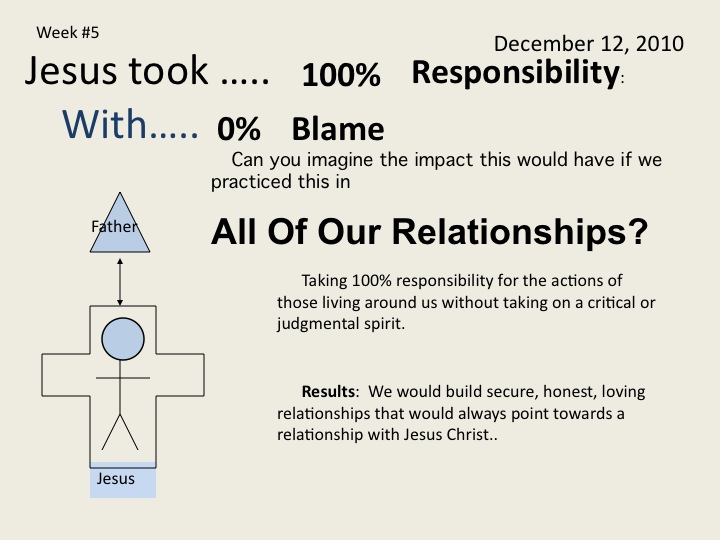
He taught that Jesus died on the cross not for the Church, nor for us, but because He was obedient to the Father.  He knew his mission, and was obedient to the point of death.  He then took 100% responsibility for our sins, yet gave 0% blame. He said, “Father, forgive them, for they know not what they do.” 

Eldon then exhorted us men that we must take 100% responsibility for our wives and 0% blame.  It is not a question of being right or wrong.  There was nothing right about Jesus being condemned to die on the cross, except that He was obedient to the Father.  Think about it! Most marital spats are “blame” sessions.

If we would apply the 100% responsibility/ 0% blame principle in every relationship we have, what an impact we would have on the world.  Hardly anyone takes responsibility in the political arena or business world, but are good at spreading the blame.  If your boss takes 100% responsibility for what you do without the blame, you would respect him, do anything for him, and be more productive.  All politicians do today is blame the other party and produce negative ads.  Why are they surprised that no one trusts them?

This lesson will go into depth on this unique principle and its implications.


God Is A Linking Verb


Names Of God & Worship


"Names of God & Worship" is the third lesson in a series of "Journey with Pappa B" to be given Sunday, Nov. 28, 2010 between 9:30 to 10:15 @ CityView Community Church in York, PANote:  On Sunday, November 28, 2010, I will be teaching the third lesson, Names of God/Worship, in my “Journey with Pappa B” Series at CityView Community Church, just north of Rt.30 on Roosevelt Ave (on top of the hill) at 9:30 a.m. until 10:15

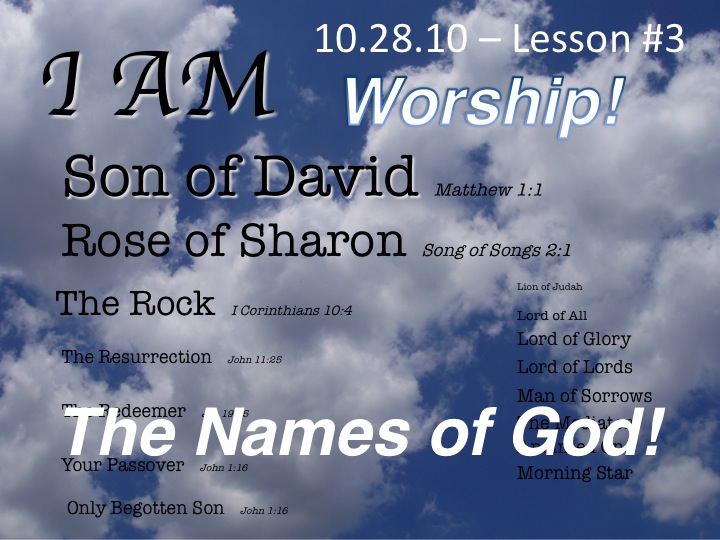
Only an 8th grade English teacher can get excited about the name of God!  When Moses asked God to reveal Himself, giving himself a name for Moses to tell his people, He said, “I AM who I AM”!  God is a LINKING VERB!  Linking Verbs must link their complement with their subject, so what comes after the Linking Verb is crucial.  If a description comes after the Linking Verb, you have a Predicate Adjective.  If what comes after it renames the subject, it is called a Predicate Noun.  God tells Moses his name, IAM, then tells his nature through Predicate Adjectives and who He is through Predicate Nouns.

For Example: Predicate Adjectives – “I AM your strength, your joy, your deliverance, your healer, etc.  Predicate Nouns – I AM the Lord God Almighty, the Alpha & Omega, the Rose of Sharon, the King of Kings.

It is incredible the amount of different names and description that are listed in the Bible for God, Jesus, and the Holy Spirit, all for the purpose of revealing himself to us!  Jesus asked his disciples, “Who do you say that I AM?” The Bible lists who He is, but the question is to each one of us, who do we say He is that is an active part of our lives?

During times of worship, when the worship leader just plays an interlude, one can just begin to verbalize those names back to Him.  I believe that worship is simple: Giving Back To Jesus What He Has Given You!  If he has healed you, delivered you, provided for you, forgiven you, etc., give it back as a proclamation of faith.  In personal prayer times, tell the Lord what He is to you, what He has done for you, who He is!  Proclaim in faith his character and nature even when it is not tangible or evident in your life.  The name of Jesus, and all the names associated with his character and nature are powerful.  Release that power.


What In The World Does “Equipping The Saints” Mean?


A Challenge to the Church and Its Believers


Does the Church take Ephesians 4 seriously?  I do not know of a local church where I live that takes “equipping the saints for the work of the service” seriously.  There are courses, books, tapes, messages, etc. on “discipleship”, but what does the Church do to actually equip them. 

Does “equipping the saints” mean “educating them”?  Do the saints need courses and degrees, educational academia, or constant Bible studies to be equipped?  It is easier to “equip the staff for the work of the service” than the saints.  Why?  In public education, we are always faced with “professional development”, and I guess the church has taken that model in its institutionalizing of clergy & staff.  Years ago we called that process for believers, the saints, “sanctification”, growing in the likeness of Jesus Christ, but “sanctification” had nothing to do with formal education, nor with “professionalizing” Christianity.

So if “equipping” doesn’t mean formally educating the saints, what does it mean?  What is the Church suppose to be doing if it is “equipping the saints for the work of the service”? 

Maybe we should be asking who or what are we serving?  What is “the service” we are equipping the saints for?  Are we to serve “the system” or the “institution” or the “tradition” of the established church?  For what reason, or what result?  Are we serving “the lost” in an effort for them to be “found”? Are we to serve the unchurch, the nonChristian, those living in their communities that don’t go to church in order to bring them into our community? 

I propose that seminaries, Bible colleges, and Bible schools basically teach “how to equip the church to maintain itself”.  We teach them church lingo or linguistics, church manners, church laws of does and don’ts.  We do not necessarily teach how to “go into the world”, but we teach how “not to be part of the world”!  Jesus sent out 70 as recorded in Luke 10:1-23, giving them specific directions before releasing them, (like vs. 9: Heal the sick who are there and tell them ‘the Kingdom of God is near you’), then rejoicing at the out come of their endeavors (vs. 21 “At that time Jesus full of joy through the Holy Spirit said, 'I praise you, Father, Lord of the heaven and earth, because you have hidden these things from the wise and learned, and revealed them to little children. Yes, Father, for this was your good pleasure’).  He didn’t equip the wise and learned, he equipped God’s children for the work of the service.

In up coming blogs, maybe we can look at this “phenomena of equipping the saints”, but the Church must define what “equipping the saints” actually means in practicality before it can move ahead with actually “equipping”.


Deut. 16:16 Jeopardy


What is your “Daily Double” worth?


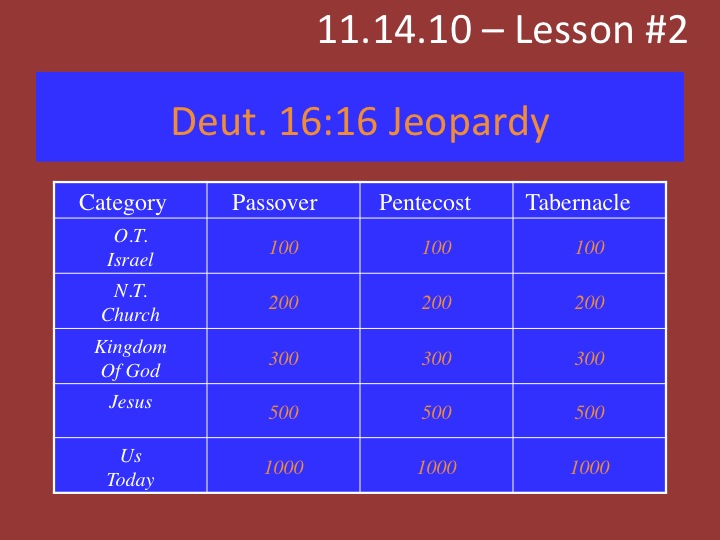
"Deut. 16:16" Jeopardy will be played Sunday, Nov. 14th, and Sunday, Nov. 21st, 2010 at the CityView Community Church, Roosevelt Ave., York, PA from 9:30 to 10:15!Note:  On Sunday, November 14, 2010, I will be teaching the second lesson in my “Journey with Pappa B” Series at CityView Community Church, just north of Rt.30 on Roosevelt Ave (on top of the hill) at 9:30 a.m. until 10:15

“Old Testament for 100”, or “New Testament for 300”, how about “Kingdom of God for 500”, or “Jesus for 1000”?  What will you wager?  Are you willing and ready to play the “Deuteronomy 16:16 Jeopardy Game”?

Jesus said that the kingdom of God is like a mustard seed, so small, yet from it comes a huge tree, which can house large birds!   This little mustard seed of a verse, Deut. 16:16, when planted in your life in faith can produce an understanding of the Kingdom of God and the entire Bible. 

Through three Jewish Festivals/Feasts, Passover, known as the Feast of Unleavened Bread, Pentecost, known as the Feast of Ingathering, and the Feast of Tabernacles, known as the Feast of Booths, we can understand the purpose of both the Old Testament and New Testament, the establishment of the Kingdom of God, their fulfillments through Jesus Christ, and how each person has to face all three of them sometime in their personal lives, and what price each will cost you.

Just like the “Daily Double”, asking “How Much Will You Wager?”, there is a price in accepting the truths and fulfillments of each of these Feasts/Festivals.  Passover requires giving up your garbage, your sinful life, and turning away from it, making Jesus your Savior; Pentecost requires giving up everything including self by making Jesus your Lord, while activating the written Word, the Logos Word, into the living, active Word, the Rhema Word; and the Feast of Tabernacles means giving up your earthly body, becoming a spiritual body in the likeness and radiance of Jesus, where we will see him in His fullness. Are we willing to pay the price?  C.S. Lewis in his classic novel “The Great Divorce” challenges those in hell to give up what is precious to them in order to accept the gift of salvation from their loved ones which they refuse because they are unwilling to pay the price.  The Rich Young Ruler, when faced with the price, backed down from his commitment.  Someone once claimed that everyman has a price. What is yours?  Come play Deuteronomy 16:16 Jeopardy with me!

Note:  On Sunday, November 14, 2010, we will study the Passover and the Feast of Tabernacles/Booths.  On Sunday, November 21, 2010, we will study Pentecost from the Old Testament, New Testament, and Kingdom of God teachings, Jesus fulfillment of that Festival, and its implications on our lives as a believer.  The revelation of these two lessons will reveal the implications of the gospel as a whole in the lives of every believer as well as define what “true worship” is!


Adam To Adam To Me


A Look At The Trinity


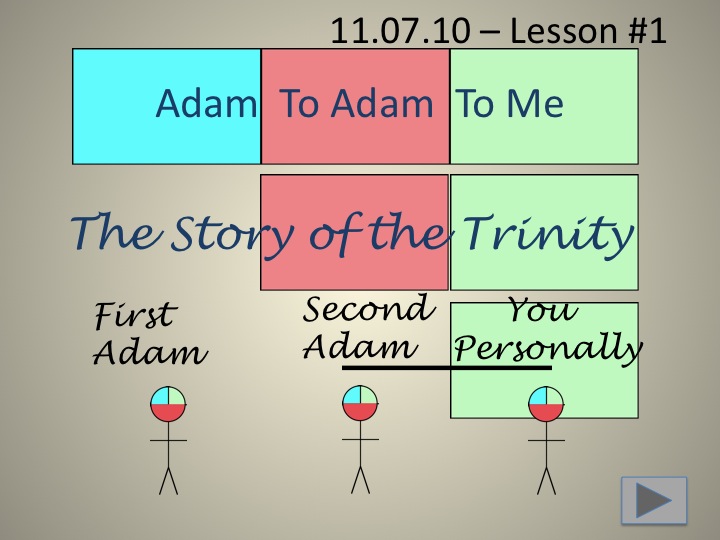
Lesson #1 - "Journey with Pappa B", Sunday, November 7, 2010 @ CityView Community Church, Roosevelt Ave., York, PA from 9:30 - 10:15 a.m.Note: On Sunday, November 7, 2010, I will be teaching the first of seven lessons in my “Journey with Pappa B” Series at CityView Community Church, just north of Rt.30 on Roosevelt Ave (on top of the hill) at 9:30 a.m. until 10:15.  The lesson features simple diagrams explaining the Trinity as seen through Philippians 2:6-11.

The first Adam was “created in Our image”, the triune image of God, Genesis 3:23 but fell; the second Adam came from the Godhead as man to mend that broken relationship through obedience in the fullness of the Trinity; now as third Adams, we, as believers in Jesus Christ can benefit from knowing  “the heart of the Father”, the “fullness of Jesus Christ”, and the leading of the “Holy Spirit” in our lives, restoring and having the benefits of the first Adam created in Genesis.

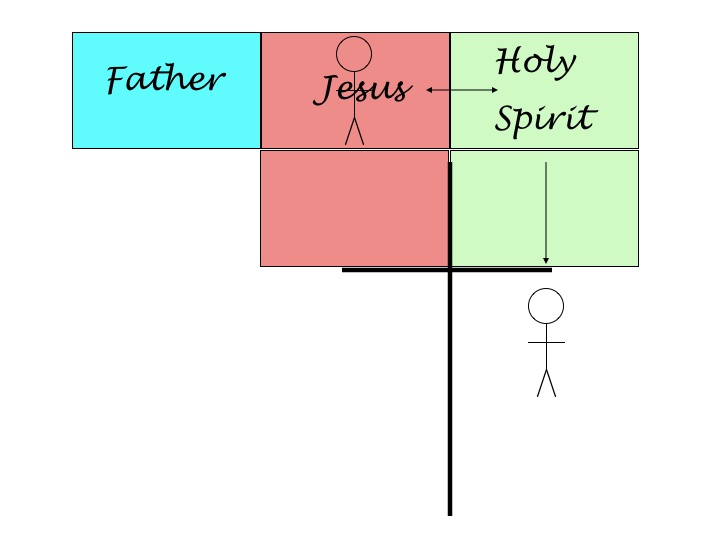
Through a simple diagram we can understand the three “natures” of God, a triune God in nature, but still one God in person.  Jesus not only came to restore through obedience what the first Adam could not do, but also revealed “the Father” to mankind, for  Jesus said, “If you have seen the me, you have seen the Father, for I and my Father are one”!  As mankind, on earth, Jesus always tried to direct our attention to the “revelation” of His Father, our heavenly Father if we are believers through Jesus Christ.

Jesus then instructed his believers that the Holy Spirit could not come unless He returned to the Father, which he did.  Now we, as believers in Jesus Christ, can learn “all truth” about Jesus’ mission on earth, and the Heart of the Father” through the Holy Spirit who indwells us, His believers, for our bodies “are the temple of the Holy Spirit”.

The pipe line to the Father, through Jesus, by the Holy Spirit is open!  We can “hear” from God, know His will for our lives, have an intimate relationship with him, establish His kingdom under His Lordship, and rule and reign with Him. We again can establish being created in “Our image”, in the image of the Trinity!


A Journey With Pappa B


A Five Decade Walk With Jesus


"A Journey With Pappa B", Sunday Mornings 9:30 a.m. = 10:15 through November and December 2010 @ CityView Community Church, Roosevelt Ave., York, PAStarting Sunday, November 7, 2010, I will have the opportunity to share some power point presentations I have created teaching concepts and principles that I have learned in my almost 50 years as a Christian.  Like Wesley, I, too, experienced that “warm feeling knowing that God was real” while sitting in the chair by my parent’s living room window almost 50 years ago.  Since that time I have taken my spiritual walk very seriously, and have learned many things.  In the 8 weeks in November and December of this year, I will present some of these principles that have been the basis of my religious belief system.

If you are in the York, PA area on a Sunday morning during this period of time, feel free to stop at CityView Community Church, just north of Rt.30 on Roosevelt Ave (on top of the hill) at 9:30 a.m. until 10:15.  If your home church has an early 8 o’clock service, or 11 o’clock service, or a Saturday evening service, you can still catch your home church’s services and attend this journey.

Here is the lineup of lessons:

Adam 2 Adam Philippians 2:6-11 – We will look at the trinity in very simple graphic form and its relation to Adam, Jesus, and ourselves.  We will see how the triune God has restored “our image” of Genesis 3:23 back into mankind, and your response to it.

Deuteronomy 16:16 Jeopardy – One little verse (a mustard seed) can explain the entire Bible (the huge tree) through 3 Jewish Festivals/Feasts bringing together the Old Testament, the New Testament, The Kingdom of God, Jesus’ Fulfillment, and our response to it.  It will also define worship.

Names of God In Worship – Jesus asked, “Who do you say that I am?”  Enjoy a grammatical trip into linking verbs, predicate adjectives, and predicate nouns as we explore the many names of God the Father, Jesus, His Son, and the Holy Spirit and apply it to our everyday worship.  “I AM”…..

Learning to Be Christ-like – Knowing the Heart of the Father – Ancient Hebrew is filled with simple pictorial alphabetical symbols that can unlock knowing what the “Heart of the Father” is.  A new appreciation for “agape” love will be nurtured in this lesson.

Learning to Be Christ-like – Solving the Mystery of Relationships – is a “horizontal” look of how Christians should build relationships like Jesus proposed: Taking 100% responsibility with 0% Blame!  This concept saved my marriage and transformed a Christian man into a Christ-like husband.

Supernaturally Natural – When the mundane, our everyday horizontal lives, is dissected by the vertical, the supernatural, a “God Moment” is created.  This lesson will give you a new appreciation of the meaning of the Cross and the realm of the supernaturally natural intervention of God in our lives.

Priesthood of Believers – Martin Luther preached this concept, but did not follow it. The Priesthood of believers is not found in the Mosaic tradition but in the order of Melchizedek, an old testament priest to whom father Abraham tithed 1/10th of all he had. What is our role as priests today since the Mosaic priesthood, temple worship, and animal sacrificial system no longer exists?

Responsive Worship – Where with the trinity within us, in our salvation, power, and intimacy, we will give back to the “I AM”, while seeking the “heart of the father” in proper relationship with mankind, acknowledging supernaturally natural moments in our life while we are practicing our priesthood!  An unplanned lesson allowing our response to what has been taught!

Are you ready to join the journey with me?  If so, stop by any/all the Sunday mornings in November and December 2010 at 9:30 a.m.  It will be a life changing journey, I know, it has changed mine!


An Old Building’s Revival


When The Bride And Groom Arrives, There Is Life!


The Rotunda, University of Pennsylvania campus, Philadelphia, PennsylvaniaThe Rotunda on the campus of University of Pennsylvania, Philadelphia, Pennsylvania looked old. Once a magnificent edifice it had not been used in years, showing its age with paint chips falling everywhere, windows cracked, light bulbs in its gorgeous lamps and chandeliers blown, lifeless, and my son chose this place to hold his wedding?  It took vision.

After getting proper paperwork through city hall, he received approval for its use for one day.  Now the challenge: how to revive an old building, to give it back its life, its glory?  Mopping forty buckets of water with Murphy’s Soap brought the color of the flooring back to life.  Paint chips were swept up and thrown away. Four spotlights aimed in the dome and three halogen lights in the arched windows produced a new ambience after sunset.  Strung paper origami cranes and butterflies flew above the floor on several strings. Circular tables with umbrellas with strung lights and more cranes enhanced the reception area.  The historic chandelier that once hung as the centerpiece of this building now rested in the center of the floor, emitting a refreshment of candles and incense.

I can only imagine the glory days of this place, those who graced its pews, those who spoke from its podium, what stirring messages and eloquent speeches that must have been delivered here.

When the day arrived for the wedding, the sun shown through the arched windows directly on where the wedding couple sat with their guests.  With the setting of the sun came a completely different setting with offset lighting bringing a cozy evening romantic atmosphere as the reception progressed.  Two students sat outside, sketchpads in hand, drawing a building they had never seen alive at night in a community teeming with life.

The day after the wedding the decorations were torn down.  A tear formed in the corner of my eye when I turned for one last look at the place that had been so transformed for a special event, now laid bare; it looked old again.  You could almost hear it groan in desperation, sighing, again losing hope.

It took a bride and a groom, the newness of a wedding, to bring the Rotunda back to life.  So it is with many churches, buildings that is, that have grown old with age, now labeled historical, hoping for revival or better days.  Church is not about the edifice; its about the Bride and the Groom, their relationship, the Bride, the Body of Christ, and the Groom, Jesus Christ.

Jesus is preparing as the Groom to return for His Bride, for a wedding reception or banquet that has been recorded in the Bible and taught throughout the centuries.  Just like my son who barked orders of things that needed to be done, having the vision for the completed project and ceremony, Jesus is getting things in order for His return for the banquet of the ages.  I guess we, as the Church, the Bride, need only to be obedient to what He is instructing through His Holy Spirit to prepare the Bride for its groom.  Sometimes all that urban renewal needs is an occupancy.


God Is Not A Noun


Grammar 101

“In the beginning God created the heavens and the earth…. and the Spirit of God was hovering over the waters, And God said…” (Gen.1.2)

“In the beginning was the Word…..” (John 1:1)

As an 8th Grade English teacher for 40 years, I have come to the conclusion that God was never meant to be a noun, only a verb.  Since the “beginning” he has proclaimed so!  In Genesis he is “hovering” and “says”, all action verbs.  He “speaks” creation into existence, then “In the beginning was the Word.”  We thinks of Acts as a noun, a name of a book in the Bible, but the book is named after what God “does” in birthing and forming his church.  It is a book of “act”-ions! Sounds like God is a linking verb.

Moses discovers this truth when he asks God for His name, to which he answers, “I AM who I AM”, a linking verb; yes, still a verb.  Linking verbs link, so you have to have something after the linking verb to name or discribe something before it! 

We want a concrete God, a concrete Church, a tangible faith, something we can see and touch, but faith is the absence of physical sight and touch but still believing.  The Church is a “living, vibrant” collections of “beings” (little I AM’s); and God is a Spirit, not tangible nor visual.  God is a Verb, not a concrete Noun, so should be His Church.

A Linking Verb can have either a Predicate Adjective or a Predicate Nominative (Noun) after it.  A Predicate Adjective “describes its subject”; a Predicate Nominative “renames its subject”.  To find out who God is, the nature of God, look at what is after his name, after the "I AM"!  He may use adjectives to describe Himself, like “I AM holy, righteous, merciful, grace, truth”, etc., or he may use a noun like, “I am the King of Kings, the Savior of the World, Eternal Light and Glory, the Alpha & Omego”, etc.

Jesus asked his disciples, “Who do you say that I AM?” They answered some say that you are a Prophet, John the Baptist, or Elijah, but Jesus throws the question back into our laps. Who do you, who are reading this, say that I AM? If you have trouble coming up with an answer, then research who God IS for he reveals Himself throughout the Bible.  He reveals His nature, His names, and His actions.  He reveals….. aka a verb!

So why do we want to make him a noun? So He’s tangible, something we can physically see or touch? He’s a verb, a God of “action”, a God that “links”.  Only what he did on the Cross “linked” fallen man back with His God. If the Church is to be an extension, a reflection, or an ambassador of God, then it has to be like a verb, full of action, linking mankind with his creator.  It needs to be living and active, not an object, a noun.

God is a Verb!


Can We Lay Down What We Value?

The 21st Century Price For Church Unity 

Recently Nick Francis, a friend of mine, gave me an extremely insightful diagram he developed displaying four camps of Christianity: a) the evangelical, he called the “Vision Driven – Mega church “Marketing” model; b) prophetic, the “Value Driven – Emergent Missional” model; c) teacher, the “Virtue Driven – Theological Message” model; and d) pastoral, Venture Driven – Process Ministry.  In his diagram he outlined each camps needs, values, strengths, weakness and definition of community.

What each group valued caught my eye. The evangelical Mega Church camp valued corporate productivity while the  prophetic Emergent Missional camp valued authenticity.  The pastoral Process Ministry valued structure and organization while the teacher Theological camp valued teaching the word, content, and clarity.

As you have seen in earlier blogs, I have wrestled with what “laying down one’s life for his brethren” (I John 3:16) means to the individual believer.  This diagram illustrated to me for the first time what it might mean corporately for the Church, for to have unity in the Church, something Jesus specifically prayed for in John 17 which has not occurred in over two thousand years, the corporate members of the body might just have to lay down what they most value on the altar to see what the Lord will do with it!  Those very things each camp valued has been the wedge of division in the Church, but I believe they should actually be the things that brings unity if they were laid on the altar.  Each camp has exemplitory strengths and glaring weaknesses. The strengths and values of each camp could augment, support, enrich the other three camps if they were laid down on the altar and received by the other camps to strengthen their weaknesses.

Anything we hold on to can be hard to release.  We have to release a sinful life through repentance to receive salvation.  Giving up that “precious” garbage and lifestyle is hard for so many as shown in C.S. Lewis’s The Great Divorce.  Giving up something we “value” is very difficult because we are afraid we will lose it. It becomes the very thing we hold on to. Jesus tried to show this to the Pharisees, the religious leaders of his day, when telling them how they were so hung up on Moses whom their tradition valued that they lost sight of the light, their Messiah, the savior of the world who was right in front them physically.

I once heard a speaker give the illustration of the little boy who had a friend over to play, but every toy his friend wanted the little boy grabbed and held on to.  Soon the little boy had his arms full of toys while his friend had nothing. Who do you pity? At first you think the boy that had nothing, but that is wrong; it is the boy who has everything but holds onto it and all those toys become useless, in fact they become a burden, and no body gets to play.   That illustration is a perfect example of the different Christian camps today in the body of Christ: they hold on to everything they value, keep it exclusive, and prohibit the others in the Church upon receiving what had been their strengths.

On a practical level, in public education at the secondary level, each “major subject” (math, English, science, & social studies) values their content area and feels their subject material is the epitome of education, refusing to cross curricular lines while teaching.  I was placed on a “multi-disciplinary team” at the middle school level where we had to work of retooling, changing our secondary mindset, by having to, at times, lay down our academic elitism for the cause of a multi-disciplinary” project which always had a greater impact on our students than did our individualistic subjects. More learning, and a better quality of learning, was done when we were willing to lay down our disciplines in an effort to work together.  The same is with the Church.

At the center of this diagram given to me was a circle with “Truth Ephesians 4:11”.  Amazingly each camp individually believes they exclusively have “the truth”, but the truth lies in the middle where they all come together, willing to lay down their values, give from their strengths to one another, and receive from the others to bolster their weaknesses, thus defining true “community”.

The person missing in his diagram was the apostle.  I believe the 21st century apostle, like Paul, a 1st century apostle, should be appalled at these divisions (I Corinthians 1).  The 21st century apostle has to not only “see” the big picture, like these four camps, but allow the Holy Spirit to lead him into leadership that would bring the four together, showing each camp their strengths and weaknesses while calling them to reach out to their fellow brethren who emphasize different values.  Only by leading them to the altar, teaching them the “power of the cross” where the “supernatural” dissects the “natural” can a “God Moment” occur brining unity in the body of Christ.  That unity is what will usher in the Lord’s return.  Let’s begin to lay down our values on the altar corporately, and lay down our lives for each other individually, and watch what the Lord is about to do.


“He’s Got The Whole World In His Hands”


A New Mindset: The Church Is Truly Word Wide At Your Finger Tips

I remember as a child singing “He’s got the whole world in his hands… He’s got you and me brother in his hands, etc.” Missionary stories, stories of the Church universal, were almost like fairy tales taught by Sunday School teachers, romanticizing people who were willing to leave their homeland, their culture, and their families to share the gospel in distant lands, in jungles, desserts, desolate places to desolate people.  The Church taught the Great Commission, and with it the condition that the Lord Jesus’ return for his Church depended on the Gospel going to all peoples and language groups, thus organizations like Wycliff Bible Translators, Mission Aviation Fellowship, Youth With A Mission, etc. being formed.

The Church to me as a child was localized, the fabric of the local community, on many street corners in the city where I lived. To travel to churches outside our county was a big deal, and attend our denomination’s annual conference bringing churches of like mind nationally together fantastic beyond belief.  I personally have friends who are on the mission field, yet they still seem so unattached because of distance and lack of communications.

Today, with the development of the World Wide Web, the Internet, I am forced to change my point of view, my perspective of the Church, for I do have access to “the whole world in his (my) hands” as I sit here with a laptop computer.  In fact, I can have the “whole world in his (my) hands” through a wireless super juiced up telephone. I can literally communicate with anyone anywhere in the world who has access to the internet.  This is challenging my limited point of view of what the Church really is.

With the proper emails, websites, blogs, chat pages, facebook, tweeting, and Skype accounts I can literally be in communication with someone else in almost every corner of the world, and not only verbally talk with them, but see their picture live. A recent “streaming” program over the internet where over 2,5000 “hits” were simultaneously watching from all around the world amazed me.  But in the score of the entire glob, what is 2,5000?

I use to think that I would like to be in a “first century” church!  There over 2,000 were saved at one location, the Temple, at one time, yet I have seen greater numbers respond to a Billy Graham invitation in a mega outdoor sports facility in my lifetime during the 20th Century!  No, we are blessed to be in the 21st Century where millions can be reached, millions can communicate, we just need to know how to use the technology to influence the masses of spiritually lost and dieing as well as communicate with the other members of the family of God.

Guttentburg’s printing press placed the Bible into the hands of the masses, ushering in the Age of Enlightenment and bringing an end to the Dark Ages.  This technology revolutionized the world that has never been the same because of it.  The internet, world wide web, computer social networking age, is ushering in another technology that has revolutionized the world in our life time.  Communicating with the world has been literally put into the palms of individuals hands like the communication of the Word, the Bible, the Logos word, was placed into people’s hands in Guttenburg’s day.  Individual believers in South Africa can communicate with those in Siberia, Russia, Argentina with Canada, New Zealand and Australia with Europe, and Lapland and Iceland with Antarctica.

Wow, I got the whole world in my hands.  Now to figure out how to use it for the Kingdom of God, to propagate the gospel of Jesus Christ, in a new way fulfilling the Great Commission.  “In the beginning was the Word, and the Word… and the Word became flesh and made his dwelling among us.” (John 1) Today we have even more power at “our finger tips” to share the gospel than any generation before us.  Let’s seek how to use it properly, effectively, and powerfully in sharing Jesus Christ to the world!


Finances, OUCH! The Way Church Does Finances!?

A Message To A Church About To Go Underground Due To Persecution


 Watchman Nee, did not realized it, but prepared the Christian Church in China for days where it would have to go underground due to persecution. Watchman Nee Who Prepared The Christian Church in China for Upcoming Days of Persecution.Over three decades ago, being introduced to the Holy Spirit, and deciding to live “by the Spirit”, I became hungry in knowing how the Spirit actually worked in my life and among His people, the people of God.  In my search I came upon a book that taxed my thinking entitled The Normal Christian Church Life by Watchman Nee.  It had a chapter in finances and the Church and one on Storehouse tithing.

Actually the book is taken from lectures Watchman Nee gave the Christian Church in China, preparing it for one of the most severe persecutions that would come in my lifetime to any Christian Church that I know of.  The living Christian Chinese Church would have to go underground and operate differently  than the “blessed” Church in America.  The Church is alive today in China, and stronger in faith, grace, mercy, love, generosity, etc. than its counterpart in the United States, yet often, we in America snub Watchman Nee’s teachings of being led by the Spirit as being influenced by “eastern thought” while we cling on to the intellect of “western thought and reason” for our answers and faith. 

After sitting through a series of sermons on “generosity” and exposing the “financial need” of the current congregation that I am attending, I noticed that 88% of the church’s budget went to local church salaries, local church expenditures, and building mortgage. 1/10th of the budget, equivalent to a tithe, went to outside our walls of influence ministries.  I have heard multitude of sermons about tithing over the years, to the point that tithing becomes an obligation, not a spiritual gift of giving.  The local church needs my tithe in order to operate its projected “budget” for the year, and the members of the church feel guilty if that projected budget isn’t met.  Are “projected budgets” biblical? 

We read in the Old Testament that we should give our tithe to the “storehouse”, but I must admit, in almost every church that I have attended over the last 50 years, there is little if any storehouse.  Churches are always asking for money as if broke.  They always appear as paupers. Nothing is “stored up”  in good times to be given as ministry in lean times.  Joseph became great, second only to pharaoh, in Egypt because he set up a “storehouse” system that saved not only a nation, but also his personal family and reestablish the strained relationships between he and his brother.  Joseph directly benefited from his “storehouse” philosophy by just being obedient to what and how the Spirit was leading him.

I know that Nee is addressing his church from his frame of understanding during his life time period, but some of the truths he exposes should make us in the West question how we do finances, ministry, missions, and how the church is run like a “business”, like an “organization”, with America’s C.E.O. pyramid mentality of leadership rather than the reverse pyramid of service that the Kingdom of God requires.

If you have time, right now, here is a must read.  This teaching helped prepared a Church that today is persecuted, underground, but spiritually healthy and alive.  A lesson, we in the West, should learn, for we do not know the day when we, too, will face persecution that will test our faith.  Maybe we in the West, who have become cold in our faith, can learn from those who have to “live by faith” in China. 

http://www.ministrybooks.org/Chapter.cfm?id=%21%2D0%20%20%0A

The Power of Preparation


The Step Toward Apostleship


“Prepare ye the way,” is a favorite Biblical slogan.  Preparation is so important to the gospels.  It was God’s plan to send “Elijah” (alias John the Baptist) to “prepare the way of the Lord” (for Jesus, the Messiah’s, coming).  Jesus just didn’t come; a way had to be prepared first.

Later Jesus sends out 70 disciples in twos telling them to “prepare the way for his coming” to those towns. They were like we call today an “advance team” before the Crusade comes to town.  Their job was to “prepare the way”. They did so well, that Jesus even sees satan falling from the sky after hearing their good reports.

So, is there anything or anyone “preparing the way” today?  It is not as popular a topic today as it was when I was a child , but I remember hearing multiple sermons on “the second coming of Jesus” when he returns for the Church, the groom coming for His bride.  If that is true, in the Biblical sense of it all, then I might assume that something or someone will be used to “prepare the way” for the groom’s return for His Bride.  Who might that be?

I would like to throw out, in the realm of the five fold ministry that these blogs propagate, that the prophets and the apostles will “prepare the way” for that event.  The prophets will prophecy about His return as we get closer to the event while the apostles will try to set things in order, which they are good at doing.

I remember seeing the painting about the large banquet table leading into eternity where all the places were “set” or “prepared”, only the participants and the event were missing.  This place “setting” is what today’s apostles are beginning to do.

As the Church recognizes people in their midst whose point of view is to “see the big picture” of the Church and whose passion is to “set things in order” in preparation for Jesus’ return, they will understand in a different light what the role of a modern apostle really is.  He doesn’t control, doesn’t dictate, doesn’t rule or reign, but “sees over” what the Holy Spirit is doing in bringing the Body of Christ, the Church, back together in unity.

I once heard a prophetic word at a Mennonite Renewal meeting that said, “There will be a time when Mennonites will only be recorded in a history book.”  Wow! A word telling Mennonites that they won’t exist as a denomination sometime in the future, but the prophetic word was received.  I believe there will be a time when labels, denominations, Christian groups, will no longer be fragmented in the Body, but they will disappear, for a follow of Jesus Christ will be known as a “Christian”, not a label of their Christian sect, group, or denomination. This is part of the “preparation” that apostles will be doing.

I believe the apostle will also renew the “apostles doctrine” or teaching, the simplicity of teaching the truth of the gospel in unity, like in the first century Church, not theological divisions. We won’t major on our differences, but in our likeness, that of being in the likeness of Jesus Christ.  These teaching will also be “preparing the way” for the groom to come for his bride.

The Bible says that Jesus will return to a Church “without spot or wrinkle”.  I believe that the prophets will be the spot removers, identifying and calling out those things that blemish the Church as a whole and we as individual believers.  The apostles will be “ironing out” the wrinkles by setting things in place.  This setting in place will be done by evangelists, pastor/shepherds, teachers, and prophets under the over sight of the apostles.

When things have been “prepared”, then look out for the event. We are “preparing”, not just planning but setting things in order for my son's wedding in October.  Now is the time of “preparation”, but look out for when all is prepared, then comes the big event. The same is for the Church!

I have been preparing for a new school year all summer, but in one week the event happens. I would not think of entering a classroom as a public school teacher if I were not prepared.  The Church needs to have the same "prepared" mentality as it anticipates the Lord's return.


Hey Church, Rethink Your Theology on Mental Health – Questions & Answers Part VII


The Church’s Steps Toward Recovery

Question:  How can the Church offer hope to those facing Mental Illness? 

Today we continue asking questions that need answered in order for the Church to make steps towards it own recovery in mental health?

Answer:   In a disease, which strips those severely ill of so many things, “hope” is the very ingredient needed when all seems “hopeless”.  I have heard the phrase “hope against hope”, but with mental illness it is “hope against hopelessness.”  How should the Church respond to the hopeless? By giving them hope.  Historically they are the only institution that has done this consistently throughout the centuries.

In the midst of darkness, in the abyss leading to suicidal tendencies, through the detaching of feelings and emotions, the one thread those in deep depression seek to hold on to is hope.  When all hope seems to be lost to the disease, suicidal tendencies begin to make sense to the one ill. 

In the movie Hook, the character Smee lost his marbles (physically and mentally) and is overjoyed at the end of the film when he “finds his marbles”.  In mental health the person ill feels like they have lost their marbles of feeling, reality, faith, hope, love, etc.  Like Smee they are so desperately hunting everywhere to get them back, but so detached that they cannot.

Hopelessness permeates depression, not only for one ill but also for their loved ones. When my wife was severely ill, not getting help from government institutions or the church, while desperately making phone call after phone call, doctor visit after doctor visit, med change after med change, with everything seemingly going nowhere, feeling stuck, I too became depressed and began to feel hopeless. I, in such a very small way, could begin to empathize rather than sympathize with my wife’s darker journey.

The poor, homeless, sick, the dredges of society have always, should always, and will always, be the focal point of the Church’s mission.  Jesus told his disciples, “You will always have the poor.”  He knew his mission and the Church’s mission to the poor, the sick, the lost. 

How can the lost be found? Through hope.  If someone is lost or missing we say there is “hope” in finding them. But after awhile we begin to lose hope when the reality of their length of being lost becomes real.  In mental health when we, the caretaker, begins to “lose” our loved one to this severe illness we at first go through “denial”, not wanting to admit this is happening.  To the depress child, the father says just to “get up, get a real job”, when in actuality the child is unable physically, emotionally, nor psychologically to be able to do that, or they would! As the detachment continues, reality sets in, and the caregiver joins in their loved one’s cry for help, usually getting frustrated when not finding any, but holding on that there is “hope” out there somewhere as the situation gets darker.  As the caregiver is getting pulled into the darkness of stigma, isolation, not knowing what to do, and not getting solutions from the medical field, they too begin to “lose” hope.  Depression is when you lose hope, so depression can be contagious. 

Although there is no “cure” for mental health, there is hope in recovery, that of making one’s life as productive as the illness allows, and the hope for a medical future.  There has been hope in medicine as the medical field has tried to tackle the problem, but side effects have thwarted that hope.  The new hope is in genetics, as research is making its move in that direction.

But spiritually, what is the Church’s basis for hope.  How is the Church to offer a hope in the resurrection, when the very spiritual life of the living dead, those deeply depressed, has been taken into the abyss of darkness where one even doubts their salvation or the value of life? That is a tough question for the Church to answer.  The Church can offer an “afterlife”, an eternal life in heaven, which may even be more appealing to one contemplating suicide where earthly life seems not to exist.  Unfortunately the victim to severe depression cannot find the peace in that promise nor the joy when they no longer know what joy is.  Instead they feel guilt!  When my wife was severely ill, she changed her passwords on various log-ins to “forgiven” because only in “forgiveness” could she see an answer to facing all her guilt spiritually.

If “forgiveness” is the key to guilt, and compassion is a “movement” or action, then the Church, and we Christians, have been called to move forward and unconditionally “forgive” victims of mental illness who do not understand what they are doing when under the influence of their severely ill conditions. We are speaking of an illness here, and must recognize it for what it is.  An illness does not equal sin in spite what some church leaders have taught in the past.  The Church needs to “move in compassion” to “forgive” the actions of the ill person, and help those ill to “forgive themselves” when guilt ridden and self esteem crushed.  When one is forgiven, hope returns.

When severely ill in the depths of the abyss of depression, my wife could not stop spiraling down, believing suicide may be a more viable option to the relief from her suffering, pain, and darkness, and could not feel remorse for what she was about to do.  One of the first signs that she was recovering and getting healthy was when she realized what actions she had done and the consequences of those actions. She felt extreme guilt.  Feeling guilt was the first signs of recovery, of again getting healthy!  As she got healthier, dealing with the forgiveness of her guilt and low self-esteem has been a constant struggle in her life.  As she has gotten better, hope too has returned.

The Church has powerful tools in forgiveness and hope, and it needs to exercise those gifts through action, through compassion:  physical acts of kindness, care, direction, and hope to those suffering from mental illness and their loved ones.